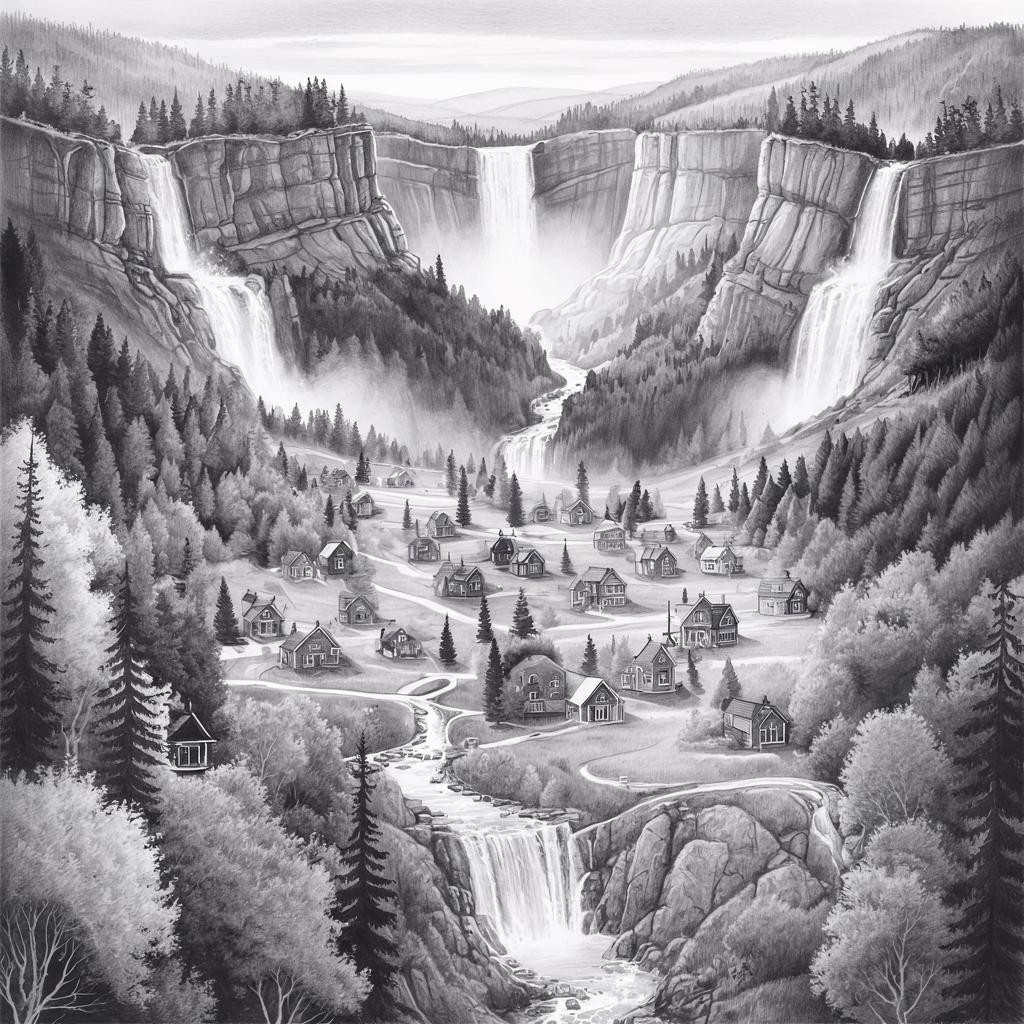
An inspirational story about the people living in the tiny home village below Mammoth Falls, Ohio.
By David Robinson
Author of the Nowhere Novel & 18 other Short and Shorter Stories, Mammoth Falls’ Unforgettable Summer, and numerous other tales, yarns, and chronicles.
Copyright 2026, David L. Robinson
Contents
Dedication
Prologue
Getting Acquainted
The Storytelling Extravaganza
The Misnamed Book Club
The Newest Newcomer
The Twins’ Misadventure
A Flotilla of Unfriendly Flyers
The Crux That Matters
The Sundowner’s Sunset
Sunday Sermonettes
The Futile Feud
The Night Visitor’s Comeuppance
Nathan’s Unexpected Confession
Epilogue
About the Author
Dedication
To Lynn for her 50+ years of love, inspiration, and unwavering support; Patti, Rich, and Jill for their special familial encouragement; my other small but loyal audience (Andy, Jim, Rich, Kathy, Bill, Betzi, Gary, and Linda) for taking the time to read, critique, and appreciate; and all the wonderful characters I have met so far, for sharing their especial stories and life lessons.
Prologue
You may already know something about Mammoth Falls, the mid-sized town (population: 55,050) located 60 miles east of Columbus, Ohio. If you read Mammoth Falls’ Unforgettable Summer, you got a close-up look at the colorful residents and their memorable stories.
However, you’re probably unfamiliar with Hopeful Valley, the picturesque community situated “down below” Mammoth Falls, next to the trio of towering waterfalls. Several ambitious settlers established the valley settlement in 2018 as a welcoming home for those restless, stubborn souls looking for a new start after enduring the most challenging periods of their lives.
The 36 residents who live in Hopeful Valley share a similar experience that has helped create a special bond. To really understand what attracts people to this unique place, you need to talk with some of them. It’s probably best to visit the valley and see for yourself.
Meanwhile, here is a partially guided tour.
**D.L. Robinson
*Getting Acquainted
“Everyone has to be on their best behavior,” Sherman Holmes advised those who had gathered at the base of the tallest waterfall. “No craziness today, please.”
September 25, 2025, was a most important day for the residents of Hopeful Valley, the distinctive community located below Mammoth Falls, Ohio. They would be on display for several Mammoth Falls leaders, including a city councilwoman who was going to review their expansion plans. (FYI–not everyone agreed with the proposed additions.)
There is one key difference between the denizens of Mammoth Falls and those living in Hopeful Valley. The latter had previously been homeless. The valley offers them a welcome opportunity to start a new life, unencumbered by high rents, a hectic lifestyle, and public scrutiny. It is a desirable sanctuary for formerly unhoused individuals, some of whom had once lived above in one of the Mammoth Falls neighborhoods. As Sherman, the unofficial mayor, tells anyone who inquiries (and some who don’t), “We welcome those who have stumbled on their pathway a few times and may have been ignored. All we ask is that they are drug-free and will be a plus for us.”
The other distinction is that most of the dwellings placed around the lower falls’ pools are tiny homes and rustic cottages, designed by a well-known Mammoth Falls architect.
Sherman, 52, had moved here when there were only a few houses, which had been placed there by a non-profit housing agency that has since closed. He is an energetic, lanky former Toledo police officer with close-cropped brown hair and bright blue eyes who came to the valley after a painful and expensive divorce, and six months living in his car.
Sherman and other tiny homers (as they affectionally call each other) are usually busy with a variety of mundane tasks—raking leaves, planting vegetables, and cleaning the walkways, as well as being engaged in their various arts and crafts activities. However, most were now preparing to welcome their Mammoth Falls guests.
At noon, Sherman and Connie Baxter, Mammoth Falls’ first black councilwoman, stood on the suspension bridge and surveyed the thriving valley below. In addition to the towering trees, there are apple orchards, carefully tended vegetable and flower gardens, and a circular maze formed from box hedges. Connie pointed to the Friends & Neighbors Park in the center of the cluster of homes.
“I never imagined it would look like this,” said Connie, a lithe, former news anchor with silky black hair, caramel colored skin, and an expressive face.
“We are happy about our progress so far,” Sherman said. “We recently added the community store and performance stage. Still have a lot of work to do before the Storytelling Extravaganza.”
“This is so unlike the haphazard mess of broken furniture, tents, and blanket-covered shopping carts found in other cities,” Connie said. “Everything here seems to be very orderly and well organized.”
Sherman nodded. “Our neighborhood has grown over the last year,” he acknowledged. “That’s why I wanted you to see for yourself. We’ve had a few folks from the town visit before. But we thought your presence was especially important, considering our future.”
After hiking down the winding stairway, Sherman guided Connie throughout the busy encampment. He stopped to introduce her to some of the occupants, including two identical-looking men with curly red hair, hazel eyes, and handlebar mustaches.
“Councilwoman, I’d like you to meet Ralph and Lawrence Ogilvy,” Sherman said. “They live over there in the teepee home.”
“It’s an unusual pleasure,” Lawrence greeted her.
“A splendiferous salutary introduction to be sure,” Ralph added.
As the brothers moved on, Sherman said quietly, “The twins are rather eccentric individuals who keep everything lively and are always looking for the next big idea. As you probably noticed, Ralph enjoys using colorful words. They were actually homeless as young boys when their family lived on the street, a traumatic experience from which they’ve never fully recovered.”
Sherman led Connie to a nearby bench, and they sat to discuss Hopeful Valley’s future plans. There was a light mist from the closest cascading waterfall.
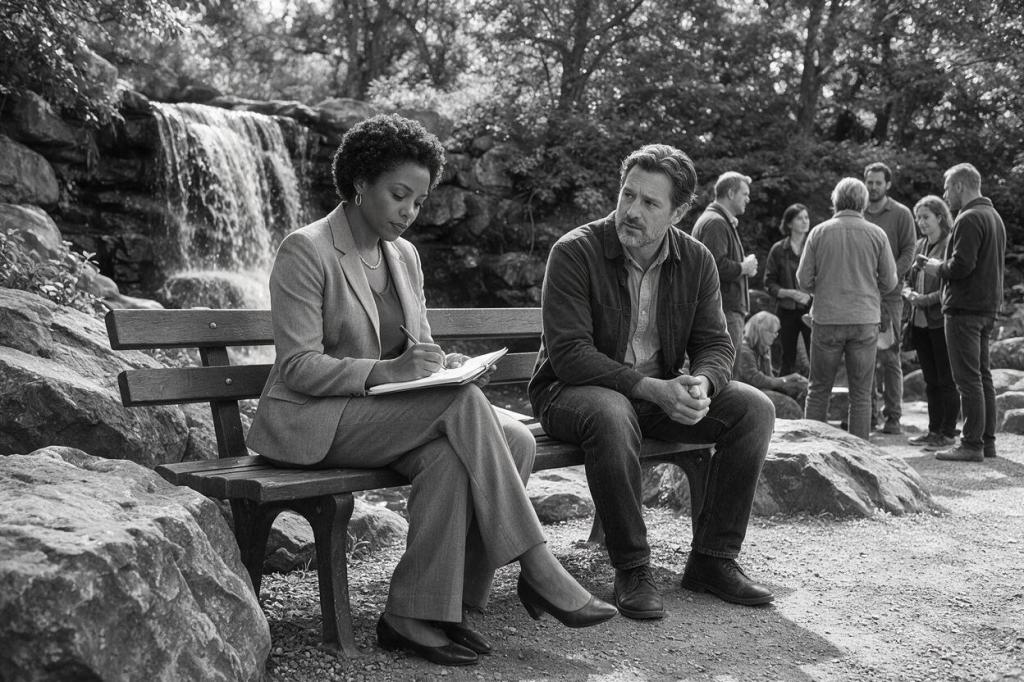
“These aren’t your typical previously homeless men and women, if there is such a thing,” Sherman declared. “For example, I’d like you to meet Rob Bratton, a former schoolteacher who was injured in a car accident and later had to stop teaching. He met his wife Alice here.”
Rob, 34, is heavy-set, bald, with gray-green eyes. “We’re glad that you’ve visited,” he emphasized. “From my research, I learned that it’s a gross generalization to say most people are homeless because of drug or mental issues. A more common denominator is usually a specific incident followed by an inability to afford high rents in apartments or other places. At least, that seems to be the case in Mammoth Falls.”
“But I believe we have rent subsidies available,” Connie replied.
“I suggest you check those figures,” Sherman said. “Rents have increased significantly, and the subsidies haven’t kept up. Plus, the application process has become so laborious that it discourages many people from trying. Some have faced many obstacles to making a seemingly simple transition to apartment life. More important is that we have a community here.”
“One that is quite comforting,” Rob noted.
“But would you prefer to live in your own place in one of the already established Mammoth Falls neighborhoods?” Connie asked.
“Not necessarily,” Sherman asserted. “Of course, everyone here wants to be in their comfort zone, whether in an apartment or other living facility. However, what has transpired here is different. Everyone living in the valley shares a particular perspective on what it’s like to be labeled homeless. We’ve dealt with harsh challenges and grown closer. That’s why we’re trying to create a more formal neighborhood. We’ve seen that the smaller homes are especially appealing to residents. We’re no longer concerned with who has the biggest house or backyard. Plus, having the same basic plot of land is a great equalizer. Ultimately, our community isn’t much different from Trickster Court, Monroe Place, or other up above neighborhoods. Hopeful Valley just happens to be an unusual setting.”
Connie smiled and wrote in her worn leather journal.
“As we’ve previously discussed, creating a new, formally recognized neighborhood can be very challenging,” she remarked. “First, I understand that initially the area wasn’t properly zoned and still lacks some of the necessary infrastructure. There’s no permanent electricity. You’re cut off from so much.”
Sherman pointed to a steel enclosure next to a large wooden shed. “Currently we have the large generator over there to run our electricity,” he responded. “But we’ve been in contact with Ohio Electric regarding the appropriate connections, and we’ll also introduce solar panels soon. We have a lot more to accomplish.”
“What about emergency medical support and access to transportation if people want to work in Mammoth Falls or neighboring communities?” she questioned.
“We have a highly qualified doctor and two nurses living here,” Sherman affirmed. He pointed to an elderly man standing nearby. “In addition, the Mammoth Falls bus service has agreed to collect people at the bridge entrance and return them home in the late afternoon. We never said it would be easy, but we have tried to anticipate the many variables.”
Connie closed her notebook and pointed to an open area. “Property ownership could be another potential stumbling block,” she continued. “I believe there is some confusion as to who has rights to some of the nearby land.”
“That’s true,” Sherman agreed. “But again, we’re doing our research and understand who actually owns the other parcel. This type of community may be atypical but not unheard of. We’ve been doing a great deal of research into other neighborhoods. We’ve been talking to land planners and other specialists.”
After her two-hour visit, Connie stood and shook hands with Sherman. “This has been an eye-opener,” she said. “I’ll do what I can to help.”
“We appreciate that,” Sherman stated. “There is something else I should tell you. There appears to be some who are trying to derail our improvement plans.”
“How so?”
“We’ve been getting anonymous letters in our mailboxes stating that the community is doomed to failure,” Sherman shared. “A few of our financial backers have received calls complaining about the proposed expansion. In addition, I’ve heard that a couple of your fellow council members have been urged not to approve our expansion plans.”
“That’s odd,” Connie said. “I will check with the other representatives.”
“That would be wonderful. We hope that you will join us at the upcoming Storytelling Extravaganza.”
“I wouldn’t miss it,” she said.
Sherman gestured to an elderly man approaching them. “Before you leave, I’d like you to meet Nathan Bannister. He is a special member of the community, in that he is the only one of us who has never been homeless.”
Nathan, 84, has a bushy white beard, a ruddy complexion, and light brown eyes.
“It’s a pleasure,” Connie said.
“Pleased to meet you,” Nathan responded.
After Sherman escorted Connie and her staff up the winding stairway, he spoke with Nathan who was waiting at the founder’s monument.
“What do you think?” Nathan asked.
“The councilwoman seems supportive,” Sherman answered. “She had a lot of questions and took extensive notes. I’m not sure about other council members.”
“We’ll have to impress her at the storytelling event,” Nathan suggested.
“I just wish we didn’t have to deal with whoever is sending the negative letters and causing other mischief,” Sherman complained.
“I’m sure we’ll soon find out who is responsible,” Nathan said. “Hopefully, it’s nothing more than a harmless prankster with too much time on his or her hands.”
“Perhaps you’re right.”
*The Much-Anticipated Storytelling Extravaganza
Nathan had a secret. But he decided to wait and share the news on October 10, during Hopeful Valley’s Storytelling Extravaganza.
“I’m certain it’s the best time to announce such a grand development,” he had assured his valley neighbors. “Just you wait and see.”
That morning, Nathan, Sherman and most other Hopeful Valley-ites were busily preparing for the popular storytelling event. The annual occasion is another chance to show off the community to their Mammoth Falls visitors.
The Mammoth Falls crowd began arriving for the celebration at 10 a.m. Climbing down the freshly painted wooden stairway, they saw the colorful “Welcome to Hopeful Valley” sign. Sherman and Nathan greeted their guests, who were curious about the 29 various-sized homes arranged around the crystal-clear waterfall pools.
“Welcome, friends,” Sherman announced.
“It’s a pleasure to have you join us,” added Lawrence who had followed Sherman and Nathan.
“Celebratory salutations,” Ralph greeted them.
The Hopeful Valley occupants had arranged tables and chairs for a receptive audience to hear the stories. Lawrence had fired up the barbecue, and Ralph was organizing the extensive buffet.
“My gosh, you’ve all done such a wonderful job,” Connie Baxter commented as she stepped off the last stair.
“It’s been a group effort,” Sherman answered. He continued to lead the guests on a tour of the singular community, stopping at various places to introduce other enthusiastic residers.
More people were arriving and finding places to watch the storytelling program. A strolling banjo player entertained guests with a bluegrass medley. There was also a juggler, and the Ogilvy brothers performed their “rather amateur” magic tricks.
Connie approached Nathan and quietly asked, “I hear you have some special news to announce.”
Nathan smiled. “You’ll have to wait a little longer,” he replied.
At noon, Sherman walked to the stage. “Welcome everyone. We’re so happy that our special guests from above could join us today. Before we start the storytelling, I wanted to share a few comments. First, special thanks to Josephine Conrad, a descendent of one of Mammoth Falls’ founders, and her family for their wonderful support during the last year. Most notably, we are so grateful for the generous donation of their land to our tiny home community. We know there were doubts that we would accomplish our goal here. To be clear, we created this valley of homes not to distance ourselves from Mammoth Falls, but rather to celebrate these people’s shared experiences. Those living here have survived homelessness and have hope for the future. I have had the privilege of helping them create this special place. In many ways, they’re not that much different from those of you who live upstairs.”
The audience applauded. “This is a neighborhood about which we can all be proud,” Connie observed.
“Of course, you didn’t come to hear me prattle on,” Sherman insisted. “You’re here to listen to some of the best storytellers from Ohio and elsewhere. That includes a few local yarn spinners. Our panel of judges will award the grand prize after the last speaker has finished.”
The 25 storytellers included:
*Barney Jacobs from Lima, Ohio, shared a long-winded account of the great train robbery.
*Cincinnati resident John Belling entertained everyone with the legend of the Loch Ness Monster.
*Gordon Lamont, a farmer from Lexington, Kentucky, spoke about the Civil War era underground railroad rescue of escaping slaves.
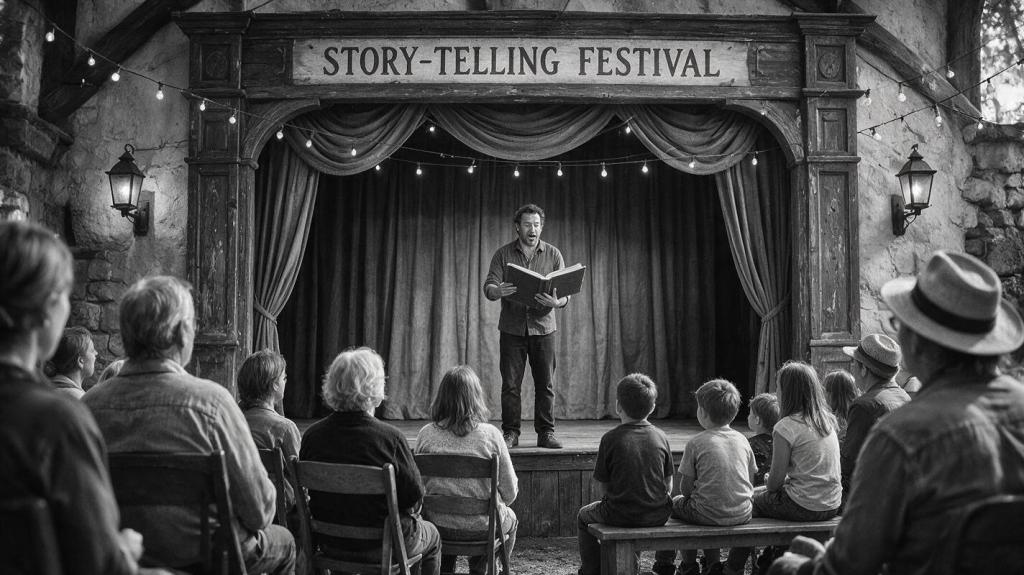
*Alice Higgins, 13, was the youngest speaker. A Mammoth Falls middle-schooler, she related a humorous anecdote about the family of trolls who lived near the waterfalls.
There were animated stories about the fish that got away, the mysterious house on the hill, the real truth about Custer’s Last Stand, my Uncle Fred’s bigfoot adventure, and a variety of other fanciful tales.
Nathan was the oldest and final speaker. He slowly climbed the stage steps and looked out at the enthusiastic crowd.
“My story embodies the dreams and passionate spirit of the Conrads, the pioneer founders of Mammoth Falls, and one special young girl,” he began.
Just then, a majestic bald eagle flew overhead and landed on a sturdy branch of the nearby oak tree.
“That’s certainly an auspicious start,” Nathan declared, pointing to the eagle. “Now, I imagine most of you know something about the founding of Mammoth Falls—but not necessarily the inspirational details—and not much at all about this valley. My story is largely based on the journals and diaries of the three Conrad families. However, I may add a few slight embellishments.”
Nathan briefly waited for the Ogilvy twins to stop whispering about their latest venture.
“When Samuel, Peter, and Albert Conrad and their families arrived here from Tennessee in 1866, they were exhausted,” Nathan explained. “Worn out from fighting in the Civil War, weary from their traveling, and tired of worrying about a home for their children. They arrived at the opening just over there by the oak tree grove entrance. The Conrad clan was enthralled with this area. They had wanted to find a beautiful, peaceful site for their new home after several years of living in battleground tents and such. In addition, Albert had endured six months in one of the horrible Confederate prisons. In a sense, they had been homeless for several years. These settlers found what they believed was their permanent resting place.”
Nathan lowered his deep baritone voice slightly to be certain he had everyone’s attention. Audience members leaned forward, straining to hear every word.
“As former farmers, the Conrads were used to hard work. They brought oak and elm tree seedlings gathered from their previous farms and the various places they had fought during the war. They even had a few sprouts from one of the Magnolia trees that President Andrew Jackson had brought from his Tennessee home to plant at the White House in 1829. It seems that a war comrade had somehow acquired the saplings and gave a few to Peter. Anyway, they set about growing the trees we see today. It was a way to blend the past with the present and, in doing so, enhance the area’s already captivating landscape. The adults and children were also busy organizing their home here. You can see what remains of their first log cabin just over there,” he said, pointing to a stand of chestnut oak trees. “Samuel and Gretchen’s 11-year-old daughter, Penny, was so happy to have a new, safe place to live, she called this area Our Hopeful Valley. She even drew a diagram of a future children’s play area. So, from the very beginning, this area was a special refuge for people who had not enjoyed a proper home in some time.”
The Ogilvy twins listened carefully, as did Sherman and everyone else.
“However, two significant changes occurred during their first year here,” Nathan said quietly. “Number one, the Conrad clan gradually realized that this valley might not offer sufficient space for the influx of people they expected to arrive during the next decade or so. After all, they had told many people of their plans to travel to this area. Plus, Ohio was recognized as a welcoming state for restless settlers. The Conrads were willing to share it with others. They began thinking that ‘Up Above’ as they referred to the much larger acreage we know as Mammoth Falls city, would be more conducive for future growth. Therefore, they acquired additional land as part of the Homestead Act and invited a pair of surveyors from their home state to help design the new town where most of you reside. They had hoped to preserve this lower valley as a park for future generations. Then, there was an unspeakable tragedy that no one had anticipated.”
“What happened?” someone shouted.
Nathan had shifted to a more solemn tone. “During the winter prior to their planned move ‘Up Above,’ Penny got quite sick, which we would know today as having pneumonia. Based on Gretchen’s diary, Penny seemed to know she was very ill and told her parents, ‘Mommy and Daddy, if something happens to me, please don’t forget about our Hopeful Valley.’ She died just after Christmas, and as you can imagine, everyone was distraught. She had been such a bright light, sending pretend letters to friends about her wonderful new home. Sam and Gretchen were obviously disconsolate and unsure what to do next. They had buried Penny under her favorite oak tree and didn’t want to leave the gravesite behind. The other families finally convinced them and their surviving three children to move up top. Sam agreed on one condition: that this area would still be a refuge for people looking for a safe, comforting place or used as a park. He and his brothers signed their combined family property in a will for that purpose. They even set a small plot aside for a future Peace Center, although they had no idea what that would entail. Of course, during the next few years, more people arrived in Mammoth Falls to join the Conrads to build their homes and businesses, and the town flourished.
“But every year on the anniversary of Penny’s death, Sam and Gretchen trekked from their home on Blanket Street to their Hopeful Valley right here. They would put flowers on Penny’s grave, and their other children would tell her stories of their new life in Mammoth Falls.”
Several people were crying, and others nodded or clapped softly. Nathan clasped his hands.
“There is a twist to my story,” he added.
“Your clandestine tidbit?” Ralph asked.
“Well, I’ve just learned that a generous, anonymous benefactor has agreed to cover the costs of the new peace center that will be located just beyond the magnolia trees,” Nathan announced. Everyone turned to see the area that he indicated.
“That’s wonderful,” said Connie.
“And one more thing,” Nathan announced. “The center will be named the Penny Conrad Peace Place and Sherman Holmes will manage it. That seems to be an ideal fit, considering his prior experience as a church deacon and volunteer dispute mediator.”
Nathan paused to sip from a glass of water. “I would like to thank you all for being so attentive while I and the other storytellers talked today.” He bowed and the crowd congratulated him with a standing ovation. As Nathan stepped off the stage, the bald eagle spread its wings and flew away. The three judges briefly conferred and then handed him the storytelling trophy.
“We have had some wonderful storytellers today,” Sherman exclaimed. “But we think you’ll agree that Nathan deserves the top prize.” The spectators applauded their approval.
For the rest of the day, the Mammoth Falls visitors sat with Hopeful Valley inhabitants at picnic benches and other spots throughout the valley. They shared more stories and made new friends. Some strolled through the gardens and waded in the bubbling waterfall pools. By late afternoon, the guests began climbing the stairway back to Mammoth Falls. Meanwhile, after helping to clean up after the Extravaganza, most of the Hopeful Valley citizens returned to their own homes. Finally, only Sherman and Nathan remained at one of the tribute benches. As dusk enveloped the Valley, they watched as a swam of fireflies flitted overhead.
“I should have mentioned that Penny especially loved watching the fireflies,” Nathan said.
“I think the story was complete as told,” Sherman responded. “It was a loving tribute. Of course, the one detail you left out is that you are the generous benefactor for the Peace Center. Nobody knew that you had squirreled away such a treasure chest.”
Nathan nodded. “I didn’t want to muddy up the waters, if you know what I mean. Keep it simple.”
“That’s fine,” said Sherman. “It was your story to tell as you saw fit.”
“I think next year’s extravaganza might be even better,” Nathan said wistfully. “I hope I’m here to enjoy it. I just thought of something. One of my favorite Mark Twain quotes goes something like this: ‘A little more kindness, A little less speed, A little more giving, A little less greed, A little more smile, A little less frown, A little less kicking, A man while he’s down, A little more “We”, A little less “I”, A little more laugh, A little less cry, A little more flowers, On the pathway of life, And fewer on graves, At the end of the strife.’ It reminds us to spend more time with the important things in life. Being nicer to each other. Less obsessed about trivial matters.”
Sherman patted Nathan on the back. “I agree with you and Mark Twain,” he said. “I think that is the ideal way to conclude this year’s celebration.”
“Although I am concerned about the criticism of our expansion,” Nathan vented.
“Well, I think that today’s successful event gave Councilwoman Baxter and so many others a supportive perspective about Hopeful Valley and will ideally put a damper on any unnecessary negativity,” Sherman stressed. “I’m following up on a few ideas. I’ll see you tomorrow, Nathan.”
“Yes, you will. Pleasant dreams, my friend.”
*The Misnamed Book Club
The October Thursday Book Club meeting would be even more energized than usual.
Some overly judgmental friends think a more accurate name for the group would be “The Wednesday Book and Gossip Club.” That’s because the monthly meetings are usually held on Wednesdays and members do more than discuss the literary classics.
To be fair, the group reviews a new book each month. They devote the first 20 minutes of each two-hour session to reading passages and sharing subjective opinions about the book’s merits. But while they don’t admit it to outsiders, the members are most enthusiastic about the freewheeling, any topic goes “Open Forum.” They dissect rumors, complain about city politics and politicians, and frequently talk behind their neighbors’ backs.
Anyway, Rob and Alice Bratton, Ralph, Madeline Monroe, Josephine Conrad, Nancy Palmer, and Gordon Roberts had gathered near the overhanging elm tree for the monthly discussion. The eclectic membership is a notable distinction of the Thursday Book Club. The main qualification is “to be willing to read and comment on books of both well-known and more obscure authors from various generations and to behave as best as you can at all times.”
“Okay everyone, let’s get started,” declared Alice, the club’s Sergeant-at-Arms. Rob’s wife (who became homeless when her first husband gambled their savings and house away), 37, is slender with strawberry-blonde hair, alabaster-white skin, and bright blue eyes.
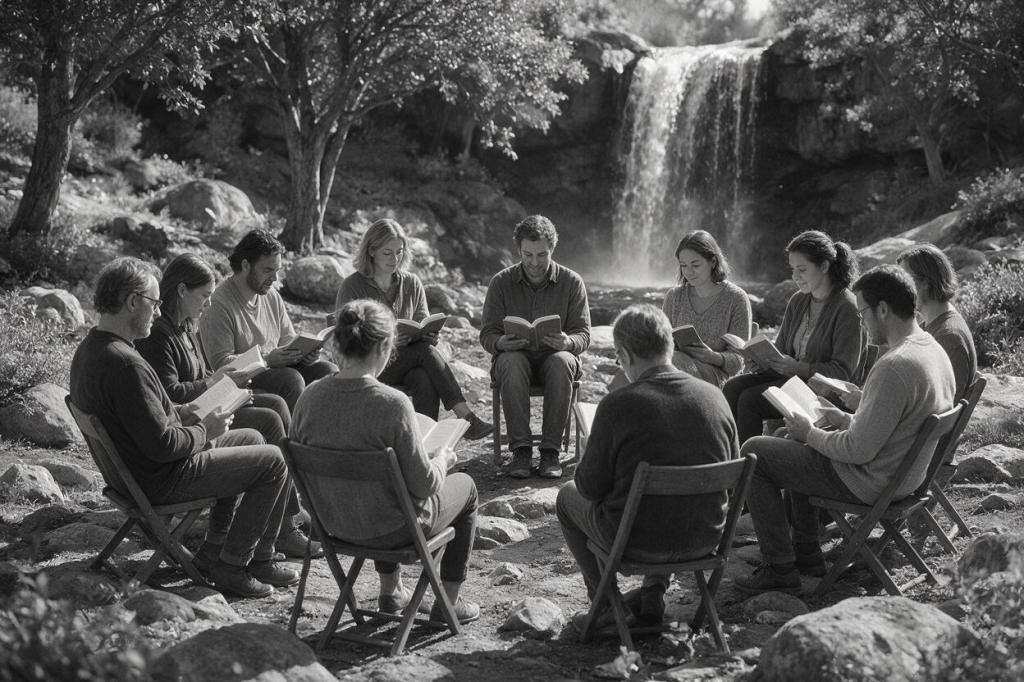
The meeting began with the Call to Order, Pledge of Allegiance, and Reading of the minutes, which usually consisted of an abbreviated summary of the previous book review and a description of other discussed items, which were not to be shared with others.
“Listen up,” Alice shouted. “Besides our review of last month’s minutes and discussion of today’s selection—Louisa May Alcott’s Little Women—we have some interesting things to consider.”
“Whose idea was Little Women?” Ralph queried. “I found it to be dry as dust and an editorial trifle compared to some of our other marvelous reads.”
“That would be me,” Madeline said defensively. “I based my suggestion on the historical best-seller lists and my own informal poll. Besides, we all voted to approve. By the way, Ralph, why do you always use such colorful, fancy pants language that many people may not understand?”
Ralph laughed. “That is an essential ingredient of my adorable and contagious personality. Besides, it’s the best way to tell us apart. Lawrence tries, but his words are perpetually pedestrian. Also, I figure that if you don’t know a particular word, you can look it up in your dictionary.” (Or see Ralph’s own version at the end of this opus.)
“Time to opine about the book,” Alice exclaimed, attempting to deflect the interruption.
Each person took a turn reading a favorite part and offering their overall rating, from “first rate” to “crummy.” The highlight was when Alice attempted to read her passage with a British accent.
“Why are you yip-yapping like that?” Ralph protested.
“I thought it provided some extra ambiance, since the story was set in London,” she asserted.
They rushed through the book review faster than usual.
“Well, we finished that one in record time,” Alice marveled. “Does anyone have something else they would like to discuss?”
Of course, there were other topics to mull over. The book clubbers were just getting started.
“Wasn’t the Story Extravaganza wonderful?” Rob said. “Some people are saying we should do something like that twice a year.”
“It was quite special, but twice yearly may be too much,” commented Josephine, who lives in Mammoth Falls and is the only non-member invited to the meetings. As the great-great granddaughter of Albert Conrad, one of the town’s three founders, Josephine is an honorary member of the book club. She is statuesque, with long white hair, almond-shaped eyes and smooth, wrinkle-free skin that belies her age.
“I agree,” Alice said. “Plus, don’t forget we have the upcoming craft fair.”
Suddenly, Ralph’s snoring interrupted Alice. They hadn’t noticed that he had fallen asleep during the book critique.
“Ralph isn’t with us again,” Alice pointed out. As she nudged his shoulder, Ralph began mumbling. “Have you been doing all of that?” he cried out. “I can’t believe you’re the one!”
“Ralph, what’s going on?” Rob asked.
“What?” Ralph replied, unaware that he had been snoozing.
“You were talking in your sleep,” Rob explained. “You muttered about someone ‘doing all of that.’ What did you mean?”
“Don’t know what you’re jibber-jabbering about,” Ralph grumbled. “But don’t let me interrupt this otherwise overstimulating scintillating conversation.”
“Okay, then,” Madeline interjected. “I heard that the odd Kennedy, the pretend health secretary, has advised against taking vaccines.”
“Recommendations from the same guy who supposedly had a serious drug problem and worms on his brain?” questioned Nancy. “Our own Doc Sheffield is probably a more reliable source.”
“That’s for sure,” Madeline stressed. “As I understand, the other Kennedys are quite embarrassed by his bizarre actions.”
“I’ve got some news,” Gordon announced. “My son Gordy is planning to visit here to make sure I’m not in what he calls ‘an old fart cult.’”
“I’m not sure why so many people think this is a strange place to live,” Rob remarked.
“I’m certain you have already set him straight on that,” Alice stressed.
“Of course, but he is very opinionated, which is the main reason we’ve been estranged for a long time,” Gordon noted. “If he does come, I will be sure to introduce him all around so that he can see it isn’t a cult.”
“On a serious note, have you all heard that Anita Larimore is having an affair with Joe Conklin, both of whom are immensely incommunicado?” said Ralph who had recovered from his nap.
“That’s yesterday’s news,” answered Madelline. “I learned this morning that her husband was out looking and found them in the park.”
“Yes, but the real lowdown is that this duplicitous, disaffected duo have been, shall we say “affairing” for more than two years,” Ralph corrected.
“On another topic–I heard that our leaders may be inviting a couple of new people to move here,” Nancy said. “Is there enough room? Seems like it could get a bit crowded.”
Rob shook his head. “I think the gradual expansion plans are appropriate,” he answered.
“Just saying,” Nancy continued. “That’s not necessarily a consensus.”
“Meanwhile, we’ve all been receiving more cryptic notes from someone bitching about the new additions being considered for our valley community,” Rob said.
“I got another one myself,” said Madeline.
“And the other stuff, including loud noises at night and the latest of a big rat put in someone’s mailbox,” Alice griped. “It’s all very strange and tiresome.”
“We’ll discuss this again with Sherman and the others and find out what’s going on,” Rob noted.
Suddenly, Josephine stood and raised her right hand.
“Josey, there’s no need to raise your hand,” Alice said. “Just butt right in like the rest of us.”
“Okay then. If you recall, during our last meeting, I mentioned that a couple of us Conradians recently discovered some interesting information in the family archives.”
She was referring to the Conrad brother descendants, some of whom lived in Mammoth Falls.
“Yes indeed,” said Nancy. “What’s the latest?”
“The old paperwork proves that the Conrad brothers did intend to donate it,” Josephine reported.
Alice clapped her hands. “That’s great,” she said. “Okay now, it seems we’ve done enough gabbing today. We can’t settle everything in one meeting. If you’re hot under the collar about any of our timely subjects, I suggest we discuss them again at our next gathering.”
“A stupendously sublime recommendation,” Ralph declared.
“Yes, I’m ready to go as well,” Madeline said. “I have enjoyed today’s session.”
After they had confirmed the November book selection, the group adjourned and members departed for home. Josephine remained behind to chat with Alice.
“I didn’t tell the others, but we have been watching closely to observe any unusual activity in the surrounding area,” Alice stated. “It seems like the mailbox deliveries and other odd occurrences always happen at night and only to a few of us at the same time. That way, the jerk doesn’t get caught.”
“I understand that people are calling the guilty party the night visitor,” Josephine said. “Interesting comment from Nancy about it being too crowded here. I wonder about her.”
They were interrupted by the deafening sound of objects crushing through the overhead branches of the nearby Conrad-planted oak tree. Alice and Josephine jumped up from their chairs and saw three oversized pumpkins breaking through the lowest branches and land on the ground.
“What the heck is this?” Josephine shouted.
“Halloween tomfoolery?” Alice speculated.
They walked closer to inspect the massive pumpkin fragments. Alice reached down and picked up a jagged piece that had a cardboard tag attached. She turned it over and read aloud the scrawled message: “No more homes here!” “I guess that disproves the notion that all of the untoward activities occur at night,” Josephine said.
“You’re right,” Alice agreed. “Not sure what to believe. I hate to think it would be one of us responsible for the bad behavior, but why would someone from up above be doing it all?”
“Perhaps more than one person is involved.”
“Since you live in Mammoth Falls, maybe you can check around,” Alice suggested.
“I’ll see what I can find,” Josephine replied as she brushed pumpkin seeds from her dress.
*The Newest Newcomer
Hopeful Valley is a PHO (previously homeless only) community, but outsiders (AKA relatives, salespeople, and maintenance workers) are welcome as long as they adhere to the vague Code of Conduct, which had never been fully defined or recorded.
There are also some who want to move there. This has been challenging because of the limited space and the city council had yet to approved the expansion. The other concern was confirming that newcomers have actually been homeless.
“Until now, it’s been an informal vetting process to make sure they are here legitimately,” Sherman pointed out to Nathan during their monthly apple harvest. “It’s become quite time consuming because of what I need to do to check up on them.”
“I understand,” Nathan replied. “We can’t risk that they might be running away from trouble and end up causing problems here.” (There had been two prior instances of people moving in to escape probation violations.)
Soon after the Storytelling Extravaganza, Sherman, Rob, Alice, and Nathan decided it was time to formulate a “sensible and fair” policy to enable others to move into the few remaining vacant houses.
“We have to be selective,” Sherman explained at an early morning meeting. “That means we’ll need to determine the criteria by which we would invite a new person. First, we need some proof that they have been homeless before. After all, we need to protect our unique concept, the reason we’re all here.”
“That’s right,” Nathan agreed. “Perhaps they should be referred by a current tiny homer or someone from Mammoth Falls. Also, this really isn’t the place for children.”
“So far, so good,” Rob acknowledged. “But what else?”
“We have to ask them why they want to live here and something about their background,” Nathan added. “Also, what their long-range plans are. For instance, is this just an interim step for them or a permanent move? Do they have a specific talent to contribute, such as construction, horticulture, first aid knowledge, or crafts?”
“Yes to those points,” Alice said.
“And I believe it should be a unanimous decision,” Rob suggested.
“It’s good that we’ve got this somewhat organized,” Sherman said. “Now that we have two open spots, we should meet with some interested parties.”
One cloudy afternoon a week later, Sherman, Nathan, and the others had an opportunity to test the newcomer interview strategy with several prospective valley dwellers who were on the waiting list, including:
*Simon Conklin, a former paralegal who had previously lived in a tent city in Cleveland. However, he admitted to have an “irregular” cocaine addiction.
*Doris Smith who had been referred by Dr. Sheffield, but midway through her interview she stood, shook her head and said quietly “I’ve made a mistake. It all seems too confining. Thanks anyway.”
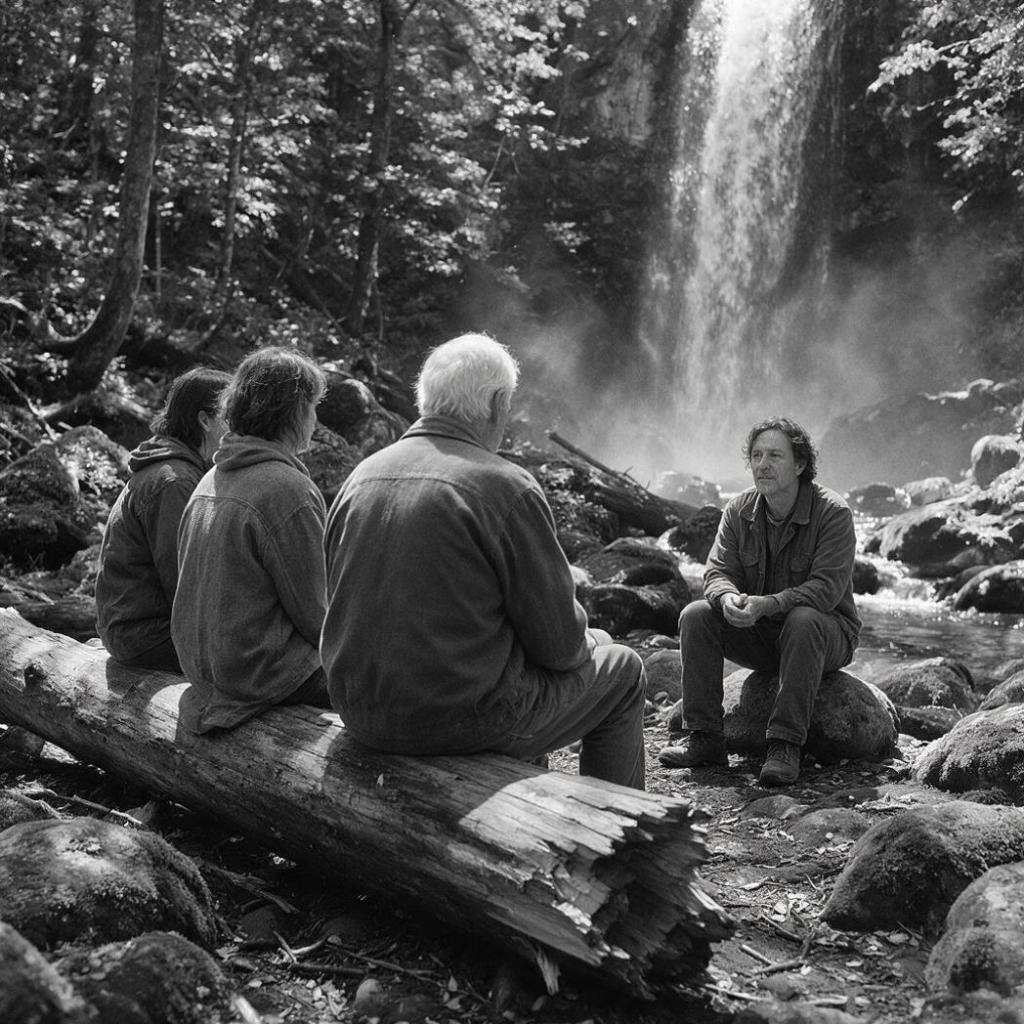
*Henry Witherspoon, an expert locksmith from Phoenix, who claimed to be a relative of the Ogilvys. “I think I’m a third cousin, twice removed or something like that,” he explained. “If I’m admitted, I can share some really wild family secrets.”
None of the initial candidates received all four approval votes, and the group wondered if they had been too judgmental in their interview assessments.
“Perhaps we’re being a bit too rigid in our approach,” Alice noted. “After all, we do have a very diverse population.”
“No, I think we need to stay true to the original standards,” Nathan replied. “Don’t we have one more person to meet?”
“Yes, her name is Barbara McNabb,” Sherman said. “She’s waiting over there. I’ll go get her.”
Sherman led Barbara to the waiting review panel. Ralph would later describe her as “somewhere between willow thin and pleasantly plump, with a cheery red face and very pronounced features.”
“Welcome to Hopeful Valley,” said Nathan. “I think we’d all like to know why you might want to live here.”
Barbara nodded and pointed to the nearby houses. “I was a guest at the storytelling event you had and saw what a nice, accepting community this seems to be.”
“Are you currently living above in a Mammoth Falls homeless shelter or somewhere else?” Sherman asked.
Barbara held up a worn document that appeared to confirm that she had graduated from the “Restart With Dignity” program based in Akron.
“For the last year, I’ve been living in transitional housing at the eastern end of town,” she explained. “I previously lived in a nice house. But after my husband died, I went downhill. Lost my job and then our house. I couldn’t seem to dig myself out of the deep pit of despair and self-pity. And then when I was homeless, my friends and remaining family members didn’t seem to understand why.”
“Some of us can certainly relate to that situation,” said Alice. “Even though we’re somewhat isolated from Mammoth Falls, we are a close-knit bunch and enjoy a special camaraderie. Do you like interacting with others and taking part in activities?”
“I love people and making new friends,” Barbara answered. “I’m anxious to live somewhere that has a generous spirit and a feeling of togetherness.”
“You don’t think you’d miss the amenities that a Mammoth Falls or another city offers?” Sherman queried.
“Not at all. Looking around here I can see that there is everything I would need. I no longer pine for a large house. My wants are few. I’m looking for a peaceful place where I can grow even older.”
They were interrupted by loud voices. Henry Witherspoon had confronted Ralph who was passing by on his way to the main apple orchard. Henry suspected that Ralph or Lawrence had blackballed him prior to his interview.
“I don’t have anything to do with the decision,” Ralph protested. “Besides, I don’t recall anything about you being connected to our family.”
“I don’t believe you,” the disgruntled visitor argued. “Your side of the family always looked down on the rest of us.”
“Not true,” Ralph claimed. “I just don’t have any runaway ruminations about you or your kin.”
“Well, you’ll be sorry,” Henry insisted. “Wait until I start sharing stories about you and the others.”
As Henry walked away, Rob restarted the discussion with Barbara. “Sorry about the outburst,” he said. “To continue, do you have any special talents or skills that you could share with others?”
“How about several years of experience as a seamstress and my pottery work?” she answered.
“That would definitely fit in,” Alice suggested. “We’re always looking for help mending clothes and we have a craft fair later this year.”
“And also, I’m pretty good at sleuthing,” Barbara added.
“How might that help?” Rob asked.
“I’ve watched a lot of crime dramas and also had a detective friend who shared some secrets with me,” she said. “Plus, while waiting to meet with you, I overheard a couple people talking about some mysterious happenings lately, and I might be able to help solve that.”
“Well, that was unexpected,” Nathan said.
“Yes, it was,” Sherman concurred. “Let us discuss and we’ll let you know in a few minutes.”
“I’ll wait by the wishing well,” Barbara said. “Thanks for the consideration.”
The judges compared notes and reviewed Barbera’s qualifications. Rob was the only one who had a minor objection.
“Are we moving too fast to get someone new?” he wondered. “Perhaps I’m just being overly cautious.”
“I think the time is right for just one new neighbor,” Sherman said.
“She does have a few special skills that would be helpful,” Alice reminded them.
“Okay then, let’s vote,” Nathan suggested.
Barbara was relieved to learn she had been accepted as the newest resident of Hopeful Valley. The following day, she moved into the vacant red and green house. She also began “sleuthing around” to help solve the night visitor dilemma, and was soon formulating her “mystery person theories.”
*The Twins’ Misadventure
The Ogilvy boys mean well but are sometimes unaware of the ramifications of their often-wayward activities.
The most recent incident occurred in late October, about a year after the twins had moved into their blue and green teepee home at the edge of pool number 2. Initially they were content hiking, reading, and playing bocce ball. They enjoyed the communal gatherings and the impromptu song fests, although neither have an especially pleasant singing voice.
But then they got restless. One morning, Ralph advised Lawrence, “We need a DIY specialty.”
“How about croquet?” Lawrence said.
“Too lazy,” Ralph countered.
“Perhaps a painting class.”
“We don’t possess the aesthetic adeptness necessary for such a grandiose pursuit,” Ralph objected.
“I’ve got it,” Lawrence answered. “We’ll do wine.”
“Like tasting?” Ralph wondered.
“No. Making it.”
Ralph shrugged his shoulders. “We don’t know anything about wine making,” he insisted. “And, we’d have to do it on the cheap or get a few friendly investors.”
Lawrence nodded in agreement. The brothers knew that their enthusiasm often clashed with common sense when they planned a new project.
“Okay then,” Lawrence concurred. “We’ll get a book from the Mammoth Falls Community Library. Plus, we have some spare ground behind the house. Eventually, we could start a small vineyard there. We should just jump in and see what happens. Who knows; this could be the start of a very profitable venture.”
The Ogilvys divided the winemaking responsibilities, with Lawrence doing the basic research and Ralph organizing and scheduling. They read two books and consulted with Facebook groups. Of course, they soon learned that it would take several years for a vineyard to grow wine-producing grapes.
“I’ve read about wine-making kits,” Ralph said. “I’ll write out a list of what we need. And we’ll go shopping at the Mammoth Falls Grab-All Market for supplies.”
A few Hopeful Valley neighbors were curious when Lawrence and Ralph returned with large bags of winemaking materials.
“What’s up, Ralph?” Sherman asked.
“It’s under wraps for now,” Ralph said conspiratorially. “We are proceeding suspiciously surreptitiously. But we’ll be having a party soon.”
The Brothers Ogilvy stored the supplies in their shed and went to work. Lawrence arranged the ingredients and supplies on a long table adjacent to the shed. Ralph began mixing, cooking, and bottling the various ingredients. They learned about a couple of shortcuts that would enable them to produce “at least a partially palatable brew sooner than later.”
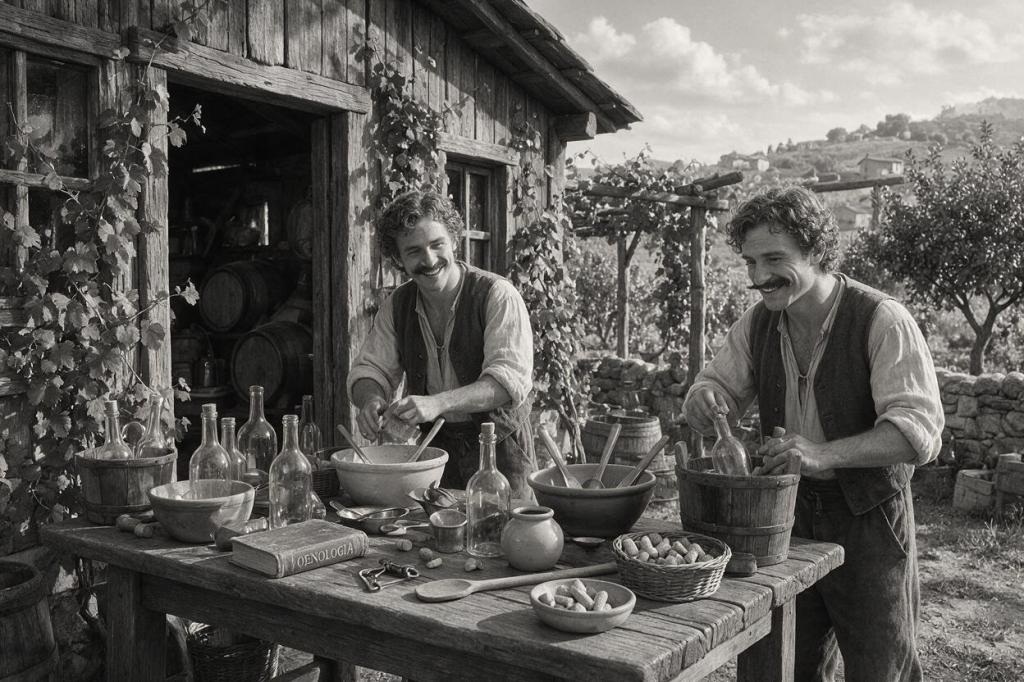
“How long will it take?” Lawrence asked.
“We have to be patient,” Ralph said impatiently.
So, they waited. And waited. Several weeks after launching their new hobby, Ralph opened one of the oversized bottles and cautiously took a small sip.
“Maybe it’s too early,” Lawrence cautioned.
“It’s not perfect, but probably drinkable,” Ralph reported.
“As if you’re an experienced wine connoisseur,” Lawrence laughed. “Let me have a sample.”
Ralph handed Lawrence a small cup of the clear liquid and said sarcastically, “I forgot you are a more sophisticated wine guzzler.”
Lawrence swirled the new wine in his mouth and swallowed. Then he looked at Ralph with smug satisfaction. “I think we’ve done it,” he said excitedly “Our first batch of Ogilvy Chardonnay is a relative success. It won’t win any prizes, but we’ve taken the first big step on our way to major success. Let’s celebrate.”
It would have been fine if the brothers had stopped after one or two glasses. But they continued sampling until the first two bottles were empty. It was dusk when they finished and fell asleep on the couch. When they awoke four hours later, Ralph poked Lawrence and said, “We just need to adjust our intake next time.”
“We should modify the recipe so that it has the same potency, but is still tasty,” Lawrence added.
The real trouble began when they made the second batch of their namesake wine and invited a few neighbors to a “come as you are” tasting party. The small group gathered inside around the cluttered table and Ralph filled the plastic cups.
“Raise your glasses, everyone,” Lawrence said. “A toast to the success of our new and potentially profitable venture.”
Ralph paired their guests’ chardonnay with cheese, crackers, and small pieces of spam and hot dog. The group laughed at each other’s jokes, spread the latest valley rumors, and eventually sang a few songs. However, after a few glasses each, they stopped pairing it with snacks and began gulping the wine.
“I think we’re getting close to being tipsy,” said one of the tasters.
“We’re moving on to the flat-out drunk stage,” another commented.
Lawrence was the first to jump into the waterfall pool, with Ralph then following him into the cold water. But Lawrence wasn’t a skilled swimmer and quickly began flailing his arms. The others jumped in to assist, but overcome by the potent wine, they also began struggling. Soon other villagers were alarmed by the “helps” and “yelps” and ran to see what was happening. Finally, Sherman and Rob found a long tree branch and began pulling the drunks to shore.
“Not the best example to show your other neighbors,” Sherman said to the inebriated wine tasters.
“We’re assuming this won’t be a regular occurrence,” admonished Nathan.
“We extend lugubrious lamentations about our uncharacteristic asshole actions,” Ralph said contritely. “We promise to be more ferociously fastidious about the proper behavior in the near and distant future.”
The other soaked and embarrassed imbibers muttered their promises to behave. After agreeing to meet again for a calmer gathering in a few weeks, they rushed back to their homes.
*A Flotilla of Unfriendly Flyers
“It’s been more than two weeks since the last mailbox notice or other mischief from our valley expansion critic,” Sherman reminded Nathan.
They were sitting at one of the easy rest benches near the sparkling blue pool, beneath the main waterfall and climbing ladder.
“Perhaps he or she has decided to stop the nonsense,” Nathan said. “That would be nice. We’ll have to wait and see.”
“Whatever the reason, it’s good to be almost back to normal,” Sherman added. “The best part….”
Suddenly they were startled to hear the loud blast of a horn from above. Sherman and Nathan looked up to see a slight figure standing next to the stairway entrance.
“What the hell?” Sherman asked.
“What can you see?” Nathan wondered. “My eyes aren’t as sharp as they used to be.”
“I just see someone dressed all in black,” Sherman answered. “Looks like he is waving at us.”
Then they saw the first bundle of papers floating downward in the breeze.
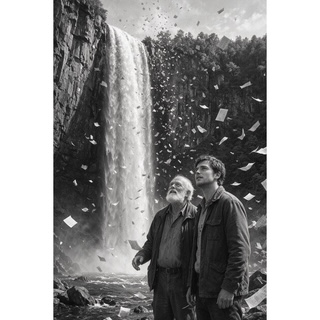
“The guy just tossed a bunch of papers at us,” Sherman added. “Unbelievable.”
There was another horn honk, and the mystery person dropped a second batch of the colorful handbills that fluttered over the valley.
“Probably some Mammoth Falls store promotion that we don’t need,” Sherman suggested.
“I’ll grab one to see what’s up,” Nathan said.
Nathan turned the paper over and scowled.
“Not quite a store advertisement,” he said. “Listen to this.”
Nathan held the paper close to his face. “Warning to those living in Hopeful Valley,” he read to Sherman. “There is trouble ahead. You don’t want new people to move in. The city won’t approve. And an influx of more people will ruin your comfy lifestyle.”
He handed a copy of the announcement to Sherman who crumpled the paper and shoved it in his pocket.
“I guess we were a bit early to be so happy about an end to the mysterious critic’s actions,” Sherman complained. “This takes the anti-valley campaign to a whole new level.”
There were more papers landing in the pools and tree branches, and strewn across the grounds. They watched as valley homeowners stopped their various activities to grab the unwanted notices.
“What the heck is this all about?” asked Rob, the first to approach Sherman and Nathan.
“It seems the critic of our Hopeful Valley is back at it,” Nathan responded.
The others were milling around, and an impromptu community meeting ensued.
“What does all this mean?” one of them asked.
“It’s very disconcerting,” another complained.
“We need to discuss this,” his neighbor requested.
Sherman held up his hands “It’s just another prank from someone in Mammoth Falls who is trying to stop any improvements we’re trying to make,” he clarified. But the protests continued.
“We’ve been hearing rumors about rents we might have to pay and that there will be strict new guidelines.”
“And also, that we could lose our special environment.”
“There could be other troubling changes.”
“All rumors,” Sherman said. “We’re not misleading you all. The expansion of the valley is a gradual process and you will have a chance to help us decide the next steps. Just be patient.”
“Why is someone from Mammoth Falls so upset about our community?” Lawrence asked. “Is this nonsense going to continue?”
“That’s what we’re trying to find out,” Sherman answered.
Several anxious onlookers began raking up the flyers and scooping them from the water. The crowd slowly dispersed, and everyone wandered off to resume their previous activities. Sherman, Nathan, Rob, and Barbara remained.
“This is most concerning,” Sherman said.
“We need to get a handle on it,” Nathan stressed.
“Perhaps I can check around in Mammoth Falls,” Barabara offered. “I can visit The Printing Place in town to see if one of their customers had the flyers made. I can also talk to a few people who might share their observations.”
“It’s worth a shot,” Sherman noted.
“I’ll get to it then,” Barbara replied and walked away to prepare for her upward hike to Mammoth Falls.
“I wonder if we should put a hold on any new plans, to let things cool down a bit,” Sherman said.
“Let’s wait to see what we find out,” Nathan recommended. “The big question is—are we faced with a large, organized effort, or just one or two people upset for some reason?”
“A good point,” Rob said.
“Okay, then,” Sherman acknowledged.
Having lived in Mammoth Falls recently, Barbara was more familiar with the newest businesses and knew a few people who worked in the city administration office. After three hours of talking with store managers, taking notes, and making amateur detective-observations, she returned to the valley with her pottery supplies and some information. She met with Sherman, Nathan, Rob and Alice at the one of the performance stage benches.
“I learned a couple of things,” she said slowly. “First, the printer remembered the customer who made the flyers was a teenage boy he didn’t recognize. He actually asked what the kid was up to but got no response.”
“Why would a Mammoth Falls youth be concerned about Hopeful Valley plans?” Sherman wondered.
“Unless he is the son or friend of the real culprit,” Nathan pointed out. “Someone who is bothered by our expansion and asked a kid to do their dirty work.”
“I checked and was told that none of the city leaders has a young son,” Barbara said. “But it could be someone else’s child.”
“And would they be capable of climbing down here to make the night letter deliveries to our people?” Sherman asked.
“It wouldn’t be that hard for an enterprising young man with a flashlight and a lot of nerve,” Barbara said. “I also asked a few store owners what they thought about Hopeful Valley and two said they were worried about losing us as their customers if we develop too much. But they didn’t admit to doing anything out of the ordinary. A friend in the city office did tell me that the valley plans had become an ongoing topic at recent meetings. I’ve got feelers out to a few contacts about other developments.”
“We just need to keep looking for answers so we can end the unwelcome drama,” Sherman said. “See whatever you can find out and we’ll do the same.”
Barbara smiled. “I’ll keep at it.”
“Perhaps there is a simple answer to all this,” Nathan said.
“We’ll see,” Sherman said quietly.
*The Crux That Matters
Nathan and Sherman were concerned that Hopeful Valley’s peaceful and cooperative atmosphere was gradually shifting.
The valley people share two common experiences: previous homelessness and personal challenges. They often remind each other that “We are more alike than not.”
Of course, there were differences, including their diverse political affiliations, which range from republican and democrat, to independent, fence sitter, and the “don’t care club.” While they usually try to avoid discussing the nation’s controversial current events, it became more difficult in 2025. Whereas most likely weren’t aware of their neighbors’ previous red versus blue viewpoints, that blissful ignorance began changing. Their dissimilarities became more visible during book club debates, apple harvesting, craft workshops, and other activities. There were snide comments, hostile side glances, and spontaneous head shaking.
Nathan and Sherman soon realized that a period of disharmony might soon descend over the valley.
“I think we need to deal with the growing dissension and what we can do to avoid the unfortunate divisions that are already happening throughout the country,” Nathan recommended to Sherman one chilly November morning.
“You’re right, but we should be careful so that we aren’t interfering with personal beliefs,” Sherman advised.
They established what they thought was a subtle approach. Sherman cautioned everyone to focus on “what unites rather than divides us.” As the valley elder, Nathan insisted it was best “to devote your extra energy to positivity and finding inner peace.”
What eventually brought them closer was the nationwide infestation of Immigration and Customs Enforcement (ICE) troopers and their controversial policies and practices. During a trip to the Mammoth Falls Emporium, Rob learned that ICE officers were planning to conduct a preliminary survey to see if they should return in greater force to round up illegal citizens.
“Apparently, once they got started in Akron and Columbus, they were told to expand their hunt,” Rob explained to Nathan and Sherman.
“That doesn’t mean they will waste their time down here,” Sherman pointed out.
“You may be right,” Rob said. “But we should be aware of what’s happening above and elsewhere in the country. I’ve heard reports of masked officers stopping people without reason and taking them away without cause. Even stories about people being shot and killed during demonstrations.”
“We can’t alarm people over these rumors,” Sherman argued.
“From what I’ve read and heard, they are accurate assessments that are becoming more frequent,” Rob persisted.
“Do you think anyone has a reason to be concerned?” Nathan queried.
“I have no idea,” Sherman said. “But we should be prepared. I guess it would be a good idea to have a community meeting to apprise everyone.”
So, they held a group gathering to share the news. The puzzled tiny homers assembled in the meeting area and waited for Nathan or Sherman to speak. They quizzed each other about what to expect.
“Why are we here?”
“I think that Sherman and Nathan worry that we’ve become less civil lately.”
“Between the AI stories and never-ending political posturing, it’s hard to know what to believe anymore.”
“That’s why it’s important we do our own research and independent thinking rather than only relying on our so-called leaders’ commentary.”
“We don’t want to be alarmists,” Sherman finally announced. “But because we are insulated from major cities, it’s essential that everyone is aware of what’s occurring in Ohio and other states. As you may have already heard, the current administration determined that the only way to reduce illegal immigration is to send squads of aggressive immigration and customs enforcement cops to various cities throughout the country, including Columbus, Akron, and Cleveland, for example. It seems their mission is to grab those people who are allegedly in the country illegally and subsequently deport them to their home countries.”
“The Icemen Cometh,” Ralph shouted. “They are vociferous and vexing in their deleterious diatribes.”
“How can they get away with that?” someone else demanded. “Doesn’t everyone have certain rights?”
“Of course, we don’t know if there is a reason to be worried and whether the ICE troopers will take the trouble to climb down here,” Nathan said. “However, your politics aside, we should all be aware and watch out for our neighbors. Meanwhile, we can’t let situations that are out of our control infect this community. We want to ensure that the valley remains a sanctuary, not a battleground.”
“As they say, ‘forewarned is forearmed,’” Sherman noted.
Suddenly, Josephine stood and waved to the others. “We may think that there aren’t any potential victims here—alleged illegal residents who came from Mexico or another country for a better way of life and perhaps didn’t follow the correct procedures. I wanted to share some information that may be relevant. During the Civil War era, several areas in Ohio were part of the Underground Railroad. Of course, it wasn’t a railroad, but a system of providing slaves safe passage from house to barn to basement to house until they arrived in a welcoming, anti-slavery county. It was a very secret process that was organized by heroic volunteers. Perhaps there is an appropriate application in the current climate.”
“Now, let’s not get ahead of ourselves,” Sherman said. “We’re not at that point yet.”
“I’m just saying,” Josephine answered. “I know more and am willing to share a few stories.” She smiled and sat down.
After the formal meeting, several smaller groups of people met to discuss their own concerns. Josephine was in an animated discussion with a few of them.
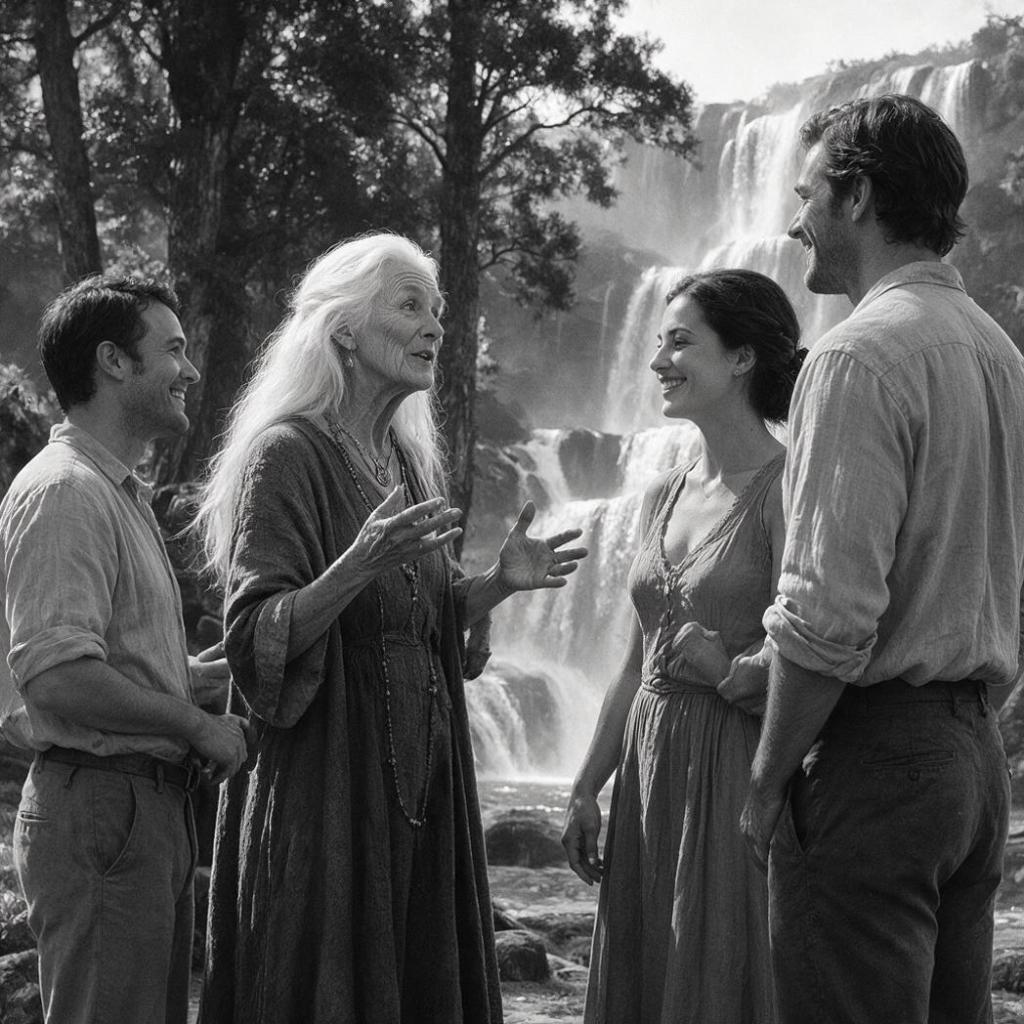
Three days later, Rob noticed that two valley homes were vacant. He met with Josephine, Nathan, and Sherman.
“They have left their places,” Rob explained. “The Steinbachs and Mendozas told their neighbors they were going on vacation.”
“Any ideas, Josehphine?” Nathan asked.
She hesitated, then nodded. “They asked for a few details about train travel,” Josephine said nonchalantly. “I mentioned where the nearest sympathetic depot might be, based on my own research, but emphasized that I didn’t know for sure if it was still functioning. I wasn’t recommending they take a specific action.”
“Did they mention where they were going?” Sherman inquired.
“I didn’t ask.”
“I assume you told them they are always welcome back here?” Nathan said.
“Of course,” Josephine responded. “When the unwelcome turbulence dies down, I’m sure they’ll return.”
*The Sundowner’s Sunset
The valley inhabitants often told others about how they depend on and care for each other, citing Burt Farmington’s situation as a notable example.
Burt moved there in 2024, having previously lived at a halfway house up above. He seemed fine at first: attending a few book club meetings, helping with the gardens, and watching the colorful sunsets from his porch. But a few weeks after his arrival, his next-door neighbor noticed something unusual.
“Burt seems to be more forgetful every day,” Alice told Sherman one day while they were gathering apples.
“Older people do tend to be forgetful,” Sherman replied.
“There is inherent indubitableness in what you claim,” said Ralph, who had been eavesdropping again.
“Yes, but this seems different,” Alice said. “I was talking with him the other day and noticed something else. I mentioned the storytelling extravaganza and Burt said he had enjoyed that day. Then no more than 10 minutes later, he asked me when the storytelling program was scheduled. There have been similar instances when he repeated a question or asked me to respond to something we already discussed several times. It could be some form of dementia.”
Sherman nodded. “I guess you could be right. Maybe we can have Doctor Sheffield talk to Burt without alarming him. We’ll see what the doc thinks.”
That afternoon, Sherman found Doctor Sheffield playing horseshoes with the Ogilvys.
“Do me a favor and have a talk with Burt sometime today,” Sherman said.
“What am I looking for?” the doctor asked.
“The potential that he has Alzheimer’s or some other form of dementia,” Sherman said. “It could be something else, but let’s be sure so we can get him help if need be.”
After lunch, the doctor approached Sherman, who was painting his front door. “Well, I talked to Burt and agree there is something amiss. But as a family physician, I’d feel much better if he had a more thorough exam in Mammoth Falls.”
“Perhaps Nathan and I can arrange that somehow,” Sherman said.
“The sooner, the better.”
The following day, Sherman and Nathan asked Burt to accompany them on a trip to Mammoth Falls. “We thought you could help us select some new plants for the vegetable garden. And while there, we’re going to get flu shots.”
“Always glad to help,” Burt said cheerfully.
When they returned to the valley that afternoon, Burt seemed quieter than usual.
“I think he was surprised to hear the formal diagnosis,” Sherman told Alice. “Burt said he knew he was acting differently but didn’t suspect that. He wants to stay here, so we’ll need to watch out for him.”
“I’ll talk to his other neighbors,” Alice said.
From that day forward, Burt seemed more subdued. He was still cheerful and willing to help others. But he was more self-conscious, hesitant to talk much that might reveal “the condition,” as he referred to it. Alice and Rob became his concerned caregivers. They made sure he got up every morning, ate breakfast, and took his meds. They and a few others also sat with him while watching his cherished sunsets.
“You can’t beat a valley sunset,” Burt told Sherman. “That glorious sight of the reddish-orange sun slowly lowering through the magnificent oak trees and then disappearing. It’s a different painting every day.”
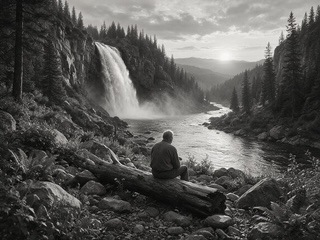
But Burt began to get more befuddled during the late afternoon sunsets. He asked Alice and Rob to repeat comments, posed the same questions, and was often frustrated and irritable.
“It’s called sundowning,” Doctor Sheffield explained to Alice. “They get more confused and anxious in the late afternoon. It’s a very unkind malady for someone who looks forward to the sunsets. It can go on for some time, hence it is often referred to as ‘the long goodbye.’”
Still, Burt remained outwardly content. Alice and the others were confident that he would be comfortable and safe until the disease worsened, and he needed additional help. That changed when Burt disappeared one morning, 10 days after his diagnosis. Alice had stopped by to make sure he was awake. But the door was open, and she didn’t see Burt inside.
“I don’t know where he is,” she announced to Sherman and Nathan. “He’s always there, sitting in his chair, waiting for me. But I can’t find him anywhere.”
“We’ll get a group together and start looking for him,” Sherman said.
The search party looked in all the obvious places. But Burt wasn’t at the vegetable garden, waterfall pool, or outdoor barbecue area.
“We’ll have to go further back through the oak grove and up a few of the trails,” Sherman advised. “If we don’t find him soon, we’ll need to call the Mammoth Falls fire department/rescue squad for assistance.”
Then they heard a shout from the other side of the pools. “I’ve found him,” Rob called out. “He’s been sitting on a large boulder near the Conrad memorial.”
The searchers slowly approached Burt, who was smiling. “I like it here,” he said softly. “It’s nice and peaceful. By the way, have you seen that big blanket over there?”
They saw the colorful banner partially twisted around the elm tree trunk. Sherman unwrapped the tattered sheet and displayed it on the ground.
“Vote No on H. Valley Expansion,” he read in an exasperated voice. “Maybe this was a leftover from the previous tornado of flyers.”
“Possibly, but we really have to get to the bottom of all this,” Nathan said. “We should check with Barbara and Josephine to see if they know anything more. Meanwhile, let’s walk Burt back home.”
“And it’s time to call his daughter, who lives in Oregon,” Alice offered.
Burt appreciated the attention he received on the way back to his home. He smiled and waved at the search party helpers and others who had gathered along the way.
“Thanks for the escort,” he said as they approached his home.
His friends were even more attentive now, making sure that he didn’t wander off again. A week later, his daughter arrived to take Burt home with her.
“I loved living in this valley,” Burt said as they prepared to climb the long stairway. “The people and the sunsets are wonderful. I’ll miss everybody. Thanks so much for being patient with me.”
“We will miss you too, Burt,” Nathan said.
“This will be a good thing,” Sherman added. “I hear they have very nice sunsets in Oregon.”
“Sounds right to me,” Burt smiled.
Then Burt and his sister climbed the stairs to an uncertain future. Halfway up, he turned and waved. “Thank you all,” he shouted. “I’ll never forget you.”
*Sunday’s Salvation Sermonettes
Sundays were a mixed blessing in the valley. That’s because some villagers realize the benefits of regular worship and others prefer more secular activities.
Neal Riley leads the weekly Salvation Sermonettes at the Outdoor Cathedral Church of Hope. Neal, 43, is an unimposing former accountant with premature gray hair and hazel-green eyes. He does his best to inspire his parishioners, some of whom are firm believers, and others who consider themselves “wafflers,” still waiting to be persuaded. Nathan, Sherman, Alice, and Rob are among the first group. The undecided include Ralph, Lawrence, Barbara, and several more.
“Don’t erroneously earmark us as atheists or agnostics,” Ralph once protested. “We’re merely consciously cogitating on the hows and whys of it all.”
Neal’s previous sermonette themes included:
*Finding Peace Within
*Charity Begins Today
*Helping Neighbors Help Themselves
*Everyday Faith Reminders
Neal gives shorter versions of these timely messages because of his lack of confidence. He hadn’t completed divinity school and thinks of himself more of a lay minister, not experienced enough to present a fuller worship service.
“I don’t feel entirely qualified and confident in offering the more formal and longer sermon,” he had explained to Sherman. “Perhaps eventually I will get there.”
Some of the churchgoers sensed his cautious approach and felt entitled to interrupt the sermonettes with a question or suggestion. They viewed the morning service to be more of a group discussion rather than the traditional church service.
Neal titled his November 20 sermonette “Finding Reasons to Believe.” Sherman, Nathan, Alice, Rob, Barbara, Ralph, Lawrence, and several others had gathered to hear him expound on “Why faith and a belief in the hereafter is crucial to our happiness and ultimate fulfillment.”
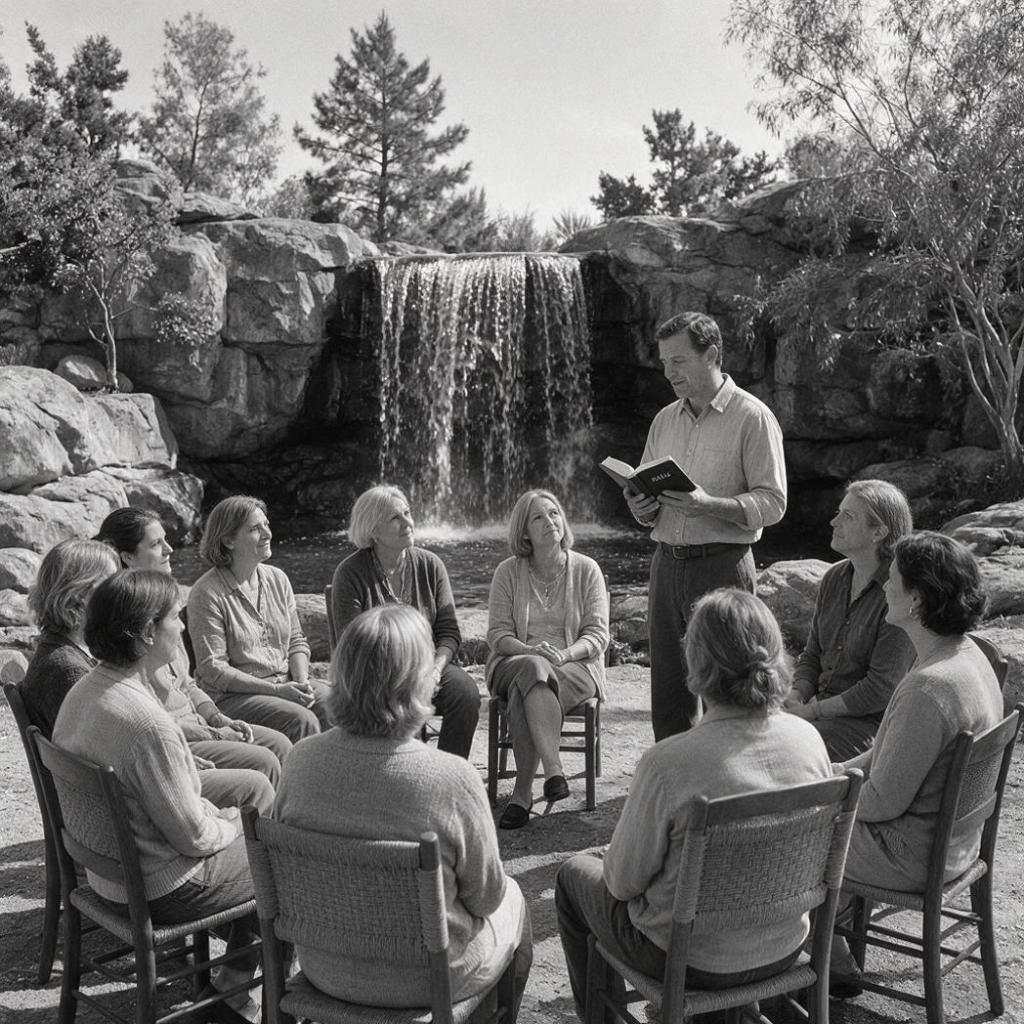
“Many of us in Hopeful Valley could have a reason to doubt,” Neal began in a soft voice. “We haven’t had it easy. Not having a place to stay, or always enough food to eat, and worried about the future for us and our friends.”
He paused as a few congregants nodded and said quietly, “I hear you,” or “that’s for certain.”
“We may wonder if God has forgotten about us,” Neal continued. “If we should have faith when we’ve been ignored. But deep down, we know that’s not really true. For example, according to Psalm 34:18, ‘The Lord is close to the brokenhearted and saves those who are crushed in spirit.’ And, Isaiah 58:7 reminds us that ‘Is it not to share your bread with the hungry and bring the homeless poor into your house; when you see the naked, to cover him, and not to hide yourself from your own flesh?’”
Ralph scratched his head. “I’m still bumfuzzled,” he interrupted. “Should we have what some call ‘blind faith,’ or the complete acceptance of what the Bible or you tell us, without questioning?”
Neal set his sermonette book on the nearby tree stump. He always hesitated before answering the mid-sermon questions. He wanted to respond but didn’t want to lose his slow-moving train of thought.
“Of course, that’s the central question, is it not?” he emphasized.
“Then, what to do?” Lawrence asked loudly.
“I believe that we have to find our own path to acceptance and faith,” Neal said. “We must ask ourselves if having everyday faith and a fundamental belief in the hereafter gives us hope and comfort. I didn’t say it’s supposed to be easy. We have to keep working at it.”
“And why would God let so many people be homeless?” Lawrence grilled Neal.
“That’s overly simplistic,” Neal advised. “We are in control of most of our own actions. God didn’t make us or others homeless. Plus, we don’t know everything about God’s plans for us.”
“Well, I guess we need to do some more soul-searching on these issues,” Barbara said. “Lots of questions and we have to find the answers on Sunday morning or during the week.”
When the brief service was over, Nathan remained behind. He could tell that Neal was discouraged.
“A very nice sermonette,” Nathan commended Neal.
Neal grimaced. “I’m not so sure,” he replied uncertainly. “I’m not able to adequately answer their questions. I feel that I’m not doing enough to serve our valley people. They deserve more. I think that if I were to leave this place, my presence wouldn’t be missed.”
“That’s not true,” Nathan said. “We all have a role to play here: Sherman, Rob, the Ogilvys, me, and you. Those here today and on other Sundays appreciate your words and help understanding some very complex topics.”
“Perhaps I should go back to school and become a real minister.”
Nathan shook his head. “No, my friend,” he said. “You’re doing just fine. You have a challenging role convincing people who have faced such adversity to have faith without questioning. I’m almost 85 and know that I’ve had doubts along the way. I keep reminding myself to believe and be grateful for every day.”
Nearby voices interrupted their discussion. Two residents stood by the drinking fountain, complaining about the night visitor’s antics.
“I just heard that two of our neighbors found worms in their mailbox along with a strange notice complaining about the two new homes being planned,” one said.
“And what about the pumpkins that were tossed from up top and smashed all over the place,” her companion complained.
Nathan shook his head. “It seems to be a more common occurrence,” he whispered to Neal. “Any idea who is making the mischief?”
“No, but I’m going to pray that it comes to light. In addition, our amateur detective Barbara mentioned she has a few ideas. One of them is that someone from Mammoth Falls is orchestrating everything with the help of one of our valley people. Apparently, she sent a few of the mailbox notices to a handwriting expert she knows.”
*The Futile Feud
Nathan didn’t know.
Alice complained she was “in the dark, as usual.”
Sherman insisted he didn’t have a clue.
No one in the valley could explain why Ralph and Lawrence had stopped communicating. Lawrence even moved out of their home on November 22 and now lived in a nearby shed.
“I’ve asked them why,” Sherman said one Sunday afternoon following the Worship Sermonette. “The only response I get from Lawrence is ‘It’s difficult to explain.’”
“I talked to Ralph the other day and all he would say is, ‘There comes a time when enough is enough,’” added Alice.
“We need to help them sort things out,” Nathan said. “In a small, usually tight-knit place like this, we can’t afford to have such petty squabbles, especially between twin brothers.”
In a normal small town, such family and neighborly disagreements would be unavoidable. But in Hopeful Valley, even petty squabbles can upset the invaluable equilibrium. Valley citizens have a kindred spirit of being homeless and are generally united despite their differences. In the two weeks since the brothers’ estrangement, the valley’s rhythm was off. Their familial spat was fodder for daily conversations and book club commentary. There weren’t as many smiles and laughter. It was inevitable that the valley locals would offer them unsolicited advice and encouragement.
“Siblings are supposed to be forever friends,” Alice said to Lawrence as they gathered applies from the delicious red apple orchard.
“That’s fine for you to lecture us,” Lawrence snapped. “But you haven’t been walking in my moccasins lately.”
Sherman found Ralph working in the garden one afternoon. “You know how concerned everyone is, don’t you?” Sherman asked.
“I can sense that,” Ralph said. “But I can’t help it. This is complicated and personal.”
“You don’t want to have any regrets later on,” Sherman continued.
“I don’t think I will,” Ralph responded. “But you have no idea about the other guy. I hope everyone will cease impetuously pontificating about our vibrant vicissitudes.”
Neal even attempted to weave the breakup situation into his Sunday Sermonette. The morning’s message was Be a Friend to Your Brother. He started with a benign opening: “Next to God, family is the most important,” he said solemnly. “We can ill afford to break the bond of brotherhood or sisterhood that is so important.”
While Neal thought it was a mild reference to the brothers’ difficulties, Lawrence saw through the barely disguised message. He stood and shouted, “You all mind your own business.” Then he walked quickly away while Neal continued with his informal preaching.
Several others tried to help as matchmaker mediators. For example, Alice invited them both to a stained glass and soap making workshop without telling the other. But as soon as Ralph saw Lawrence inside, he turned around and left. Rob asked for help painting the garden fence. When Lawrence arrived, he noticed Ralph was already there. Lawrence muttered a few obscenities and walked away.
The Ogilvy estrangement would likely have continued if not for an unusual and potentially catastrophic event on the day before Thanksgiving.
Lawrence was the first to smell the smoke at about midnight. He scrambled from his small shed and looked toward the cloudless sky above the tall teepee home. Lawrence rubbed his eyes and then saw the flames arising from the top of the twisted oak tree. It’s near our house, he thought frantically.
“Fire!” he hollered. “There’s a fire.”
Lawrence ran toward the fire and saw that two trees were aflame and sparks were moving closer to the teepee. He continued to shout, “Fire, help, help.” By the time he reached their home, others were awake and walking outside. Lawrence pounded on the teepee door.
“Get up, Ralph!” he shouted. “Come outside now!”
The fire was only a few feet from their house as Rob and Sherman aimed garden hoses to douse the flames. Suddenly Ralph opened the door and hurried down the walkway. “What’s happened?” he cried.
“There’s a fire just over there and Lawrence most likely saved your house and others too,” Alice observed.
Nearly all the valley folks were standing around now. Ralph walked over to Lawrence and hugged him.
“You saved me,” Ralph cried.
“I’m sure you would have made it out in time,” Lawrence replied. “How did this start?”
“Looks like we have a downed electrical line over there,” Rob said. “That’s most likely the cause.”
Lawrence moved back home in the morning. It was as if there had never been a rift between the twins. That afternoon Sherman saw Ralph repairing a boulder wall.
“Everything back to normal?” Sherman asked.
“We’re in a state of arrested awesomeness,” Ralph answered.
“I’m curious. What started your disagreement?”
Ralph hesitated. “It seems so trivial now,” he finally began. “It started when Lawrence and I were remembering our early family life. It began as a casual conversation. He commented that he thought I might have been adopted. Of course, he was kidding. But it made me think our parents treated him better. He’s always been my best friend. But right then I was upset at the memories. I shouted at him to shut up. He told me to calm down. I called him a few names.”
“And he moved out?”
“That might have been the endpoint,” Ralph added. “But as I walked away from our argument, he lashed out at me for criticizing Trump and for being happy about the mid-term election results. I got mad back, and we stopped talking. Then he moved out. It shows how easily families can be splintered by spontaneous events and comments. There was a wall between us and eventually we didn’t even know why. Anyway, we have agreed that it’s all wavering water under the falls, if you know what I mean.”
Sherman smiled. “Yes, I do. We’re glad to have you both back.”
“We’ll make sure to avoid another argufying brabble,” Ralph conceded. “There are too many more important things going on, like the government shutdowns and the proposed impeachments, and of course, the source of all the recent anti-expansion vandalism in our valley. Also, during Lawrence’s absence, I found some family correspondence that suggested we might both be adopted after all. I’m not sure if it’s true, but I’m going to take a closer look before elucidating this to brother Lawrence. No sense in getting him worked up in a premature luxurious lather.”
“I understand,” Sherman said. “We all wish you the best.”
As Sherman turned to leave, he and Ralph noticed the reflection pool was changing colors. The purple hue appeared to be coming from the surging waterfall. They looked up and saw a black-clad figure waving.
“Apparently, that scoundrel dressed in garish black garb added some putrid puce pigment to the astounding apex of the waterfall,” Ralph proclaimed. “I assume it’s another anti-growth protest that has plagued our otherwise phlegmatic pleasantville population.”
“This has got to stop!” Sherman shouted.
*The Night Visitor’s Comeuppance
By early December, Valley residents had become accustomed to and extremely frustrated by the unwanted mail, flyers, and other anti-expansion actions.
Alice and Rob told Sherman about their plans to install cameras on top of their home.
“We should have done this earlier,” Alice emphasized.
“We’ve resisted adding cameras because we didn’t want to interfere with everyone’s privacy,” Sherman admitted. “But I guess it’s time.”
“We hope the cameras will capture an image of whoever is leaving notes and other stuff in our mailboxes. But let’s not tell anyone else about it.”
“Be careful how you place them,” Sherman stated. “We don’t want to catch our neighbors in compromising situations.”
“How so?” Alice asked.
“For example, if someone is late night skinny dipping in the pond.”
Alice laughed. “We only want to catch the night visitor in the act.”
“Okay, then,” Sherman said.
They checked the cameras every morning to see if there was anyone skulking around the immediate area. But there was nothing to observe except the night illuminated by the bright yellow moon, and the occasional skunks and raccoons wandering aimlessly nearby.
“It looks like our angry nighttime mailman may have retired,” Alice told Sherman one afternoon. “Lately, there’s been nothing to watch.”
But then two days later, Alice and Rob were surprised to learn the camera had captured a shadowy figure creep up slowly and put something in their mailbox and stop at a few other nearby places. The video showed him pausing before turning around and walking away. They were especially alarmed to learn the mailman’s identity.
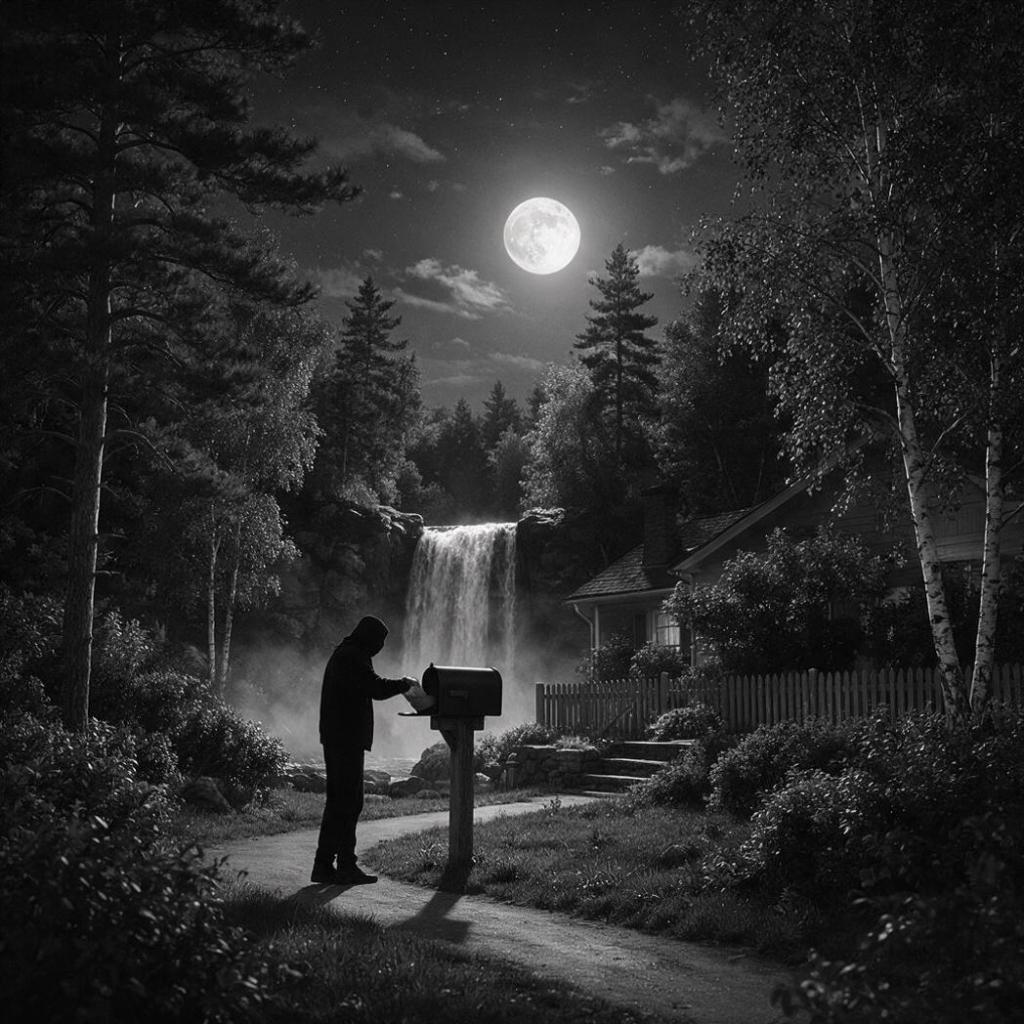
“We’ve got to talk to Sherman straightaway,” Alice said.
“Let’s go find him,” Rob agreed.
After watching the video, Sherman asked a few valley dwellers to meet at the main picnic table. Nathan, Alice, Rob, Neal, Ralph, Barbara, and Lawrence sat on the wooden benches and waited for Sherman to speak.
Sherman pointed to the I-pad screen. “Look closely,” he said.
Afterwards, Sherman stood and complained in an uncharacteristically stern voice, “Lawrence, I think we’re all stumped why you were delivering the warning letters and doing everything else. Apparently, you are the night visitor who has been responsible for a variety of unfortunate acts.”
Lawrence was flummoxed and began stammering. “I didn’t mean…only tried to….in hindsight…”
“What was your purpose?” Sherman demanded.
Lawrence shook his head and frowned. “I only wanted to slow the new housing project down a little,” he confessed sheepishly. Lawrence seemed to have regained his ability to speak clearly. “As you know, Ralph and I had a long homeless spell as kids. We were later passed around to several foster homes. Ever since, I have craved normalcy and been nervous about big changes. I know I’m not the only one who has been worried that the influx of more people could change our way of life. I meant to stop, but it all just spiraled out of control.”
Ralph’s startled expression indicated he was as surprised as the others.
“Ralph had nothing to do with this,” Lawrence stressed. “I did it all at night when he was sleeping.”
“I am mortifyingly mystified,” Ralph lamented. “I wish you had confided in me. I could have helped you avoid this mess.”
“You obviously had some help with your various escapades,” Nathan said.
Lawrence nodded. “I paid a Mammoth Falls High School kid to drop some leaflets, add the purple suds mix, and do a few other things. He thought it was a lot of fun. But that’s it.”
Sherman pointed to the valley’s open area beyond the apple orchard and garden. “We’re a long way from adding new homes,” he said. “It’s still in the final planning phase for City Council acceptance and ultimately the residents’ approval. We also have to remember that there are other people like you, Ralph and the others, who might need a place to stay.”
“Plus, it might have been much better if you had discussed this and expressed your concerns, rather than alarm everyone with notices, pumpkins, purple water, and other stunts,” Nathan added.
Lawrence lowered his head. “You’re right,” he said meekly. “I went overboard. What’s my penance to be?”
“Your what?” Sherman wondered.
“How do I get back in your good graces,” Lawarence replied. “I don’t want my transgressions to get in the way of our otherwise good relations.”
Sherman smiled. “Well, there could be a long to do list to achieve that goal. But as a starter, I think you should visit each house to explain and apologize for your actions.”
“I could do that in a group gathering instead,” Lawrence offered.
“Yes, but this way you’ll appreciate the experience more,” Sherman stressed.
“Alright, I’m off to do my duty,” Lawrence grumbled. “I am sorry.”
As Lawrence walked away, Nathan suddenly shuddered and closed his eyes.
“Are you alright, Nate?” Sherman asked.
“I’ve had some serious breathing issues lately,” Nathan said. “I think I’ll visit the doctor again today.”
“I’ll accompany you,” Sherman said.
The others remained seated. “I do hope Nathan will be okay,” Alice said after they left.
“We’ll pray that he will be fine,” Neal said.
Meanwhile, Lawrence began his apology walk. He knocked lightly on William Saxton’s front door. I do hope everyone understands, he thought. I guess I’ve learned my lesson.
The creaky door opened slowly, and Lawrence faced William, who was still in his bathrobe.
“Hello, Lawrence, what can I do for you on this fine day?”
“I came to apologize.”
“Whatever for?”
“You’ll understand once I share my story. Can I come in?”
*Nathan’s Unexpected Confession
Nathan had been in the hospital for a week, when the nurse called Sherman.
“She said that Nathan has something important to tell us so we should be sure to visit him today,” he explained to Alice and Rob.
“I wonder what it is,” Alice said.
“Let’s find out,” Sherman answered.
They quickly prepared a care package of Nathan’s favorite items (a railroading magazine, strawberry pie, and lemon soda) and left for the hospital.
On the climb up to Mammoth Falls, Alice suddenly stopped and faced Sherman. “I’ve been meaning to ask for a long time. How is it that Nathan lives in the valley although he was never homeless?”
“He wanted to be quiet on that subject, but it’s quite simple,” Sherman said smiling. “Nathan arrived one day and said he wanted to help fund the development of Hopeful Valley, but he wanted to live there. There was something extra special about Nathan that made us like him. Even though he was quite secretive, he was always supportive and friendly.”
Upon their arrival at Mammoth Falls Angels Hospital, they learned Nathan was in the acute care section. Sherman, Alice, and Rob quietly entered his room.
“Greetings, good friends,” Nathan welcomed them. He was smiling but appeared tired, and it was obvious he had earlier been hooked up to wires and oxygen.
“You’re looking good, Nathan,” Sherman said.
“Liar,” Nathan replied in a hoarse voice. “But thanks for the positivity. Please sit. I want to share something with you.”
“What’s that?” Sherman asked.
“My story before Mammoth Falls and Hopeful Valley.”
“You’ve told us you had been in real estate for many years,” Alice commented.
“That was a very general summary,” Nathan said abruptly. “But it doesn’t reflect the very shameful details of a decades-long career as a terrible landlord.”
Sherman and Alice glanced at each other. Sherman raised his right hand to keep Nathan from talking further.
“Nathan, you can give us the details after you’ve recovered and are back home. You should get some more rest.”
Nathan shook his head.
“That assumes I will get out of here,” he said weakly. “And that’s not a certainty, so I do want to give you my backstory now.”
“Don’t overexert yourself,” Alice pleaded.
Nathan nodded. “I’ll try. Anyway, I started out small by buying a house and flipping it. Of course, the real estate market was much different back then. I was very ambitious and determined to be wealthy at an early age. I was soon able to purchase a small apartment building. In the beginning I was a very concerned and reasonable landlord. I was fair to my tenants. But once I added another couple of apartment complexes, I lost my perspective, and part of my humanity.”
“It isn’t necessary to explain,” Sherman interrupted.
“Yes, it is,” Nathan insisted. “As my real estate portfolio grew, so did my appetite for a greater return on my investments. I raised rents everywhere and paid less attention to timely repairs and other building enhancements. I bumped the rents up to a point where some of the long-time tenants couldn’t afford it. A few were evicted and replaced with new tenants, and so on. Of course, I told myself that this was just a good, common-sense business practice. But that didn’t change the fact that I had become greedy and selfish.”
Sherman looked at Alice, who fidgeted as they watched their friend relate his personal history.
“By the time I was 65, I was insanely wealthy,” Nathan continued. “But I clung to my obsession with being super successful. Then one day, about nine years ago, I had an unusual and uncomfortable encounter.”
“What was it?” asked Sherman. He no longer tried to keep Nathan from relating his background.
“I was walking in front of one of my properties and an older homeless woman approached me. She was dressed nicer than you would expect from someone living on the streets. She smiled and said, ‘Hello, Mr. Bannister.’ I explained that I didn’t know who she was. The woman patiently explained that she had lived in one of my apartments until the rent had been raised so many times that she couldn’t afford it and was forced to move. She eventually ended up homeless. I tried to walk away from that awkward conversation, but she was persistent. The woman said that I should visit the nearby homeless encampment where I would find a few other of my former tenants. Of course, I ignored the invitation for some time because I rationalized it wasn’t really my fault.”
Nathan was wheezing. He paused to take a sip of water and wipe his forehead.
“Nathan, you should rest now,” urged the nurse who had entered the room to check his vitals.
“I’m almost finished,” he responded. “I need to explain to these nice people. About three weeks after meeting the woman, I decided to stop by the homeless camp and did meet several former tenants there. They all shared a similar story of being forced out of my apartments and not able to recover. I said something about trying to help and then ran back to my penthouse apartment several blocks away. I spent several days just drinking and thinking about what I had done. I realized how my greed had such tragic consequences. It wasn’t an overnight conversion, but I began to see how I could have run things differently. What was especially disconcerting was recalling how as a young man, I was so committed to doing what my parents and grandparents constantly told me: ‘Leave the world a better place.’ As I got older, I just lost my way. Several months after those encounters, I closed my business, sold the penthouse apartment, and moved to Mammoth Falls. I gradually became aware of the town’s homeless situation. While not as bad as other parts of Ohio or the country in general, it was a stark reminder of the responsibility we have for doing better. As you all developed Hopeful Valley, I wanted to be part of it. It was a late start in regaining my humaneness.”
“You’ve done so much to help develop our community,” Alice said.
“From donating money to using your contacts to work through all the regulations,” Sherman added.
“It will never be enough,” confided Nathan. “Never. But perhaps this will help a little more.”
He handed a large envelope to Sherman. “I’d like you to wait and read this at the upcoming Wine Tasting and Craft Fair.”
“You should be the one to read whatever it is,” Sherman said.
“Just in case I’m still in here,” Nathan laughed.
“You’ll be in the valley with the rest of us,” Rob insisted.
’’That would be nice,” Nathan said. “Now let me get some more rest. Thanks for the basket of treats.”
On their way home, Sherman, Alice and Rob discussed Nathan’s condition.
“He looked worn out today,” Alice said.
“We’ll just have to pray and be positive,” Sherman stressed. “Sometimes that’s all we can do. That’s what Nathan once told me.”
“I’m counting on him being at the festival with the rest of us,” Alice persisted. “He has to be there.”
**Epilogue
The Amazing Wine Tasting and Craft Fair on December 28 was a huge success. Mammoth Falls residents and others from throughout central Ohio came to buy soaps, candles, pottery, and other craft items from the valley artisans, and taste the Ogilvy Deluxe Chardonnay.
Unfortunately, Nathan was unable to attend the festivities. He had passed away a week earlier.
As he had promised during their recent hospital visit, Sherman read Nathan’s letter during a special opening ceremony. He gazed at his receptive audience. “I’d like to read this message from Nathan, our cherished and long-time friend and neighbor,” he said in a tremulous voice. “Nathan wrote this while he was in the hospital, which we hoped he would leave to be with us today. Here goes: ‘Dear friends, I’m obviously not there to celebrate with you, despite the doctors’ best efforts. Please don’t make this a sad occasion on my account. As my mother once said, ‘Grieve for me, but only for a little bit. I’ve had a grand life.’”
Sherman paused briefly and then continued reading Nathan’s letter: “I want to thank all my dear neighbors for your wonderful friendship. I learned a lot from you—about humility, loyalty and what’s really important. I hope my new gift to you will help maintain the traditions. When I first heard about The Hopeful Valley Promise, I wasn’t quite sure what it meant. But I gradually realized the Promise is that we care for each other, however we might do so. While we can interpret the Promise in our own individual ways, I believe we can all do something to make a difference in the valley and elsewhere. Please continue pursuing your best life, knowing that you’ve been a huge blessing to me. Promise to make the world a better place.”
Sherman wiped his tears and folded the paper. “Now I know that if Nathan was here, he would encourage us to wander around, meet new people, and give thanks for our community. So please enjoy the rest of your day.”
Nathan’s $4 million donation helped Hopeful Valley expand with several new homes and the addition of the solar power system. It also enabled them to complete construction of the Penny Conrad Peace Center, which appropriately opened on September 21, 2026 (International Peace Day), and start a community trust fund so residents would never have to be homeless again.
During the next few years, the valley community expanded gradually as a special sanctuary for those who have been homeless. In 2028, The National Council on Homelessness named Hopeful Valley one of the country’s top 10 Communities for the Previously Unhoused.
I encourage you to learn more about Hopeful Valley, Ohio. I’m certain you will be as impressed as I was.
***David Robinson
Ralph’s Dictionary
*Author’s Note: Ralph Ogilvy asked that I include his special dictionary so that you might better understand his “momentous manner of speaking” (his words). He also thought it was important to include his rationale for using the specific language. DLR
Aesthetic Adeptness—Sufficient creative ability enabling one to perform challenging activities (“Lawrence and I can’t draw a stick figure accurately, let alone paint a portrait.”)
Astounding Apex—Very impressive, uppermost point (“You can’t help but be amazingly awestruck when looking at the tippy top of that waterfall.”)
Argufying—Disputing, disagreeing (“Haven’t most of us been guilty of this?”)
Arrested Awesomeness—A state of extremely impressive/pleasing behavior or relations (“My twin and I had returned to the state of brotherly contentment, until the next time we aren’t.”)
Brabble—A quarrel or spat (“These are inevitable when you live so close to your eccentric neighbors, including siblings.”)
Bumfuzzled—Confused, bewildered (“I’m not easily mystified, but I’m still grappling with the matters of the heavenly afterlife and related subjects. Perhaps uncertain would have been a better choice, but bumfuzzled just slipped out.”)
Celebratory Salutations—Heartily welcoming someone to a significant event (“Isn’t that better than a simple ‘Hello’ or ‘Hi there’?”)
Clandestine Tidbit—A minor secret (“In hindsight, I thought Nathan was up to something.”)
Consciously Cogitating—Intently pondering or meditating about a specific topic (“While I’m not necessarily recognized as a particularly deep thinker, I am known to dwell on some things way longer than necessary.”)
Deleterious Diatribes—Harmful, adverse speech or criticism (“I thought that was an appropriate way to refer to ICE-related commentary. The ice-cold marauders might disagree.”)
Duplicitous, Disaffected Duo—Dishonest, discontented, estranged (“This pair of sneaky, unhappy spouses was overly confident they wouldn’t get caught.”)
Ferociously Fastidious—Excessively detailed in one’s approach to a particular situation (“Something that I have to work at because I often gloss over the important points.”)
Immensely Incommunicado—Extremely hard to reach, out of touch, unable to communicate (“If you’re having an affair—as this naughty pair was—you probably prefer to be secretive.”)
Impetuously Pontificating—An unthinking way of sharing an annoying (even pompous) opinion (“Several of our usually nice friends thought it was fine to rant and rave about a private family disagreement.”)
Inherent Indubitableness—Essential, definite, unquestionable (“I just loved the sound of those two words.”)
Jibber-jabbering—Silly, worthless talk (“The conversations that I find others (not me) sometimes engage in.”)
Lollygagging—Dawdle, waste time (“I know several valley people who are more successful lollygaggers than I am.”)
Lugubrious Lamentations—Sad, gloomy expressions (“Believe it or not, we actually did feel somewhat bad about our errant behavior.”)
Luxurious Lather—A grand state of agitation or nervous excitement (“I was worried that Lawrence would get overly overwrought to learn we might be adopted. I was likewise concerned.”)
Perpetually Pedestrian—Typically commonplace and unimaginative (“He didn’t try to flower up his normal, day-to-day language.”)
Phlegmatic Pleasantville Population—Calm, composed, a community known for its generally conforming behavior (“Of course, I was referring to the uncharacteristic rebellious behavior in our otherwise united populace.”)
Runaway Ruminations—Continuously focusing on/thinking about something (“In this particular instance I wanted William Witherspoon to understand that we hadn’t been thinking about him as a member of the extended family. I also wasn’t happy to hear that he might spread unfair rumors about us.”)
Splendiferous Salutary—Magnificent/splendid introductory greeting (“I couldn’t help myself. After all, she was a VIP visitor.”)
Stupendously Sublime—Noble, lofty, awe-inspiring (“This probably was an effusive use of the English language. But you get the gist.”)
Suspiciously Surreptitiously—Kept secret in a dubious manner (“I guess you could question why our winemaking should be under wraps, but considering the rascally and snoopy behavior of a few pals, it made sense to be cautious.”)
Vibrant Vicissitudes—High energy (enthusiastic) change of circumstances (“At the time, I had no idea as to the meaning. It just rolled off my tongue. But there definitely was a change in our day-to-day situation.”)
Yip Yapping–Talking nonstop, often about unimportant or personal topics (“There are some major yip-yappers in the valley. I prefer to be brief and to the point, although I understand not everyone considers my comments important.”)
Vociferous and Vexing—Vocal/outspoken language causing worry or annoyance (“Yes, I could have said it much simpler. But I was proud of this description.”)
About The Author
David L. Robinson is also the author of The Nowhere Novel and 18 Other Short & Shorter Stories, and Mammoth Falls’ Unforgettable Summer (both available on Amazon).
In addition, he was co-author of The Far End of America, ghostwriter for three best-selling business/motivational books, writer/editor of the San Diego’s Endangered Species booklet, and author of numerous newspaper and magazine articles.
David resides in Hemet, CA (after a long stay in San Diego) with his talented artist wife Lynn. They generously share their space with Wolfie, a rambunctious but lovable Maine Coon cat.
###

