The Almost Forgotten Ringmaster (7/31/26)
By David L. Robinson
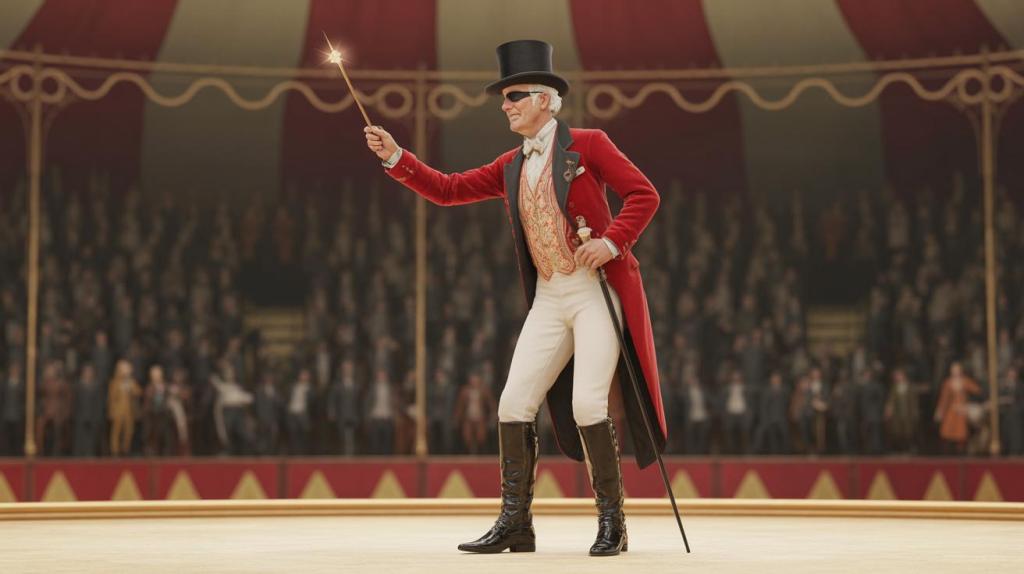
Jerome P. Robinette felt unwanted and irrelevant.
“I’m an anachronism,” the Pasadena, California resident complained to his wife, Betty, one early winter morning. “I was the best at what I did. Forty years with all the big ones—Barnum & Bailey, Ringling Brothers, Circus Vargas, and the others.”
“You certainly were,” Betty agreed.
“But nobody wants or cares about an old school circus ringmaster,” Jerome lamented. “The days of the grand circuses are long gone.”
Betty looked fondly at her husband. “You were magical as the leading man,” she marveled. “Dressed so smartly and always in command.”
Jerome, 68, closed his eyes. He was no longer as slim as he had been during his cherished ringmaster career. His once wavy jet-black hair had faded to a dull gray, and his face was starchy white.
“What I would give for another run as the king of the big top,” he said quietly. “Just one more center stage performance.”
“Something will turn up, dear,” insisted Betty, a petite, auburn-haired former flight attendant. “I just know it will.”
“I doubt it,” Jerome grumbled. “Today’s circuses are all about glitz and lasers. No animals and none of the classic acts. It will never be the same. I wouldn’t fit in.”
“You need to be ready should a new opportunity come along,” Betty suggested.
“I always am,” Jerome replied. “My red and gold jacket is cleaned and pressed, the black boots are polished, and the top hat is blocked and ready to wear. Just have to wait and see. Meanwhile, I think I’ll meet my circus pals in the park.”
“Okay, Jerome, but be positive. No one enjoys being around a sad clown or a whiny ringmaster.”
Jerome kissed Betty on the cheek and hurried the four blocks to Green Square Park. Several times a week, he joined a few other ex-circus performers to reminisce about their past glory. As he passed under the entrance archway, Jerome saw that his three former colleagues were already sitting at their favorite table.
“Hi gang,” he announced to Bobo, the incredible strongman; Marvin, the renowned sword swallower; and Beatrice, the exceptionally limber contortionist. “How are you all today?”
“Hello back at you, Jerome,” they yelled in unison.
For the next two hours, they retold familiar stories about past performances, griped that current circuses were “lifeless and predictable,” and shared their popcorn and peanuts snacks.
“Remember watching the enormous tents being set up?” Marvin said.
“And the wonderful crowds who came to watch,” added Beatrice.
“Don’t forget our superb performances and Jerome directing the whole damn thing,” Bobo exclaimed. “Those were some times.”
“If it wasn’t for the animal lovers who complained about how circuses mistreated the elephants and lions,” Marvin groused.
“Of course, the public’s changing tastes in entertainment didn’t help,” Jerome added.
They always concluded their discussions with a group hug.
“Until next time, my good friends,” Jerome said.
When he got home that afternoon, Betty was waiting expectantly. She handed Jerome an oversized manilla envelope.
“You’ll never guess what I have,” she prompted.
“I’d rather not have to speculate,” Jerome snapped.
Betty frowned and handed him the envelope. “Okay then, Mr. Impatience. Here you go. It must be exciting news.”
Jerome looked at it closely. “The return label says this is from ‘The Newest and Most Unusual Circus on Earth.’ What the hell does that mean?”
“It has to be something special. Hurry and open it.”
Jerome carefully unsealed the envelope and read the pale blue parchment.
“Dear Jerome Robinette. You’re cordially invited to interview for a special role with the Newest and Most Unusual Circus Ever, which will outperform and out-entertain all others. Please attend our interview and training session at 2 p.m. on November 20 at the Downtown Development Center. Yours Truly, Henry “Hank” Pepperidge, Proprietor & Empresario of the Newest Circus on Earth.”
Jerome folded the gilt-edged invitation and smiled. “What do you know about that?” he announced. “This could be the something I’ve been waiting for.”
“It is exciting,” agreed Betty. “Also, very mysterious.”
Jerome nodded. “Whatever the position, I must prepare my uniform.”
On the morning of his interview, Jerome arose earlier than usual, had breakfast, and dressed in his immaculate ringmaster outfit. He was nervous but also confident this would be a “glorious and turning point kind of day.” He posed proudly in front of the hallway mirror.
“Off I go,” he told Betty. “Better to be early on such a day. Wish me luck.”
“You won’t need it,” Betty said. “You are the master. They will absolutely love you.”
Jerone hurried to the Development Center, where he met Hank Pepperidge and the others. They asked Jerome about his previous experience, explained the new circus in great detail, and had him debut his basic Ringmaster routine. Three hours later, he was back home.
“How did it go?” Betty asked as he entered the front door.
“I am the ringmaster for this newest and most unusual circus on earth,” he said excitedly.
“Oh my gosh, that’s wonderful news. Just as I expected. Was it just as you imagined, dear?”
“Not hardly,” Jerome answered uncertainly. “Far away from what I thought it would be. Strange, indeed. I almost didn’t accept this role. I’ll explain it all to you, and then I must let Bobo, Marvin, and Beatrice know so they’ll support me at the opening performance.”
“Is it the traditional animals and trapeze type acts?” Betty persisted.
“No, it’s not. I will explain, and you must tell no one. I’m not sure I can pull it off.”
“Whatever you say, dear. But I know you can do anything.”
***
Jerome arrived at the Rose Bowl two hours prior to opening day of the Newest and Most Unusual Circus on Earth. He waited patiently for the first spectators to arrive. Soon, the stands were crowded, every seat was filled. Young ushers handed each guest a free bag of popcorn and a multi-colored blindfold as they entered the arena. Jerome could see Betty, along with Bobo, Beatrice, and Marvin.
I’ll need their help, Jerome thought as he stood nervously on the elevated platform.
At 3 p.m. the lights dimmed, the John Philip Sousa music started, and Jerone raised his baton. He was shaking.
“Ladies and gentlemen, welcome to the Newest and Most Unusual Circus on Earth,” he announced in his baritone voice. “You’re about to be amazed and thrilled beyond belief.”
The audience applauded and waited eagerly for the first act to appear.
“Attention everyone,” Jerome continued. “Before we begin, I want you to pull the blindfolds over your eyes. Trust me, you will soon understand.”
He watched as the surprised spectators held the handkerchiefs. Some did as instructed, while others hesitated.
“We can’t begin the circus until you are completely ready,” he reminded them.
Finally, all had their eyes covered, although some whispered and shook their heads in disbelief.
“Wonderful,” Jerome continued. “Now, I want you to imagine the biggest elephant you’ve ever seen. What do you see? Just shout out.”
“I don’t see no damn elephant,” shouted one portly man who had lowered his blindfold. He realized there were no animals, clowns, or other acts, only Ringmaster Robinette standing in the center ring.
“Please, sir, replace your blindfold and be patient,” Jerome advised. “Use your imagination and you will be enthralled.”
The music started up again, and Jerome raised his imaginary baton.
“We call this the circus of the imagination,” Jerome continued. “There’s been nothing like it before. Be willing to let your mind roam.”
“What’s going on here?” an exasperated woman cried out. “I bought a ticket for a real circus, not some old man talking crazy.”
Jerome was nervous, wondering if they would shout him off the stage.
“I can see an elephant stepping up on the stage and raising its trunk,” cried one supportive guest.
Jerome looked to the front row and saw it was Bobo. The grumbling subsided slightly as Jerome continued.
“Very good, sir,” he shouted.
“It’s amazing,” said a woman who Jerome recognized as Beatrice. “I can see the elephant walking through the jungle.”
Suddenly, more people described what they were watching.
“I see an elephant with two baby elephants walking down a narrow pathway.”
“My elephant is standing on two feet.”
“I’m watching two of them dance.”
“Such colorful outfits they’re wearing.”
“And their babies are following them around the arena.”
Jerome smiled, although no one noticed. He was becoming more confident about the rest of the show.
“This next act will be even more amazing,” Jerome exclaimed as the audience applauded. “Open your imagination and you’ll see Molly the prancing bear on our center platform.”
“What a wonderful-looking bear it is,” a young man agreed.
“And look at how he steps up and down the stairs,” another added.
“I’ve seen nothing like it before.”
“Much bigger than what you see at the zoo.”
Jerome led them through the full series of imaginative circus scenes: the trapeze artist, high-wire dancer, cannon shooting a man onto the net, the lions and tigers, and more. With each performance, the crowd became even more enthusiastic and offered louder applause.
“Ladies and gentlemen, you have been a wonderful audience today,” Jerome announced after the final act. “We hope you’ve enjoyed yourselves and that you will tell everyone about the Newest and Most Unusual Circus on Earth.”
They clapped and shouted “bravo,” “congratulations,” and “first-rate.” Jerome greeted his new fans as they walked out of the Rose Bowl arena.
“A marvelous show,” one exclaimed.
“Best circus ever,” another said.
“I had my doubts, but my hat is off to you,” added the man who had first complained.
Betty and Jerome’s old circus pals were the last to exit.
“You were terrific,” Betty complimented Jerome.
“I’m glad you clued us in ahead of time,” Bobo said. “We’re proud of you.”
“That was some sight,” Beatrice said.
“I couldn’t have done it without you,” Jerome said.
“During the show I could almost see us all out there together,” Marvin said. “Of course, we were all much younger.”
“There is still more to come,” Jerome advised them. “The owner wants me to continue, but with an even more unique show.”
“What could be stranger than what we’ve just seen?” Bobo wondered.
Jerome clapped his hands. “Apparently, they’re in the final stages of organizing a first-of-its kind traveling circus. One where the animals are in control.”
“Say what?” Beatrice asked.
“I know little yet,” Jerome said. “It seems they have a very intelligent bear that will be the master of ceremonies leading the human performers and I would be his guide. So, the bear will be directing the trapeze artist, the sword swallower, the human cannonball and other acts. I guess you and some of our old circus comrades could have new jobs.”
“What will they think of next?” Beatrice wondered.
“I’m sure they’ll have a few more oddball ideas,” Bobo laughed. “Boy, what fun we’ll have.”
“Happy days are here again,” Jerome promised his pals.
# # #
The Mysterious Oak Tree Message
David L. Robinson (2/12/25)
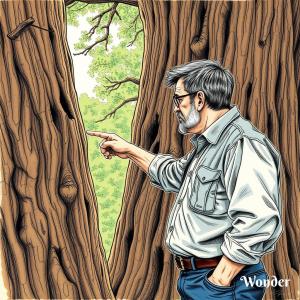
Charlie Prentice looked closely at the scarred oak tree in the center of Pasadena, California’s Pleasant Park. He was most interested in the hodgepodge of initials and dates that park visitors had carved into the bark.
The 45-year-old bespectacled, gray-haired defense attorney spent one or two days a week surveying the trees for new messages. He agreed with work colleagues and others that it was an odd hobby but one that helped him cope after his wife died. Charlie had become a well-known authority on tree messaging and had authored several articles on the subject.
Most carvings were declarations of young love or benign and fanciful boasts. Charlie added the newest ones to his Tree Messages Notebook: “Bill & Rose, a match made in Heaven, 3/8/24,” “John and Paul, Happy at Last, 2/7/24,” “Johnny B, Living Large,” 5/16/23,” and “I’ll be rich by age 30, SMH, 1/2/24.” As he walked slowly around the weathered oak tree, Charlie noticed a more mysterious inscription he had missed on his previous visits: “I didn’t mean to do it. I’m so sorry. Please help. Larry J. Grove, 3/20/23”
That is the most interesting carving I’ve ever seen, Charlie thought. I wonder what it means. And if the writer was really serious, why would he add his last name?
Ordinarily, Charlie’s main focus was collecting the tree messages for his notebook. He had no interest in learning about the authors. But he was intrigued about this distinctive notice and thought it deserved extra attention. So, when he got home that afternoon, Charlie searched the Internet and learned that there were five Larry Groves in the Pasadena area, one of whom had the correct middle initial. A further check showed that two others had died.
I wonder what the back story is. Probably best to leave it alone—it’s none of my business. On the other hand, it would be fun to follow up and see.
Charlie leaned back on his recliner. Not typically inclined to intrude in someone else’s personal affairs, he was uncertain whether to proceed.
“What the hell,” he finally said. “Why not?”
Charlie reached for his phone and pressed the numbers.
*****
“Hello
“Is this Lawrence or Larry J. Grove?”
“Who’s asking?”
“My name is Charlie Prentice. I live here in Pasadena and thought you might have been someone I went to high school with.”
“So what? No longer interested in high school connections.”
“I actually called on the off chance that you might be the same Larry Grove who wrote his initials on an oak tree in Pleasant Park. There was also a message: ‘I didn’t mean to do it. I’m sorry.’”
“You got the wrong guy. I think there was a Grove who lived here before me. Anyway, I’m not the tree message type. And even if I knew what you’re talking about—which I don’t—what business is it of yours? Also seems like reading trees and calling people is a strange way to spend your time.”
“It probably isn’t any of my business, and I’ve never called a tree author. But from my experience, most people who carve their initials on a tree are expressing their love for someone else or to mark another type of milestone. The one I just mentioned was more confessional. Whoever did write it seemed contrite, wanting to unload his guilt for something.”
“So, you’re some type of psychologist?”
“No. But I’ve read a lot about what prompts people to carve tree messages. It seems that whoever wrote this one was trying to share so that he could forget about a specific situation.”
“All very interesting, but you’ve got the wrong guy. Besides, I don’t get out much anymore because I’m in a wheelchair.”
“Okay then. Sorry to bother you. Have a wonderful day.”
“Hold on.”
“What?”
“Let’s suppose, on a strictly hypothetical basis, that this person you’re discussing did something many years ago that he is ashamed of and has been nagging at him ever since. What good would it do to blab about this now? Just asking because I’m curious about the idea of people carving initials on trees.”
“Good question. I suppose it all depends on the writer. Hypothetically speaking, sometimes just opening up to another person could make a difference.”
“Could that person still get in trouble?”
“As an attorney, I’d say that in the strict sense, it’s a matter of what occurred. For example, let’s say it was a minor shoplifting situation when the person was young. I would think at this point there’s nothing to worry about.”
“What if it was way more serious?”
“Perhaps this hypothetical person would still want to confess. He could talk to an attorney.”
“I see. Let’s assume that this imaginary Grove person didn’t necessarily carve the hypothetical message.”
“That’s the name and number I saw on the tree. But sure, it is possible someone else wrote the message, like the person who previously lived in your house.”
“I’m just spit-balling now, but perhaps there was a Larry Grove Senior, and it was his son who was the main culprit? Of course, this is all conjecture.”
“Then maybe the father was less guilty and might not have to worry.”
“The hypothetical son could have written the message. You would think the asshole would have gotten over his guilt.”
“That is definitely a complicated situation. It could be that the hypothetical father would like to correct the problem.”
“I doubt it. I would imagine the crazy father is too old to have such second thoughts. Probably had no desire to go to jail or prison.”
“I have a suggestion.”
“I have a better one for you.”
“What’s that?”
“Forget the whole thing. The bottom line is you called the wrong person, and I’ve just been playing with you. I really don’t know anything about the tree carving. Don’t have a son. Never been to that park. I’ve been bored lately and thought it would be fun to string you along. I think I’ve succeeded.”
“Hypothetically speaking?”
“No. Realistically speaking.”
“Well, this has been a strange conversation. Sorry to have bothered you.”
“No bother. It has been interesting to talk with you. And good luck with whatever it is you’re doing.”
*****
On his next trip to Pleasant Park, Charlie cataloged a new batch of tree initials and notes on his way to the oak tree.
“Let’s see if there are any new carvings on my favorite oak,” he whispered.
Charlie approached the tree and abruptly stopped. He saw that the confessional message was missing. Someone had stripped off a large section of the bark.
“What the hell,” he mumbled.
“What’s that?” said an elderly woman seated on a nearby bench.
“Nothing,” Charlie replied.
Charlie quickly left the park and returned home. He sat quietly at the kitchen table and reviewed his notebook.
It makes no sense, he thought. I should just let it go. But I’m still curious. I have to call the hypothetical imposter again. I’m sure he doesn’t know anything more. I just want to let him know what I saw.
Charlie tapped the keypad and waited.
“The number you are calling is no longer in service. It has been permanently disconnected.”
Charlie smiled. “The fake father must have been involved in that crime, whatever it was,” he said eagerly. “It looks like I wasn’t barking up the wrong tree after all.”
*****
Halloween Street Happenings (10/18/24)

The neighbors on this block celebrate differently than the rest of us.
Story copyright by David Robinson, 2024
By David L. Robinson
The residents of Halloween Street in Pasadena, California celebrated the traditional holidays, but All Hallows’ Eve was the centerpiece—the main attraction.
Because of their distinctive street name, the Halloween Street denizens felt obligated to “go big or bigger or face the consequences.” A few people living along the unusually long and winding cul-de-sac engaged in the traditional trick-or-treating or hosted “safe night” events. But the majority favored unique and out-of-the-box (pumpkin) activities, and eagerly anticipated October 31.
Senior Tricksters—At approximately 7 p.m., Todd Barnett and his wife Sally, along with Pete and Alexis Conklin, Richard and Kathy Stevens, and Jason Graff met at the corner of Halloween Street and Linda Vista Avenue to begin their annual “ H-shenanigans.” All wore colorful capes and stylish Mardi Gras eye masks.
“Once again, the Over 60 Halloweeny Brigade is ready to carry out some major tricks,” Todd announced.
“We’ve been looking forward to this for months,” Alexis said.
“Our action plan is much more ambitious and exciting than last year,” agreed Jason.
The senior tricksters crept through adjacent streets for the next two hours to “perform” their juvenile and increasingly unfriendly pranks. They switched “Vote Trump” signs with the “I’m For Harris” flags on lawns and walkways, sprayed shaving cream on windows, placed bags of chicken livers on front door mats, planted a “for sale” sign on one house, and tossed red dye packs in backyard swimming pools. They knew their masks afforded them sufficient protection from outdoor cameras. Plus, they were emboldened by their previous unchallenged spooking.
“I feel like a kid again,” said Sally as they snuck quietly along their four-block route.
“Me too,” laughed Richard.
“The best thing is that these people have no idea that the tricks were planned and executed by a group of daring, creative seniors,” said Kathy.
“Nor will they ever know,” added Jason.
When they had finished pranking the last house, the weary group hiked back to Halloween Street. Approaching their own homes, the friends were startled to see what had occurred in their absence. Sneaky intruders had invaded the neighborhood and plastered their four front doors with a messy collage of newspaper shreds, fabric pieces, feathers, and thick tape. The unwelcome guests also had posted large hand-lettered signs: “Next year, think twice before messing with other houses. Act like adults.”
“What the hell?” Richard shouted. “Who would have done this?”
“Maybe someone snitched on us, but I’m not sure who it could be,” suggested Alexis. “We will have to be more careful next year.”
“Perhaps our Halloweeny Brigade reputations have exceeded us,” added Kathy.
“You mean preceded us,” corrected Todd.
“Whatever,” Kathy answered. “The point is they were aware of our previous year’s escapades and were on the lookout. Hold on. There’s an added note on our sign. It says, ‘We knew it was you all because one of your friendly neighbors spilled the beans. They said you might be headed our way.'”
“Well, that puts a damper on the night’s celebration,” Pete exclaimed.
The Imagination Haunted House—Peggy Smith and Will Monroe, both 15, left their Halloween Street houses at 7:30 p.m. to visit the two-story Truly Haunted Place at the top of the block. Peggy was dressed as a Barbie lookalike, and Will wore a gruesome-looking clown mask and an oversized trench coat. The pair hadn’t told their parents where they were going. The rundown house had been vacant for several years, except during Halloween week. That’s when three unknown conspirators created the haunted walk.
When Peggy and Will arrived, a long line of other young masqueraders was waiting to enter. After about 20 minutes, Barbie and Clown Face reached the front door, where a gangly ghost blindfolded them.
“Why are we blindfolded?” Will asked. “We won’t be able to see the scary scenes.”
“This haunted house is different than others you might have been to,” the ghost said in a growly voice. “It’s all about the sounds. I guarantee you will be frightened. A guide will be next to you during your trip, so don’t try to remove the blindfold.”
He led them down a short stairway to begin the unusual hike.
“Walk slowly and enjoy yourselves. You’re in for a real treat.”
Will held on to Peggy’s hand, and they began the journey.
“This is very strange,” Peggy whispered. “Not what I expected.”
“It was your idea,” Will said. “It seems like we’re in the basement.”
“We might as well enjoy the weird experience,” Peggy said.
As they moved slowly along the damp, musky-smelling walkway, Will and Peggy heard the screams, shrieks, and “help me” cries. The frantic sounds were so realistic that it seemed as if the haunted house performers were standing next to them. Peggy shuddered as the plaintive moans grew louder. They occasionally felt a light mist cover their faces.
Twenty minutes later, someone stopped them. “You’ve come to the end,” a young woman shouted. “Remove your blindfolds and carefully climb up the steps.”
Peggy and Will uncovered their eyes and saw they were at the bottom of a rickety stairway.
“That was certainly odd,” Peggy said.
“I’ll say,” Will agreed. “Let’s get out of here.”
Peggy and Will climbed to the top of the stairs and pushed through the slightly open door. They rubbed their eyes and looked up at the half-moon night.
“We’re outside again, but it’s not the same place,” Will said uncertainly. “Looks like we are in a different neighborhood.”
Peggy shook her head. “Like we walked along an underground tunnel beneath the house and then to a different block?” she asked.
“I guess so. Look over there.”
Will pointed to a small table next to a nearby streetlight. There was an array of old paper bags and a sign that advised “Take just one each. We’ll be watching.”
“No treats for me,” Will said.
“This is crazy,” Peggy answered. “I’m ready for home.”
They ignored the table of candy bags and walked silently back to Halloween Street.
The Frightened Caller—Steven Freeling wasn’t a joiner, so he liked celebrating Halloween alone. While the senior pranksters walked past his house, Steven sat in his worn recliner. He sipped from a tall wine glass and smoked a cigar, ready to begin making his usual “fright calls.” His surprised audience ranged from laughing teenagers to elderly shut-ins, most of whom enjoyed the mildly scary stories.
Steven dialed random telephone numbers and read from a carefully prepared script. On his fifth call, he connected with a reluctant participant.
“Hello there,” he said in his raspy voice. “This is the Halloween howler with a most frightening story, certain to alarm and make your skin crawl.”
“I’m not scared.”
“But you will be as soon as you hear about the story of the hidden bodies.”
“I love to hear about bodies, especially if they’ve been mutilated.”
“Well then, you will appreciate the story of the Franklin twins, Janet and Barbara. It all started on the night of October 31, 2023. That’s when the twins were home alone. Their parents were unaware that a mysterious stranger had been wandering the nearby neighborhoods on Halloween in search of children he could kidnap and take to a mountain cabin. Otherwise, they wouldn’t have left their kids alone. At about 9:30 p.m., the bearded man snuck in a basement window and waited for the two girls to fall asleep.”
“What about the mutilations?”
“I’m getting to that.”
“Oh, I’m terrified.”
“You will be when you learn what happened.”
“I doubt it.”
“Be patient. It’s worth the wait. As I was saying, it was about 10 p.m. when the intruder started upstairs…”
“Time is up.”
“What do you mean?”
“I’m going to interrupt this boring tale to advise that you’ve been a stupid asshole who has called the wrong person.”
“I’m at the best part of the story, so I must continue.”
“I’ll finish for you. While you’ve been yapping about a jerk story, I’ve used a special phone app to record your voice that will help gain access to some of your financial information…”
“Wait a minute. I’m just providing a harmless, entertaining story. There’s no need to be so angry.”
“It’s just your luck that you called me. Anyway, the initial info I just got is a start on my way to grab your social security number and a few other essentials. Plus, I’ve got your address at 625 Halloween Street, which will give me some additional leverage. I could share more, but it’s best to keep you in the dark if you get my meaning. I know where you live, but you don’t know my location. Don’t report this, or a real Halloween ghoul will visit you. Now who is frightened? Goodbye, Halloween howler.”
Decorations Overload—Jack and Norma Crenshaw were known for their elaborate Halloween decorations. The empty-nester couple and their adult children usually began designing and arranging the ostentatious yard displays in late September. Then, on the morning of October 31, they added the deluxe additions. Some say they went too far this year.
Several people stopped by early to watch them set up, but Jack waved them away. “Come back tonight to see the big surprise,” he shouted.
“What is it?” a snoopy passerby queried.
“It wouldn’t be a surprise, then, would it?” Jack replied impatiently.
Finally, at 6:30 p.m., Jack turned on the floodlights to illuminate the various scenes arranged throughout the large lawn and garden areas. There was a trio of spindly skeletons hanging from a twisted oak tree, a menacing witch stirring a cauldron of steaming dry ice vapors, an eight-foot Dracula holding a bloody cross, and several other frightful night creations. Emily Johnson, 10, was the first to notice the newest and strangest exhibit. She walked close to get a look at the large wooden casket and then screamed.
“Oh my gosh, there’s a dead body in that,” Emily cried.
It didn’t take long for a crowd to gather around the casket. The curious onlookers stared at a very lifelike body of an older, white-haired woman with bright red lipstick. Emily’s father poked the woman’s arm and then touched her face.
“It’s a real person,” he exclaimed. “She’s dead.”
“She looks somewhat familiar,” Emily’s older sister announced. “I think it’s Jack Crenshaw’s mother.”
“Someone call the police,” another bystander suggested.
By now, a large crowd had gathered, and within ten minutes, a police car arrived. Hearing the commotion, the Crenshaws came outside.
“This is a real dead body,” the police sergeant said loudly.
“Yes, it’s my dear mother,” Jack explained. “She always loved our Halloween displays. She’s been quite ill for some time, so we brought her home from the hospital. Mom said she wanted to be included in this year’s decorations, and as witnessed by her doctor yesterday, she signed a waiver form allowing us to do it. Then she died last night. We’re just fulfilling her wishes.”
The wary policeman shook his head and said, “Of course, we’ll check it out, but even if it was completely legal, why would you do this? It’s just embarrassing to her and distressing for everyone out here.”
“No one loved a good joke more than Mom,” Jack said. “She would so enjoy this spectacle.”
“Whatever you say,” the policeman answered. “But I suggest that we help you relocate the casket so that we don’t have an even greater crowd complaining that you may have gone too far.”
“Okay, if you insist,” Jack grumbled. “We’ll take Mom back inside and get her ready for the funeral home director, who has been on standby tonight.”
Bonfire Updates—At 9 p.m., many Halloween Street residents gathered for a bonfire celebration to rehash the evening’s activities. The Halloweeny Brigade recounted their tricks and wondered who was responsible for defacing their houses. Peggy and Will explained how strange their haunted house trip was. A nervous Steven Freeling asked for advice on how to deal with the threat he had received. The Crenshaws complained that “police and neighborly interference” had ruined their “best ever” display.
“All in all, it’s been quite a Halloween,” said Todd. “One for the books.”
“If we start planning tomorrow, I bet next year will be even more extravagant,” added Richard.
“Remember our motto,” Jack prompted.
“Go big or bigger or face the consequences,” everyone shouted.
Then they doused the fire and returned to their houses. No one had noticed the sallow-faced, bearded man observing them from an upstairs window in the nearby duplex. Bob Parker was a newcomer to Halloween Street, having recently rented a room in the Loomis place. He was also the recipient of Steven Freeling’s final fright call.
Bob made a few notes in his Dastardly Days Journal and smiled. “This should be an interesting place to live for a while,” he said quietly. “I wonder what they do on Thanksgiving. I’m sure we’ll all think of something mutually entertaining. I’ll be ready.”
# # #
Hook, Line & Sinker (9/21/24)

Fishing lessons often include much more than casting techniques.
Story copyright by David L. Robinson, 2024
By David Robinson
John Robins looked down at the Big River Stream flowing into Windy Lake. There was a slight breeze, making it ideal for an outing with his oldest son.
This was the last “Wild Ass Fishing Festival” John and his son, Gary, would attend. They had participated in the annual fishing contest-storytelling event several times, but after the previous year’s boisterous gathering, decided once more was enough.
“Are you about ready?” asked John, a tall, broad-shouldered 46-year-old with short brown hair and hazel eyes.
“Just checking my tackle box to make sure I’ve got everything,” said Gary, 18. He has curly blond hair and blue eyes and is about the same height as his father.
John glanced at his son. “We didn’t have to do this again,” he said. “Who knows what kind of trouble there will be this time? It’s no surprise that a fishing festival organized by a weekend motorcycle group would be somewhat rowdy. If it hadn’t been for your Uncle Pete, we probably wouldn’t have signed up the first time.”
Gary nodded. “I know, pop, but this could be the last time we’ll fish together for a while. Besides, perhaps we’ll even have a chance to win a prize this year.”
“I doubt it. Remember, some of the others don’t fish by the same rules.”
“That’s true,” Gary said.” But remember the entertaining side shows we have witnessed. Also, before we start, I’ve been meaning to tell you something.”
“What’s that?” John asked.
Gary hesitated, then shook his head. “On second thought, it can wait until later.”
“We have time,” John said. “What’s on your mind.”
“Lots of things, but right now, I think we should get to the fish that are waiting for us.”
John nodded uncertainly. What’s he thinking? He has been quieter lately. Something is bothering him.
“Okay then. Let’s go.”
As the father and son team walked down the winding trail to the edge of Big River Stream, they saw several hopeful anglers who had arrived even earlier than usual. Some were bunched up, crowding each other along the stream, while others had found more open spots to fish. Many were drinking beer or other strong beverages from large paper cups.
“You can see a few of them next to the fish stocking truck,” Gary said. “And look at that one tossing in some worms. He’s forgetting that such chumming isn’t allowed in the contest. Another guy is fishing with two rods, which is an obvious infraction.”
“Same as always,” John said. “You know what your grandfather Gilbert would say.”
“Of course,” Gary answered. “I can hear him now. ‘Give the damn fish a chance to get acclimated. And remember, it’s not about the catch, but rather to enjoy the experience.”
They both laughed.
“Let’s wander upstream to find a less crowded place,” John suggested.
Walking past several overzealous anglers, John and Gary smiled at their incessant bantering.
“This is my usual place,” one of the anglers grumbled.
“There are no reserved spaces at this contest,” another one snapped.
“Let the bickering begin,” Gary said as they walked around the arguing fishermen.
“What did you say?” the first grumbler asked.
“Just wishing you luck,” Gary replied.
Then, they heard the loud cries from two others who had fallen into the stream.
“You pushed me!” one of them shouted.
“Did not!” the other insisted.
Several of their friends helped the floundering men back to shore. John and Gary continued hiking along the dirt path until they reached a sandy patch just past a stand of quaking aspen trees.
“Let’s try here for a while,” John said. “I think we are far enough away from most of the others.”
John sat in front of a fallen oak log next to a large boulder. Gary surveyed the peaceful scene. “I’ll miss these days,” he said wistfully.
“As will I,” John agreed. “But there will be other trips.”
“Won’t be quite the same if I’m not around.”
“I know.”
They fished in silence for half an hour, listening to the rushing water and chirping blue jays. John leaned back and closed his eyes.
“Keep checking my pole, just in case I nod off,” John said. “Meanwhile, did you want to talk about something now?”
“A bit later, dad. I’m still thinking about it. But no worries, I’ll watch your rod.”
Gary cast out a couple of different lures but had no strikes, so he switched to bait. An hour later, he saw that his father was asleep.
I’ve got to work this out, Gary thought. I can’t prolong the indecision. It’s too important. He moved slowly downstream, trying to ignore the loud voices of the other contestants.
Soon after Gary left, John felt the tug on the fishing rod and opened his eyes. “Got something!” he said loudly. “I thought you were going to watch out for me.” But Gary wasn’t there. John reeled in the undersized rainbow trout, gently removed the hook, and placed the fish back into the stream.
Where did Gary go? I hate it when he wanders away. John gathered his fishing bag and stringer and began looking for his son. He walked quickly past a clearing where several other anglers had gathered but didn’t see Gary. John turned to the other direction and continued his search. He followed the narrow trail through a rocky area and around two fallen logs. Then John finally saw Gary, who was proudly holding a stringer of mid-sized trout.
“How long have you been here?” John asked. “I was worried.”
“About what?”
“That one of the drunk fishermen might start an argument or bump into you. You usually don’t wander off by yourself on our trips.”
“It’s all good,” Gary said. “I thought I’d try my luck and master the art of being patient, which I’m not known for. I also did some more thinking along the way. Anyway, you looked so content back there.”
“I had a sleepy streak and actually dreamed I was about your age fishing with your grandfather.”
“That sounds interesting. In addition to this stringer of keepers, I caught two guys cheating.”
“How?”
“The first one, who is wearing a red vest and straw hat, had just left the trout farm where people pay to catch huge fish,” Gary explained. “He had a hefty rainbow on his stringer. He’s obviously going to claim that it came from the stream.”
“You’re kidding?”
“Nope. Then, soon after, I watched his partner insert some sinker weight into one of his trout.”
“Unbelievable.”
“But I took a few photos with my phone so we can share the news with the judges.”
“The cheaters may not even be part of the contest,” John said.
“We’ll see. We should head back to the judging table. Who knows, with our combined catch, we might even get a prize.”
As they walked toward the judges’ stage, Gary pointed toward the line-up of expectant fishermen. There were loud boasts, such as “You don’t have much of a chance with those puny fish,” “Mine outweigh yours by several pounds,” and “No trophies for you amateurs.”
“I knew it,” Gary said. “The two guys I watched are waiting to have their trout measured and weighed. We need to let the judges know they cheated.”
“Leave it be,” John advised. “As your grandfather would say: ‘When you flout the rules, be prepared for fish karma.’”
“Okay,” Gary conceded. “I’m going to put our stuff in the car, and you can stand in line.”
When Gary returned, he saw that his father was getting their fish checked. The lead judge then suddenly announced, “I have a brief update. Two of our regular contestants have decided to withdraw as a protest to our strict judging rules. Sorry to hear that, but we’ll keep weighing and measuring for the rest of you.”
“Any idea why they might have quit?” Gary asked.
John shrugged his shoulders slightly. “I might have said something in passing to the strange fellows who might have worried their reputations would be tarnished. You were right; we may get a trophy after all. Meanwhile, what was it that you wanted to tell me earlier?”
Gary leaned against the nearby fence railing. “I was going to tell you on the drive home. I heard you and Mom arguing last night, and I know you’ve both thought about separating.”
John waved his right hand. “Hold on, Gary. We….”
“Let me finish,” Gary insisted. “I originally planned to say that I had been thinking about going to community college for my first semester or a year so I could be around to help or…”
“We haven’t made any decisions. Anyway, what could you do?”
“You’re right,” Gary continued. “As I wandered away to fish alone and clear my head, I remembered one of the fishing lessons Grandpa Gilbert and you often shared.”
“What was that?” John asked.
Gary pointed in the direction of Windy Lake. “The gist of it is ‘Be responsible for your own fishing experience,’” he said. “Do everything you can to enjoy the adventure. Always remember the three P’s: Be prepared, patient, and profoundly appreciative of the outdoors. Don’t blame others, the weather, the bait, or whatever else if you don’t catch anything because then you would have missed the point. At the end of the day, it’s all about the company you keep, the conversations and laughter you share, and the enjoyment of our beautiful surroundings.”
John gave Gary the two thumbs up sign of approval. “I’m with you so far. Now finish connecting the dots to our situation.”
“I applied that lesson to our family and my future,” Gary added. “I realized there’s not much I can do to help the two of you work things out. In my own way, I’ve done everything I can during the last two years to prepare and be patient. I’ve stayed positive, kept my grades up, tried to be a good big brother, and been extra helpful whenever possible. I’m trying to be responsible for my next chapter, which I’ve finally decided means heading off to the university in a few weeks. Instead of a memorable fishing experience, I’m about to start an exciting college adventure.”
John clapped his hands. “You’ve made the right decision,” he said. “Your mom and I are still trying. You don’t need to defer your future to help us find ours.” He patted Gary on the back and added, “It’s amazing the insights you can develop while fishing.”
Gary nodded. “That’s what you’ve always said. Now, if I’m not mistaken, I just heard our names called as the third-place winners.”
“The perfect way to end our day here,” John added. “Your grandfather would be proud.”
####
Nighttime at the Majestic Taxidermy Emporium
Where “things” aren’t always as they seem.
Copyright 2024 By David L. Robinson
Welcoming Walt
On Walt Smiley’s first day at Toledo’s Majestic Taxidermy Emporium, officer manager Toby McCurdy handed him an apron and a worn copy of the company handbook.
“Welcome, Walt,” Toby said. “It’s nice to have you on the team. I’ll show you around.”
On his brief introductory tour, Walt saw the three large rooms labeled “Fishes & More,” “Special Companions,” and “Odds & Ends.”
“Don’t go in the workrooms unless Mr. Pender invites you,” Toby stressed.
“I hear you,” Walt responded enthusiastically.
Mort Pender had hired Walt as an assistant and potential taxidermy apprentice. Walt, short and stocky with close-cropped brown hair and pale blue eyes, was happy to start what he hoped would be a long-term career. He considered himself a team player and initially planned to follow the Emporium’s guidelines. After all, Pender was well known as Toledo’s premier taxidermist and eccentric philanthropist. He replicated lifelike models of anglers’ prize catches, preserved hunting trophies, and offered other more “discreet” services.
“What’s in the last room?” Walt asked Toby, currently the Emporium’s only other full-time employee.
“Can’t tell you,” Toby answered. “It’s up to Mr. P. to say when the time is right.” Toby is wiry and thin, with a white goatee and several ornate tattoos on his right forearm.
“What’s Mr. Pender like?” Walt asked Toby.
“You haven’t met him?”
“No, I haven’t. He sent me the job offer in a letter.”
“Of course,” Toby said. “That is his normal routine. Anyway, Mr. Pender isn’t exactly tall, thin, or fat. He’s kind of in-between. I guess you’d say he’s average-looking. Mr. P is an all-around good guy. He works during the day doing the taxidermy work and meeting with clients. And you’ll miss seeing him most days because you’re on the night shift. But I’m sure you’ll meet our boss eventually.”
During his first two months at the Emporium, Walt was busy cleaning the small lobby, hallways, and storage areas. As Toby had directed, he stayed away from the three workrooms.
But Walt was undeniably curious.
Fishes & More
Walt had been working at the Emporium for four months before he got the nerve even to consider entering one of the rooms. He carefully evaluated the pros and cons of “looking around a bit.”
It was just after midnight on a warm July evening. As usual, Walt was all alone. He carefully opened the door to the Fishes & More room. The blinds were tightly closed, so it was very dark. Walt flipped the light switch and saw that various fish species surrounded him.
“Goodness,” Walt said quietly. “Would you look at this?”
He walked slowly around the room to survey the taxidermy specialties. There were two very large marlins, several yellowtail fish, a thresher shark, and a giant sea bass mounted on the wall. Other fishes were kept in huge glass display cases. Walt also counted eight preserved animal heads. Most of the creatures had tags with the owners’ names and pick-up dates. He also saw a long steel sink with various tools, solutions, and other taxidermy supplies.
“I guess this is about what I expected,” Walt whispered. He then turned off the light, closed the door, and continued his nighttime duties.
As Walt arrived for work the following evening, he saw Toby exit the building.
“I went into the fish room last night,” Walt admitted nervously as Toby opened his car door. “I was so curious. It’s fascinating. Never seen so many fishes and other creatures.”
Toby looked at him with a puzzled expression and shook his head. “You shouldn’t have done that,” he admonished. “I’ve told you several times to stay out of the workplaces. Strictly off limits. No ifs, ands, or buts about it.”
Walt nodded sheepishly. “I got carried away. I’ll be careful from now on.”
“No harm done so far,” Toby said. “But keep out of the other rooms. If and when he’s ready, Mr. Pender will give you the lowdown.”
“I got it.”
Special Companions
A few weeks after visiting the fishes, Walt began pondering about the Companions room. What the hell is in there, he wondered. Do people actually have their pets stuffed? It’s kind of eerie if you ask me. I can’t imagine having my Buster dog made into a statue. Maybe it’s something else altogether.
But Walt didn’t want to irritate Toby, so he just continued doing his job—dusting and cleaning, straightening up, and organizing the reception/showroom area. Of course, he still hoped to meet Mr. Pender.
However, Walt’s curiosity occasionally exceeded his common sense. Such was the case on the evening of August 20. He was polishing the door knobs when he approached the Pets room. He stopped and leaned against the doorway. I think what Toby really meant was to stay away from the last room, Walt reasoned. He didn’t seem so concerned about the pet place. A sneak peek shouldn’t hurt. But the door is most likely locked.
Yet, the door wasn’t secured, and Walt slowly entered the room. When he turned the lights on, he saw a menagerie of domesticated animals. There were cats and dogs, a large parrot, an overweight rabbit, a coiled snake, and a blue-gray colored tortoise. Some were lined up along wooden shelves, and others posed on top of marble pedestals. A few had notes attached: “Owner wants a smile,” “Make it look like he’s barking,” and “Don’t forget the bow tie.”
“It’s hard to imagine that many people have their pets stuffed for display,” he said softly. “Well, to each his own.”
Walt turned off the light and hastily exited the pet room.
Two days after the pet room visit, Walt mentioned his “lapse of judgment” to Toby.
“I took a quick look in the Companions room,” he said. “I wasn’t there very long.”
Toby scowled. “I’m disappointed you didn’t listen to my advice,” he said solemnly. “Suppose I’ll get over it. But remember what they say: ‘curiosity killed the cat.’ The pun was intended. Here’s another appropriate one: ‘Don’t look a gift horse in the mouth.’”
Walt frowned. “I’m not sure what that means here,” he said.
“It’s very simple,” Toby explained. “I won’t say a word to Mr. Pender about your visits to the first two rooms. That’s the gift. But don’t take my generosity for granted. That would be ignoring my gift. Don’t—I repeat, don’t—intrude in the third room.”
“I won’t,” Walt said contritely.
The Last Room
After six months on the job, Walt found a letter in his Emporium locker announcing that he was promoted to Taxidermy Apprentice, Level One.
“Kind of odd that Mr. Pender doesn’t tell me in person,” he said to Toby, who was leaving the Emporium.
“That’s just the way he likes it,” Toby explained.
“I understand,” Walt said. “I just thought it was a bit strange. But I’m happy nonetheless.”
Walt had heeded Toby’s advice about not entering the last room. He kept busy cleaning, polishing, and organizing. In addition, his new Apprentice Level 1 responsibilities included taking inventory, filing, and ordering supplies. He didn’t want to jeopardize the trust Mr. Pender accorded him. So, he kept his distance from the Odds & Ends room.
But his recent promotion had emboldened him. He walked throughout the building with a new confidence, a swagger that would have been obvious if there were any other employees to notice.
“I think I’ve found a real career,” he said to himself one evening, “Next step is working side-by-side with Mr. Pender.”
Walt later admitted that he had gradually become overconfident in his role at the Emporium. Anyway, at 11 p.m. the evening before Thanksgiving, he was walking down the long corridor when he noticed the light under the Odds & Ends door. It’s not good to have the lights on all night, he thought. I’d be doing my duty to turn them off. While there, what would it hurt if I took a quick look around? Probably just bigger fish and pets. Maybe a horse or two. This time, I won’t say anything to Toby.
He nudged the door, and it creaked open. As he entered, Walt was dumbfounded and stupefied. His eyes widened at the sight of five people sitting in chairs around a table. There was an old man and woman, a younger man, a teenager, and a toddler. He could see a few other lifelike figures leaning against the wall. He couldn’t tell if they were imitations or actually stuffed people. Walt was frightened.
“Stuffed people,” he mumbled. “Oh my gosh. I didn’t imagine this.”
Walt quickly backed up and bumped into Toby, who had just entered the room. He grabbed Walt’s left arm.
“You weren’t supposed to be in here,” Toby exclaimed loudly.
“Yes…but…I,” Walt stammered. “But I don’t get why they are in here. It’s like a wax museum but for average, everyday people.”
“People have three choices when they die,” Toby said impatiently. “They can be buried underground, cremated, or be on display to comfort their friends or relatives. But please don’t change the subject. You broke the Emporium’s most important rule.”
“I just came in to turn off the lights.”
“You don’t expect me to believe that. You could be fired.”
“Mr. Pender would have to do that.”
Toby smiled and nodded. “That’s right. But have you ever seen Mr. Pender?”
“No, but…”
“Perhaps there’s a reason for that. Do you get my drift?”
Walt was uncertain about what Toby was suggesting. He sometimes missed subtle clues.
“You don’t mean?” he whispered.
“Yes, Toby McCurdy is just a pseudonym,” he said. “I am the mysterious Mr. Pender. But let’s get back to my original point. I could fire you.”
Walt looked down. He hadn’t expected this.
“If you are him, I’d rather you didn’t fire me,” Walt said meekly. “I really like and need this job.”
“Well then, it seems you have a choice. Door number one—so to speak—is that you no longer have a job.”
“That’s not good,” Walt replied.
Toby/Mr. Pender took a small notebook from his top pocket. He scribbled a few notes and handed the folded paper to Walt.
“Door #2 is here,” he informed Walt. “Read it after you get home. Make your choice and meet me here tomorrow at 10 a.m.”
Walt hurried home and sat in his worn recliner. He read the note and dropped the paper. “Some choice,” he moaned. “Damned if I do and double damned if I don’t.” Walt finally decided but slept fitfully that night.
Walt’s Choice
When Walt arrived at the Emporium the following morning, he saw Toby/Mr. Pender in the lobby. As he entered the front door, the master taxidermist smiled.
“Well, Walt, what’s it to be?”
“I’ll take the second door,” he said apprehensively.
“A wise choice. Follow me.”
Pender led Toby down the corridor, into the Odds & Ends room, and behind an enclosed alcove. Pender pointed to an oversized barber chair.
“The first thing is to remove all your clothes except your briefs. Then sit in the chair.”
Walt disrobed and climbed onto the chair. He was nervous and perspiring profusely.
“The note said that I would be a model. What if I don’t want to be on display?”
“You had a choice. Now sit still.”
Pender proceeded to brush a thick rubbery substance over Walt’s arms, legs, and torso.
“This won’t take long at all, and then we’ll work on your head and face,” Pender said. “It’s all quite easy. Once we have the master cast, I can make copies.”
“Then what?”
“We’ll sell your dummy to scare houses, carnivals, and even to some wealthy individuals. They’re always looking for new characters. You’ll be famous.”
“And still have my job as an apprentice?”
“Oh, you have a long career ahead of you,” Pender said excitedly. “More unusual experiences await you.”
“Is that a good thing?” Walt wondered.
“It is what it is, my good friend. Stay tuned.”
###
The Band Camp Mystery
*Sam Baker’s Journal (Diaries are for girls)
Transcribed by David L. Robinson

(Story copyright by David L. Robinson, 2024)
Saturday
I hope Band Camp isn’t a mistake. Mom and Dad thought it would be a good idea, to help me be more confident. Not sure about that, but we’ll see. Dad said something like “Do your best, have fun, and if you make a couple of new friends, it’s a bonus.” Shawn didn’t really care…he was just happy to be left alone while I was away.
It’s a very hot summer day and it was a two-hour bus ride to the camp. During the trip, the incoming 7th graders (me) had to introduce ourselves to the others. Some fun that was.
They assigned us to the tent-like cabins based on age and sex. Obviously, they didn’t want to mix the boys and girls. I’m in one of the two 7th grade tent, as is John, Hank, and couple of other bandmate friends. Our tent counselor is Gordon Baxter, a 9th grader who seems nice enough, but also a bit bossy so far.
Lunch was okay……. if you like chipped beef on toast (like I’m sure). Several of us scraped off the beef mess and ate the bread, along with some fruit and a strange desert. Not a great menu.
Lights out—I’m writing this with a flashlight… Hard to get to sleep—too much snoring. As I lay in bed, I keep thinking that this could be a long week. Then just as I was dozing off, there was a terrible, loud scream outside one of the nearby tents. We could hear somebody cry, and then several others running around nearby. After a while, we heard Mr. Powell on the loudspeaker: “Attention campers, there’s been an accident outside one of the tents. Please stay inside. Do not leave. We’ll make an announcement at breakfast.”
Of course we were totally curious as to what happened outside. And a little nervous.
Sunday
At breakfast, Mr. Powell explained what the scream was all about. “Last night, as Brenda Walker was returning to her tent after having a practice session, she was pushed from behind and fell down. She’s okay now, but we don’t know who did it. We take this very seriously, and guarantee we’ll find out who the guilty party is.”
They also reminded us to turn our cell phones off, so as not to interrupt our practice sessions. Like anyone will pay attention to that.
They posted the week’s schedule and there are a lot of practices and one-on-one performances before the big day. Had our first morning session. Not everyone knows that I’ve only started taking lessons so I have a lot of work to do to catch up. Just hope I’m ready for the parade. The first song we’re practicing is Souza’s Stars & Stripes.
Everybody has been talking about what happened to Brenda and wondering which camper might have pushed her. One rumor is that it might have been a ninth grader who was mad at Brenda for some reason. Meanwhile, Mr. Powell and Steve Potter, our drum major, have been grilling everybody to see if we know who might have done it.
There is a really cute girl named Nancy Little who plays the oboe. We smiled at each other during the afternoon practice. I think she may like me.
Dinner was some kind of casserole. Sure isn’t like Mom’s cooking.
Some guy had a nightmare and we had to wake him up. He kept saying “I didn’t do it.” Very weird. And, then just after we calmed him down, there was a very loud banging sound outside—like a gun going off. Of course, it was scary and we heard campers in other tents yell about it. And just like last night, Mr. Powell went live on the loud speaker. “This is Mr. Powell. We’ve confirmed that sound was a bunch of firecrackers thrown into tent #5. Whoever did this will be punished. And If you know something, tell us immediately. We will be taking measures to find out who is doing these things. But please stay in your tents tonight.” Wow, two nights in a row.
Monday
After breakfast, we had morning practice. It was divided by sections. So, our clarinet group met under an oak tree, which is fine except for the biting bugs that kept falling on our heads. Next time I’ll wear a hat.
Afterwards we got time to swim and hike around. I got way too sunburned.
On the way back from the pool, John and I saw a couple of seniors smoking weed behind the outhouse. Just imagine the trouble they’d be in if they got caught.
We also got our first letters from home. Mom and dad wanted to be sure I was behaving and doing okay. Shawn wondered if I had met John P. Souza yet. I’ll have to explain to him when I get home. I wrote back about the mysterious late night happenings. I didn’t want to call home about it, as some kids are doing.
Dinner was better—hamburgers and fries. Also, we had smores for dessert.
We’re all waiting for the other shoe to drop—another strange night thing. And at about 10 p.m. it fell. One boy in our tent yelled “smoke, smoke..” and turned the light on. Smoke was everywhere. We jumped up and ran out of the tent in our pajamas. Soon after Mr. Powell and a parent aide ran up to see what was going on. They walked into our tent and Mr. Powell yelled “It was a smoke bomb of some kind. Did you see anyone nearby?” We hadn’t noticed anything, so after the smoke cleared we went back into the tent.
Waiting to fall asleep again, I started wondering who could be doing all the mischief. I’m pretty good with mysteries—and love the game Clue. But I don’t have any idea now.
Tuesday
At breakfast Mr. Powell stood on a table and announced very in a very angry voice: “As you all know by now, last night someone set off a smoke bomb in one of the tents. And this morning, we discovered several instruments in the main practice room were damaged. This bad behavior must stop. I warn the culprit that we are watching you very carefully.” Mr. Powell is funny to watch when he’s mad—all red/puffy faced and arms waving around like a windmill.
Our section leader spent time coaching us on some of the music arrangements. Doing the best I can. Also wondering if picking the clarinet was the best choice. I think the saxophone players and drummers have more fun. But it’s too late to switch now.
There was a minor food fight in the cafeteria during lunch. It started when someone tossed some banana peels over their head and then others joined in. Two parent aides broke it up before too much food was flying.
I’ve noticed that there are several small groups that stick together. There are the athletes, the smart kids, gamers and the loners who don’t seem to fit in. Not sure where I belong.
Just before curfew, some of our tent mates discussed the mystery happenings and formed a pool with the three most likely suspects named. They are Jimmy Long, an 8th grader, and Bill Riley and Claude Cook, both in 9th. Everybody put in a quarter and voted for their choice.
Wednesday
The practices are getting longer and more complicated.
Two campers got in a big argument after practice today. They were arguing about who was the better drummer and the shouting turned into shoving.
I saw a couple of kids sitting by themselves during lunch and they seemed kind of lonely. So, I introduced myself and sat with them. Peter later asked me why I did.
Most of the campers are ignoring the no phone use rule. They’re always checking for new text messages and watching u-tube videos. Also posting messages accusing a few of the campers as being the ones doing the felony pranks. This has led to a couple “shaming” incidents.
I’ve been thinking that maybe Mr. Beasley, the camp maintenance man could be the one causing all the night time trouble. He is a shifty looking guy who is always frowning and he also isn’t very nice to the campers. Not sure why he would be doing everything, but you never know.
They sent an eighth grader home today because he had the flu. Hope of the rest of us don’t catch it.
Later we had a songfest, including our school’s spirit songs. Not great voices.
We couldn’t swim that afternoon because the pool water had turned purple—another crazy incident. Someone had tossed dye into the pool.
We were woken at about midnight when two raccoons came into our tent and walked over Peter and John’s bunks. They hollered and the raccoons ran off. Someone probably let the raccoons in. The same person who has done everything else?
Thursday
During breakfast Mr. Powell and a senior counselors announced that tomorrow they’re going to make an announcement about the mysterious events. They think they know who is responsible, but want to be sure. Of course, we’re all very curious.
We practiced the parade march performance again today. It’s a much longer field than I expected. Our section leader asked how I was doing and I said OKAY. It’s odd that Drum major Steve wasn’t there. Maybe he is sick.
One thing I’ve learned about camp is that you have to work hard to get along. There are so many different people, not all the kind you might choose as friends. But I suppose that’s how it will be at junior high school
I needed to practice on my own for a while but it’s hard to find any privacy. So, I started to play in the outhouse. But it smelled terrible so I had to leave.
There were no unusual activities tonight.
Friday
Up early for a major practice. Everyone is focused on the parade and the mysterious events announcement.
Mr. Powell called everyone together and told us the news. What a total surprise! I would never have thought that our drum major Steve is the camp prankster. Mr. Powell said that during the week they put cameras up in a couple of places and Steve was caught two different times. They said that he admitted everything and explained he was upset because Mr. Powell was going to replace him as drum major. Sounds like he has some major issues. Anyway, his parents came to take him home and Mr. Powell said that Steve may be suspended from school.
Nancy Little and I held hands again and signed each other’s music book.
In the afternoon we had a full dress rehearsal for the big parade. We play Stars and Stripes to mid-field, then face the audience and play two other pieces, and then one more as we march to the end. It’s all over in about 20 minutes—after all the practicing!
Tomorrow is the big day. I’m quite nervous.
Saturday
There was a very large crowd of parents and other family members watching our parade performance. It was so hot that a couple of the parents got faint. Dad, mom and Shawn sat in the front row/mid-field and waved to me the entire time, which was a little embarrassing. I felt bad that some of the campers’ families didn’t attend.
One highlight of the parade was when big Ben Lark (a very large kid), who plays the tuba, stepped on a rock and tripped. He fell into the guy next to him, who bumped into the next person, and so on. A few people in the crowd laughed but the tuba players quickly recovered.
I’m sure that mom, dad and Shawn had no idea that I wasn’t actually playing my clarinet. I had almost learned all the music, but not quite. I didn’t want to perform off tempo and confuse the other clarinet players. I moved my fingers on the keys so it looked like I was playing. I’m not going to tell mom and dad now. I’ll let them know later. I will definitely be able to play good enough during the march at next year’s camp performance. (if I go again)
Before we left the camp, I introduced Nancy Little to mom and dad. I can’t wait to see her again.
On the ride home, Shawn fell asleep. While dad and mom talked (and said what a great job I did at the parade performance!), I thought about the busy time we had at camp. I was glad to have gone. I learned to play the clarinet better and had some fun. There was a huge camp mystery. Met Nancy. Also, I probably have 2 or 3 new friends. I guess it was a pretty good week.
###
The Bridge, a Body, and His Letter (7/7/24)
By David L. Robinson
(Story copyright by David L. Robinson, 2024)
Part 1 The Discovery
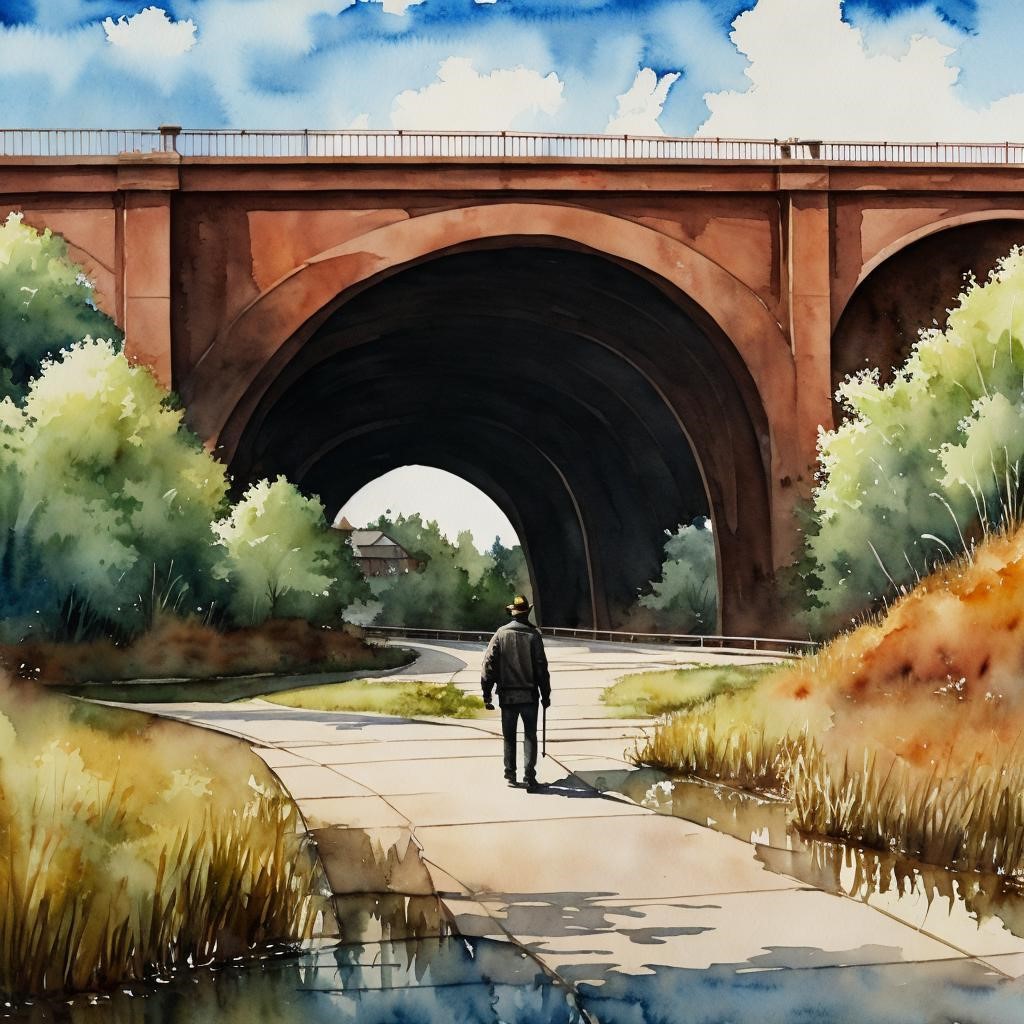
Frank Peterson first saw the crumpled body as he passed through the oak tree grove under Los Angeles’ St. Christopher Bridge. Frank had almost finished his morning hike when he made the gruesome discovery.
“What the hell!” he cried. “What’s happened?”
Frank slowly approached the lifeless figure. The man was thin, slightly balding, and had what appeared to be dried blood on his forehead and around his mouth. Although usually at ease in difficult situations, Frank was now exceedingly agitated.
“Have to call 911,” he said nervously.
Frank pulled the phone from his back pocket and dialed the emergency number.
“I was just walking along the train under the St. Christopher Bridge when I found the body,” Frank explained to the dispatcher. “Very shocking. Okay, I’ll check his pulse.”
Cradling the phone under his chin, Frank knelt down and lightly felt for a pulse on the man’s right wrist. “There’s nothing,” he mumbled. “He seems to be dead. What do I do? Yes, I’ll wait here until the police arrive.”
Frank, 52, sat on a large boulder next to the body. He was shaking. The only other time he had been up close with a body was at his father’s open-casket funeral.
“I can’t believe this,” said Frank, who is heavy-set, with wavy black hair and a neatly trimmed beard.
Frank looked down again. The stranger was wearing a dark blue suit and red tie, but he didn’t have shoes.
“He looks somewhat familiar, but I don’t know why,” Frank said.
Then Frank remembered he and his wife had an appointment that morning with a loan officer to discuss a refinance for their house. I’ve got to ask Helen to reschedule.
The phone slipped from his hand and fell next to the body. He reached down to retrieve it and noticed the man was clutching a St. Christopher medallion.
“Helen, it’s me. Something terrible has happened. I was finishing my walk when I came upon a body under the bridge. He’s dead. I’ve called the police and waiting for someone to get here. Yes, cancel our bank appointment with Mr. Monroe. I’ve got to go; I see two policemen approaching.”
While one officer checked the body, the other sat next to Frank. “Mr. Peterson? I’m Sergeant Dexter. Thanks for waiting. We know this has been a shock. Can you explain how you discovered the victim?”
Frank quietly told the policeman that he was startled to see the body while taking his regular walk.
“Do you think he was murdered somewhere and dumped here?” Frank asked.
“That’s possible,” the officer responded. “But it’s just as likely he jumped from the bridge. We’ll check his pockets for any notes and look above to see if there’s anything.”
Just then, the other officer approached and announced, “I found a short note that just said ‘Sorry for the mess.’ Also, a company identification badge says his name is Jonathan Monroe. Perhaps he lived nearby. Does that name sound familiar for any reason?”
Frank shook his head. “My wife and I did have an appointment with a Mr. Monroe,” he replied. “Probably just a coincidence. He seems vaguely familiar, but I’m not sure.”
“We’re waiting for the coroner to arrive to collect the body,” the Sergeant explained. “We’ll do a follow-up and contact you for any other questions. Would you like a ride to your home?”
Frank shook his head. “No, I live close by. I’ll just walk.”
The short distance to his home on Bixby Street seemed like miles. Walking briskly, Frank averted his eyes from the ground as if there might be another unwelcome sight. As he approached the entrance to his cul-de-sac neighborhood, Frank saw the small group of people gathered in his driveway.
Great, Helen had to call everyone already,
His wife ran to hug him. “Oh my gosh, Frank, what a horrible thing,” said Helen, a tall, slender redhead.
“Yes, it was. The worst thing ever. Why is everyone here?”
“They were just worried,” Helen answered.
“So, you found a jumper?” exclaimed Stephen Palmer, his next-door neighbor.
“We don’t know how it happened,” Frank said irritably. “If it was suicide, you could call him something other than a ‘jumper.'”
“We know who it was,” said Connie, Stephen’s wife.
“I think it might have been the man Helen and I were supposed to meet,” Frank said. “But did you actually know him?”
“In a way, we all did,” Stephen answered.
Part 2: Questions and Partial Answers
Frank, Helen, the Palmers, and a few other Bixby Street residents were standing in the Peterson’s driveway. Frank had yet to recover from his morning ordeal.
“Well, how did you or we know Jonathan Monroe?” Frank asked.
“I guess you don’t remember,” said Stephen. “He lived at the top of our street. Moved in about a year ago.”
“I recall seeing him in front of his house a few times,” added Connie.
“I knew the name but don’t remember ever seeing him,” Frank said. “Did he ever attend any of our neighborhood events?”
“He had been here almost a year, so he was due to be invited,” Dean Simpson said.
“Why would he have killed himself?” Frank wondered.
“That is the million-dollar question,” Stephen replied.
Jonathan Monroe’s suicide was a staple of the neighborhood discussions for the next several weeks. For example, at the monthly book club meeting, Helen confirmed that it was a suicide. “The police told Frank that they found his shoes on the bridge.”
Ann Donley asked, “Why would he do it?”
“He may have had serious financial difficulties,” suggested Sonia Pettigrew.
“Perhaps he was going through a terrible divorce,” Helen added.
“He could have been seriously ill,” offered Connie.
During the following night’s men’s poker game, Stephen said, “The mortgage banking field has been very competitive lately. There aren’t a lot of buyers. Mr. Monroe might have felt overwhelmed.”
“But is that any reason to jump off a bridge?” Frank wondered.
“Hard to know what a desperate person has on their mind,” said Bill Pettigrew.
“I wonder why he didn’t reach out to someone,” Dean said. “He could have asked one of us for help with a problem.”
Frank frowned. “We’re not always the most welcoming group to new people,” he said.
“That’s a bit unfair,” complained Stephen. “It just takes a while to get to know us.”
“We may know more after his sister arrives next week,” said Frank. “She’s coming here to collect his belongings.”
“It will be nice to learn more,” Stephen agreed.
“No matter how you slice it, it’s just so damn sad,” Bill said.
Part 3: The Letter, Photos, and More Questions
Mary Monroe-Slader had called everyone together for an informal memorial for her brother. They sat on folding chairs in the nearly empty living room of the house that Jonathan had leased.
“Thank you all for being here,” she said wearily. “This is a tough time for me. I’ll be returning home to Phoenix this afternoon, but I wanted to share a few thoughts with the people who lived in his community.”
The mourners nodded but remained silent.
“We weren’t especially close,” Mary continued. “But lately, we did talk more often. I’m as mystified as you probably are. Jon hadn’t seemed overly depressed. He didn’t have any financial problems that I could tell.”
“There must have been something,” Bill suggested in a low voice.
“Maybe,” Mary said. “Jon always wanted to belong, to be part of something. He didn’t seem to fit in, even when we were kids. I know he was excited to move here from his Tucson home.”
“We didn’t really know him,” Sonia confided.
“From looking at all those photos on the table, I thought you did,” Mary added.
Everyone turned to look at the array of photos on the folding table. There were black-and-white images of the various barbeques, holiday parties, and other neighborhood gatherings.
“He must have taken those from a distance because I don’t remember him being at one of the events,” said Helen.
“I guess that explains it,” Mary said. Also, I did want to read you the short note Jon left behind. “Dear Mary and neighbors, I’m sorry for any trouble I may have caused. This is not anyone’s fault or responsibility—it was my decision. I was looking for something that may have been unrealistic. You all seem like such nice people. Sometimes, there are no real answers—just questions. Don’t forget to hug each other often.”
Mary folded the note and put it in her purse. She smiled and added, “Jon set aside a small amount of money to be donated to your community garden. I guess he really enjoyed visiting it.”
“We’re just so sad that we still don’t know why,” Sonia said.
“Like Jon wrote,” Mary said. “Sometimes there aren’t any satisfying answers. But it does remind us to do a better job of getting to know each other.”
A month after Mary left, a new family moved into the home Jonathan had lived in for a year. It was the day before the Bixby Street annual Welcome Summer barbeque. Frank, Helen, and the Palmers walked up the block to greet the couple.
“Welcome, neighbors,” Stephen said cheerfully. “We’re glad to have you here.”
“And we want you to join our barbeque tomorrow,” added Helen.
“That’s very nice of you,” said Millie Prescott.
“We know you’ll fit right in,” said Frank.
“We sure hope so,” said Art Prescott. “Our old friend, Mary Monroe-Slader, recommended it to us. She said this is a very friendly, welcoming place.”
“Maybe she’s giving us another chance,” Frank said.
“How’s that?” asked Art.
“Nothing,” Frank answered. “See you at the barbeque.”
####
The Newest New Story For You (5/16/24):
Searching for the Woman Who Drove That Flatbed Ford
Copyright, David L. Robinson, 2024
A Winslow Introduction
Mac Stanley already regretted his decision to accept his second job as a private detective.
“From top-tier homicide investigations to a missing person,” Mac grumbled. “I probably should have stayed retired.”
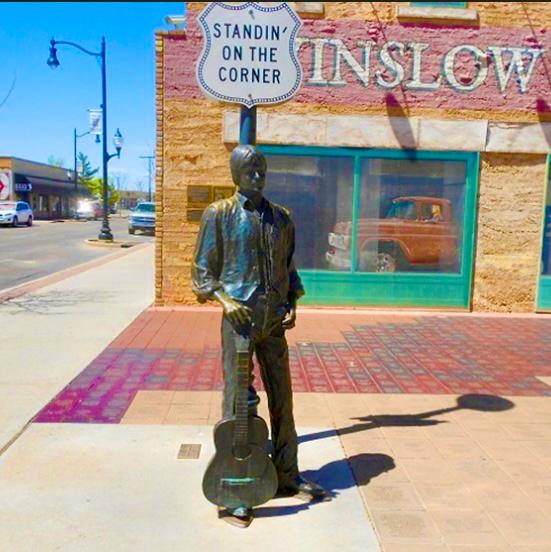
He leaned back on the faded green bench in the brick-covered park at the busy juncture of Old Highway 66 and North Kinsley Avenue. You may have heard about that crowded space in Winslow, Arizona (75 miles southeast of Flagstaff)—the one memorialized in Take It Easy. This wildly popular 1972 Eagles song inexplicably has helped attract more than 100,000 visitors to Winslow annually.
But there’s a lot more you don’t know about that unique corner, Mac, and especially the case he was working on in September 2023. It involved the middle-aged woman who inspired the song, the person he was asked to find.
Anyway, Mac—the 45-year-old former Los Angeles Police detective— was sitting rather than standing near that corner on the morning of September 10 because he was still recovering from knee surgery. He had arrived in Winslow from his Santa Barbara home the day before. Mac reluctantly agreed to find the missing woman after her sister called him. Charlene Temple explained, “It’s an odd situation. My older sister, Jane, has disappeared from her apartment in Winslow, Arizona. One of her neighbors there said my sister’s ex-boyfriend had been stalking her. I guess he’s also been telling everyone she was the girl driving the old Ford truck that the Eagles music group mentioned in one of their hits. Somehow, this old guy is trying to capitalize on her alleged background or for some other reason. Anyway, I haven’t been able to reach her, and I’m worried.”
Mac was now waiting to meet with Wade Butler, the Winslow Tribune reporter he had contacted a week earlier. It was only 9 a.m., and there was already a greater-than-usual assemblage of people gathered near the bronze statue of the guitar player clad in jeans, vest, and boots. The city installed the monument in 1999 with the expectation that it would help revitalize the local economy. The curious crowd would be followed by the lunchtime group and the evening’s lonely wanderers. Of course, there was foot traffic at all hours, with loyal Eagles fans and curious onlookers anxious to take a selfie and call home to sing, “I’m standing on the corner in Winslow, Arizona, such a fine sight to see….”
****
Mac considered himself a graduate student of Sherlock Holmes’ deduction methodology, employing a combination of meticulous observation and logical reasoning. He often explained that it was simple enough. During one of his early conversations with Ben Paxton, his Santa Barbara neighbor and beachcombing companion, Mac said, “Most people ignore the most obvious details. For example, how would you describe me?” Ben glanced at his friend and responded, “A rather short, stocky white guy with a beard.”
Mac smiled and said, “A closer look would tell you that I’m about 5′ 6′, probably 30 pounds overweight; close-cropped white hair with a matching goatee; ruddy complexion—possibly from being outdoors a lot; and a crescent-shaped scar on my right cheek. I’ve got a misshapen, broken nose, maybe from a fight during my younger years; soft hands, which could indicate I’m not accustomed to much manual labor; dark blue eyes that some might consider intimidating and others would say are……”
“Alright, I get it,” Ben conceded.
*****
Wade Butler arrived at 10:45 a.m. “Hello, Mr. Stanley,” he said. “How are you?”
“I’m fine, Wade,” Mac said. “And you?”
“Decent enough for an underpaid reporter,” replied Wade, who is thin with short red hair, cocoa-colored eyes, and thick glasses.
“In our phone conversation, you mentioned an interest in information about the missing woman, Jane Temple,” Wade reminded him.
“That’s right,” Mac said. “As I explained, Jane’s sister asked me to see if I could find her.”
“Charlene Temple also called us,” Wade noted. I suggested she contact the police, whose job it is to find missing people, including Jane, the alleged mystery woman in the flatbed Ford truck. I checked with them, and they did a welfare check, but no one was home. There was no sign of a break-in or any other disturbance. So far, the police are treating it as a voluntary disappearance.”
“Have her Winslow neighbors seen her?”
“As I understand from her good friend, Jane packed a bag and left. She may be staying with someone else in town. Your timing is interesting because I’m working on a story about the woman in the Ford truck for part of the paper’s coverage of the annual ’Standin’ on the Corner Festival’ later this month. You know, the human-interest stuff.”
“You referred to her as the ‘alleged’ mystery woman?”
“Yes. There has always been uncertainty about who inspired the Eagles song. For example, there is some discrepancy about whether Jackson Browne, the singer who co-wrote the song, saw the girl in the Flagstaff area or here. Also, the wife of a Winslow judge said it was her. I thought that was very strange.”
“What about the rumor that someone was stalking Jane?” Mac queried.
“There may be something to that. I understand that a man from Ohio offered a reward for information on the identity of a young woman who may have passed through Arizona in 1971. Apparently, he wanted to know if it might be the former girlfriend he had been looking for. Of course, you never know about such claims.”
“Interesting story,” Mac said. “Fifty-two years is a long time.”
“But it could be a great article if the Ford driver was some guy’s old girlfriend who wants to be reunited. I would appreciate it if you could let me know if you learn something more from your conversations and other sleuthing.”
“You said that Jane has a good friend living nearby. You know where I could find her?”
“Her name is Ivy Spaulding. You can probably find her near the 9-11 Remembrance Garden Memorial. She’s an older woman with long white hair who usually wears colorful outfits. You’ll probably see her there in the afternoon. Ivy goes there to feed the birds and greet friends.”
“I’ll let you know if I talk with her,” Mac said. “Perhaps I’ll see you again while I’m here.”
He watched Wade walk down Baxter Street on his way back to the Tribune office. Mac wrote a few notes in his journal. The last notation said, “I wonder if Butler is sharing everything he knows. Maybe he’s holding back to see what details I can offer for his story. Never trust an enterprising reporter.”
##
A Friend’s Greeting
Mac had a special place to visit before looking for Ivy: Winslow’s 9-11 Remembrance Garden.
The city had constructed the memorial with two beams recovered from the wreckage of the World Trade Center towers. Mac strolled to the corner of Transcon Lane and old Route 66 near the Flying J Truck Stop. He paused before the curved brick wall with the United We Stand inscription. Mac placed a red rose at the base of one of the beams planted in the grassy area.
“Thinking of you and the others, Bob,” he said quietly. His brother wasn’t supposed to be in his office in the North Tower that day. Mac had planned to see him in October, 2011 but the terrorist attack prevented their reunion.
Mac heard footsteps behind him and turned quickly to face the older woman with long white hair. She wore an oversized flowery dress.
It could be her, he thought.
“Are you Ivy Spaulding?”
“I might be,” she said. “And you?”
Mac showed her his private investigator’s license. “I’m Mac Stanley, a private investigator hired to find Jane Temple. I believe you know her.”
Ivy looked closely at Mac.
“Yes, she is a good friend,” Ivy replied. “Who asked you to find her?”
“Jane’s sister, Charlene, who has been unable to reach her. Can we talk?”
“Sure, I have a few minutes.” Ivy sat down next to Mac.
“I only want to meet with Jane briefly so I can assure Charlene that all is well,” Mac said. “I’m assuming that Jane is hiding out for a good reason.”
Ivy frowned and folded her hands.
“Hypothetically speaking, let’s say a young woman lives in another state and wants to escape a terrible relationship,” she said. “So, one day, she gets in her run-down truck and starts driving. She finds this place and likes it. But then a songwriter thinks it’s a good idea to write about the time he might have seen this woman smile at him. And the former boyfriend-abuser might have read about it and wants to find the nice lady.”
Mac nodded. “You’re referring to Jane.”
“Of course, I’m talking hypothetically.”
“But 50 or so years later, the boyfriend still wants to find her? Seems rather implausible.”
“Ordinarily, yes, but consider that this guy has a long memory. He thinks that maybe this girl took something from him, and while he may be in his seventies now, is still obsessed with finding her. Recent articles about the Standin’ on the Corner festival mentioned her, and that’s made things worse. She really doesn’t want to be found now.”
“I understand. But can you tell Jane that her sister is worried and wants to know she’s okay? If you can give her that message, she may be willing to meet with me.”
“I will certainly relay that message.”
“Can you give me a number so I can call you?”
“I’ll call you.”
“When?”
“When I do.”
Mac handed her his card. “This has my cell phone number.”
“I’ll see what I can do,” Ivy said.
“I’ll look forward to our next conversation,” Mac replied.
But Ivy had already walked away.
This could take longer than I anticipated, Mac thought. I wonder if she is going to give Jane my message.
###
The Runaway Sister
“Mr. Stanley, it’s Ivy. I’ve talked with Jane. She is willing to meet with you.”
“That’s great news, Ivy. When and where?”
“She’s still nervous about meeting with strangers. So, she has planned detailed directions for you to follow.”
“Where will I meet her?”
“You need to get your first clue regarding her whereabouts from the manager of the Stop & Shop store on West Third Street at 11 a.m. today. He’ll give you more information then.”
“This could be an interesting afternoon,” he said uncertainly.
“Good luck, Mr. Stanley. Perhaps you can help Jane.”
“I will certainly try.”
Two hours later, Mac left the hotel and walked three blocks to the Stop & Shop convenience store. He introduced himself to the manager, who was busy taking inventory.
“Ivy told me you would stop by,” the curious manager said. She wanted me to give you this piece of paper. It looks like you might be on a scavenger hunt of some kind.”
“More like a person hunt. But at this point, I’m not certain of anything.”
“I hear you. We’re living in a strange time.”
Mac unfolded the paper and began his march through downtown Winslow. For the next hour, he traipsed the three-mile route to the Old Trails Museum, La Posada Hotel, E&O Kitchen, Arizona 66 Trading Company, and the Amtrak Depot, where he found the last clue. The note on the depot bulletin board explained: “If you like books, you will love this place on Gilmore Street. Look for a woman wearing a yellow coat and dark glasses.”
“I guess she’s waiting for me at the Winslow library,” he said wearily.
As Mac approached the library, he saw several people sitting at picnic tables. Then he noticed the woman in a yellow coat waiting at a nearby bench.
“You must be Jane,” he said.
She looked up and smiled. “You found me, Mr. Stanley.”
Jane removed the glasses and put them in her purse. She has bright green eyes, curly gray hair, and a smooth, alabaster complexion.
“It’s nice to meet you finally,” Mac said.
“My sister sent you to find me?”
“Yes. Charlene was worried when she didn’t hear from you.”
“While I dearly love my sister, you should understand that we haven’t been especially close in recent years.”
Mac waited for her to continue. But she didn’t.
“Of course, it’s none of my business, but why is that?” Mac prompted.
“There is no spectacular reason. It is more of a gradual distance over time. We’ve been in different places in our location and politics, among other things. However, I still don’t want Charlene to worry about me. I was going to call her, but you can go back and report that all is good.”
“But that’s not true, is it?” Mac said.
“How do you mean?”
“I’ve heard about your problem with an old boyfriend who has been pestering you. And you’re staying at another place?”
Jane nodded. “I’m not sure how you could help,” she said.
“I’m good at solving people’s challenges. I intervene in conflicts, convince the bad actors to walk away, and try to make the problems disappear.”
Jane smiled. “Bad actors,” she repeated. “That’s an interesting term. But what would you do in my situation?”
“The first step would be to talk with the man bothering you. See if there’s anything we’re missing. A secret of some kind. Most importantly, convince him to stop badgering you.”
“I guess I should trust you because Charlene sent you?”
“That and because I’m an honest, sincere, and experienced detective.”
“That sounds good. I would love to get back to my own apartment and normal routine. It all started when this long-ago boyfriend, Charles Simpson, began sending me emails and text messages.”
“About what?”
“At first, he said he just wanted to ‘reconnect,’ as he put it. Then he said he was coming here for a visit and wanted to catch up. Based on our previous difficult relationship, I didn’t want to have anything to do with him, so I ignored the messages.”
“What was his response?”
“The messages got a bit angrier. Charles said he knew where I lived. And then two weeks ago, I got a message from his son, George, who said he might come to Winslow instead. Here, look at a few of the messages.”
Jane handed her phone to Mac. Mac scrolled down to read a few of the comments:
“It’s been a long time, and I need to see you….”
“Stop avoiding me. We must talk soon…”
“Why aren’t you answering?”
“You can’t still be angry…”
“I know where you live…”
“It’s George. I’m writing at Dad’s request….please respond…”
Mac returned the phone to Jane.
“I get the idea,” he said. “Not exactly threatening, but certainly insistent.”
“But at that point, I was upset and decided to leave my place for a few days. Then yesterday, George left a phone message that he had arrived in town and wanted to meet. I have probably overreacted to all of this.”
“Not necessarily. I don’t blame you for being concerned. You never know. Give me the phone number George Simpson left, and I’ll call him today.”
“I hope you can do something.”
“I can and will.”
Mac closed his notebook and briefly hesitated.
“Before going, I must ask. Are you really the woman who was driving the flatbed Ford?”
Jane laughed. “Yes. Although I know there are conflicting stories. Plus, I think the Eagles song made it seem overly dramatic. Heck, I was just driving by in my beat-up truck on the way to San Diego to meet Charlene. I didn’t even know Jackson Browne had seen me in Flagstaff or Winslow. I guess he was walking around that corner when I drove by. I slowed down as I approached a stop light. A man waved, and I smiled and waved back. It wasn’t until I heard the song that he wrote with Glen Frey that I made the connection.”
“How do you mean?”
“Long story, but suffice to say that a month or so after the song came out, there was an article in the Tribune with a photo someone had taken of me driving. It was shortly before the first annual Standin’ in the Park Festival. The paper asked readers to identify the person driving through town. The article appeared in newspapers throughout the country. So, I called to say it was probably me. Then, I was invited to the Festival that year. I loved Winslow, and the festival was so much fun that I decided to live here.”
“I can see why you liked living here,” Mac said. “Seems like a friendly town.”
“At first, it was great. I would be known as the woman driving the flatbed Ford. I got to help judge the Festival’s chili cook-off and singing contests.”
“What changed?”
“The novelty wore off. So, I moved back to California and found work as a teacher’s aide. But then I got restless again and returned to Winslow about a year ago. All was fine until the newspaper ran an article about Charles Simpson searching for me. Then, he began sending emails and text messages. It dredged up very painful memories, and it’s been a nightmare ever since.”
“I understand. We’ll get this sorted out. After I contact George, I’ll call you later today or early tomorrow. Then you can attend the Festival in peace, and I’ll join you before returning to Santa Barbara.”
“That would be wonderful. I look forward to hearing from you.”
Mac scratched his head. I wonder what I’m missing. Was she overly concerned about the boyfriend’s contact? And why is George involved?
*****
“Sam, it’s Mac Stanley. I’m in Winslow, Arizona, and I need a favor.”
“Hey, Mac, how goes it?”
“Okay, but I need an assist. I’m involved with a simple missing person case and would like some info from the NCIC (National Crime Information Center) database.”
“You do recall from your time here at the Los Angeles P.D. that we’re not supposed to share the information with outsiders?”
“Well, I’m not exactly an outsider. But I know you’ll make an exception for an old partner.”
“What is it?”
“Can you see if a man named Charles Simpson from Canton, Ohio, has any priors or anything else sticks out?”
“Will do. Meanwhile, how is life as a private eye?”
“It’s still a work in progress.”
###
The Unavoidable Confrontation
Mac waited for George Simpson to meet him at the back booth of the El Posada hotel restaurant. At 11:30 a.m., the man who had described himself as “somewhat chunky, with short brown hair and wearing a San Diego Padres sweatshirt” entered and walked over to Mac.
“Mr. Stanley?”
“That’s right, George. Thanks for joining me here.”
“You said you wanted to find out why my father and I have been trying to contact Jane Temple. I think there’s been a big misunderstanding.”
“Not from Jane’s perspective,” Mac replied. “You and your father have made her extremely uncomfortable and ignored her pleas to stop.”
George smiled. “Did she explain our situation?”
“How do you mean?”
“Sounds like she didn’t. I’ll let her tell you. “
“I’d like to know if there’s something else.”
“You need to ask her. But aside from that, I haven’t intended to cause problems. I guess we could have handled things differently. I’m not accustomed to being involved in this kind of quarrel.”
“So why have you?”
“My father started sending her unnecessarily strong messages. In his way, he was trying to reconnect. But then, two weeks ago, he had a heart attack and isn’t doing very well. He asked me to find her.”
“Why did he want to talk with Jane?”
“Couple of things. First, to apologize for how he acted many years ago.”
“Being abusive?”
“Dad explained that he wasn’t the nicest person back then. He was jealous and easy to anger. They had arguments. I don’t think it was physical.”
“According to a report, the Canton police department had made several visits to your father’s house on domestic violence complaints.”
“I’m not aware of that. I wasn’t around then. But from what he recently told me, I suppose his unrelenting criticism and belittling wore her down. Then she ran away.”
“It seems that their relationship didn’t end on a positive note.”
“I’m not here to excuse him. But as I said, he’s quite ill now. He had written to her, and she wouldn’t respond. Then he read about this year’s Festival and asked me to take over.”
“What do you want?”
“In addition to apologizing on behalf of my father, I’m here to return this box to her.”
“What’s inside?”
“Some of her personal things, including family photos, letters, some jewelry, and a few other items. Take a look. Believe me, I have no ulterior motive.”
Mac opened the large hat box and made a cursory examination.
“Okay then. I’ll see if I can set this up with Jane.”
“That would be good. Then I’ll leave Winslow, and she will never hear from my father again.”
“Agreed. I’ll phone you later.”
******
“Are you willing to meet with George? He wants to apologize for his father’s bad behavior and give you something.”
“You’re sure he’s being honest? I’m not anxious to continue with his father’s rants and other nonsense.”
“He seems uncomfortable about being in this position and sincere about his intentions. Apparently, Charles is genuinely remorseful and wants to die in peace, knowing you’ve forgiven him.”
“Okay. I’m willing to meet if it means I can put all this behind me. We could meet at the Festival beer garden tomorrow.”
“There is one other thing,” Mac said. “George said something about his and your situation. What does that mean?”
“We can discuss that more tomorrow,” Jane answered.
“I think I already know,” Mac said. “But I’ll wait.”
Mac put the phone back in his pocket. She didn’t know I took a sneak peek in the box.
###
The Taking it Easier Resolution
By the time Mac arrived at 1 p.m., loud Festival celebrants had already crowded the beer garden. A few minutes later, he watched Jane walk quickly through the entrance.
“Nice to see you again,” he said. “George should be here soon.”
“Sooner, the better,” she said. “But before he gets here, I need to tell you something.”
“I have a question for you as well. The police report I reviewed stated that Charles Simpson had a young, pregnant girlfriend. There were some photos inside the box and…”
“I didn’t mention before that George is my son,” she interrupted.
Mac nodded “He did allude to something, and I thought there was some stronger relationship between the two of you. He does look like you.”
Jane sighed. “I left Charles when I was pregnant with George,” she explained. “I raised George alone until he was 18, and then he moved in with his father. My son and I have had a rather difficult relationship since then. He resented that I didn’t talk much about Charles.””
“I also learned that Charles had claimed you stole a ring.”
“He gave it to me.”
“I guess that’s between the two of you,” Mac said. “There’s George now.”
George carried the large box that was wrapped in a bright red ribbon.
“Hello, Mac and Jane,” he said
“You can call me mom.”
“So, you’ve told him. I do appreciate you both taking the time. I’m almost as anxious as you to have this over with.”
“I’m not sure about that,” Jane said. “What’s the box for?”
He handed it to her. “Dad had stored several family photos, a favorite scarf, and some other things you left behind. Also, your diary, which Dad insisted he hadn’t read.”
“That wasn’t necessary,” she said.
“Part of the closure process,” George said.
“Whatever. I see that he wrapped it in my favorite color.”
Jane opened the box and spread the contents on the table. She held up a gold ring and jeweled necklace.
“These two pieces and the diary are all I want. You can return the rest to sender.”
“I’m truly sorry for the unpleasantness over the last couple of months,” George said. “I think Dad’s messages about wanting to meet and talk were a little too strong.”
“You think? It scared the hell out of me.”
“Again, I’m sorry for that. When Dad got very sick, he asked me to be his surrogate apologist.”
She shook her head. “Okay, George. You’ve done your job. I accept your apology. By the way, how long can you stay?”
“At least a few days. Enough time to catch up and mend fences.”
They looked up as the festival announcer walked onto the stage. He clapped his hands.
“We are incredibly fortunate to have special guests today,” he yelled over the boisterous celebration. “First and foremost, a special welcome to the Eagles, including the late great Glen Frey’s son, Deacon, who joins us today on guitar and vocals. Plus, a unique guest appearance by Jackson Browne, who co-wrote the Winslow anthem Take it Easy, which is, of course, the reason we’re all here this weekend. Before they help kick this Festival off, Jackson has something he wants to say.”
Jackson Browne, 74, has long brown hair, a trimmed white beard, and blue-green eyes. He stepped up to the microphone and announced, ‘As most of you know, Take It Easy is based on a real-life event. In the summer of 1971, I was passing through Arizona and decided to take a brief break in this wonderful town. I was standing on the corner that you’ve all heard about and just happened to look over at cars passing by. I saw a very pretty young woman driving a flatbed Ford truck slow down as she approached a stop sign. She glanced over in my direction and smiled. Of course, I smiled and waved at her. And then she drove off. This encounter lasted only a minute, but left a huge impression on me. And that my friends, is the genesis of Take It Easy.”
Jackson paused as the band lined up ready to sing. “I’m so happy to be here today, especially because the woman driving that flatbed Ford so many years ago is also with us,” he continued. “This is a surprise for Jane Temple, as she didn’t think I’d recognize her. But the pretty young woman who smiled at me way back when is now a pretty, mature woman. She’s sitting right down there. Please stand, Jane.”
“This is so embarrassing,” Jane said as she slowly rose and waved at Jackson. The audience responded with a standing ovation.
“And now, our favorite song,” Jackson shouted.
As the band begin playing and the audience sung along, Mac leaned in closer to Jane and whispered, “Looks like I can leave today and tell Charlene that you’re alive and well.”
She nodded. “I’ll call her today,” Jane said. “Thanks for everything you’ve done.”
“It has been an unusual experience,” he replied. “I wish you and George well. Get those fences fixed.”
Mac stood and hugged Jane. He left the beer garden on his way to the Flagstaff-Pulliam Airport and back to Santa Barbara. He was anxious to return home. A new case awaited him. This one was much more serious than a missing person search.
# # #
The Sisters In That House Near the Rose Bowl
A trilogy of pithy vignettes about life in a Pasadena, California neighborhood.
By David L. Robinson

Copyright 2024, David L. Robinson
Behind The Fence
“Has anyone seen the Palmer sisters recently?” Jimmy Westin asked the others at their Vista View neighborhood Labor Day barbeque. “I haven’t noticed them in a long while. I hope they’re alright.”
Jimmy, 42, is a tall, broad-shouldered, blue-eyed high school wrestling coach and a church deacon. He also is the neighborhood’s gregarious, first-class event organizer.
“This is nothing unusual,” said Bernard Montgomery, the Westins’ next-door neighbor. “To say the old ladies are reclusive is an understatement.”
Beatrice and Cynthia Palmer lived in the stately Victorian-era manor at the base of the mountain that overlooked the Rose Bowl in Pasadena, California. They had inherited the sprawling manse from their mother, who had died 20 years earlier. The ¾ acre property covered almost an entire block. It was protected by a heavy wrought iron fence and spiraling boxwood hedges.
“They could be dead for all we know,” said Jimmy, whose family lived adjacent to the Palmer property.
“Someone is in there because we see the lights on and hear their classical music,” noted Bernard, 41, heavyset, with premature gray hair and deep-set hazel eyes. “I’m sure we’ll see them sometime soon.”
On Labor Day and other holiday gatherings, the conversations often drifted to the Palmers. Beatrice, 89, was a former pediatrician, and Cynthia, 92, had been a successful defense attorney. After Cynthia’s husband died, she moved in with her spinster sister. There were all kinds of stories about them. The gossip included rumors that the house was haunted and that an uncle had buried treasure behind a basement wall. One curious and unsubstantiated narrative suggested that no one had seen the sisters lately because both were slightly disfigured from a house fire. Few of the current Vista View residents recalled actually seeing the Palmers.
The local kids were especially interested in the Palmers and the mysterious house. They peered through the overgrown shrubbery on their way home from school and boasted of wanting to see one of the “scary witches.” The more adventuresome teens tried to enter the grand estate by climbing over the fence or following a delivery van as it approached the front gate. But the errant youths always retreated before reaching their destination.
Some parents were concerned that their mischievous children might get caught for trespassing or other mischief. They didn’t have to worry until Halloween when Jake Simpson and John Pender Jr. briefly disappeared. Jimmy and other concerned neighbors began searching the area when the boys hadn’t returned home at 8:30 p.m. on All Hallows Eve. They learned that Jake and John were planning to sneak into the basement of the big house “just for fun.”
“They said they were going on a snoop patrol,” one young girl explained to John’s parents. “You never can tell with those two.”
The increasingly frantic search patrol wandered through the four-block sector, looking for the missing boys. They encountered various groups of young witches, pale ghosts, Trump lookalikes, and angry demons. But John and Jake weren’t among them. Several of the costumed trick or treaters said they had seen the boys earlier.
“John was wearing a black cape and hooded mask, and Jake had some kind of ghoulish outfit,” a Barbie pretender explained.
“They both carried canvas bags labeled ‘special tricks,’ added a slender zombie.
Jake’s father was about to call the police when Jimmy Westin made the welcome discovery at about 9 p.m. As he passed the orange grove behind the Palmers’ place, Jimmy heard loud snoring. He saw the two seated figures leaning against the gnarled tree trunk. It was Jake and John Jr.
“Wake up, you two!” he shouted.
They lurched forward in surprise. “What’s going on?” John asked.
“A search for two missing, misbehaving boys,” Jimmy explained. “That would be you. Your families have been quite worried.”
“Oh,” muttered Jake. “We were planning to sneak a peek at the witches’ house, but we fell asleep while planning our entrance.”
“What’s in your bag?” Jimmy asked.
“Nothing much,” Jake replied.
“Such as?” Jimmy insisted.
“Just a couple of paint bombs,” John said quietly.
“Well, it seems like we found you just in time,” Jimmy admonished them. “Let’s get you home to face the music.”
“Speaking of music, we heard some loud noises coming from the house,” John said. “It was very eerie.”
“We’ll talk about that later,” Jimmy said. “Let’s go.”
As he led the boys out of the orange grove, Jimmy also heard the strange funeral dirge sound coming from the house.
“That is creepy,” he said. “I wonder what the Palmers are up to.”
Next……
The Garden Party
The Vista View residents were surprised to get an invitation to the Palmers’ garden party.
The gold trim card announced: “Dear friends, we request the honor of your presence at our magical garden party on November 25. Join us for a walk through our gardens, food and refreshments, and stimulating conversations. The party starts promptly at 1 p.m. (Please park on the street.)”
“That proves that the old girls are alive and well,” Jimmy said as he and Bernard washed their cars on a cold November afternoon.
“I suppose you’re right,” Bernard concurred.
“Are you and Frances going?”
“We wouldn’t miss a chance to see the gardens and, more importantly, the old gals themselves,” Bernard said.
The neighbors, various Pasadena VIPs, and other Palmer friends and acquaintances began arriving early the day after Thanksgiving. They waited patiently at the outside entrance. At 1 p.m., the gate creaked open, and the party guests started up the long, steep driveway. The younger people stepped briskly ahead while some older ones straggled behind.
A large sign at the top of the driveway greeted them: “Welcome to the Splendid Palmer Garden Party. Make yourself at home.”
“This is incredible,” said Jimmy. “It’s even more elaborate than I expected.”
He and the others stared at the expansive gardens surrounding the three-story mansion. The centerpiece is the neatly manicured hedge and flower garden maze that features a mix of multi-colored roses, rainbow tulips, calla lilies and other distinctive flora. A red, white, and blue arbor is at either entrance to the maze.
“My gosh,” said Paul Wilson, Pasadena’s deputy mayor. “I’m impressed. What a fantastic arrangement.”
There were striped canopies hanging above the long tables covered with blue and green table linens. The hosts had arranged the tables with various foods—fancy hors d’oeuvres, plates of meat and bread, deserts, and more. Three waiters dressed in starched tuxedos carried trays of champagne-filled flutes and other beverages.
“This is something,” said Bernard. “I’m looking forward to meeting the Palmers.
“Never seen anything like it,” agreed Jimmy. “Wonder when they’ll be coming down.”
A string quartet played Mozart and Brahams as the servers greeted new arrivals. While the adults conversed with each other, played croquet on the huge lawn, and waited for the Palmers to appear, boisterous children gathered in the play area. It was a festive afternoon until they heard the anguished cry.
“Help, I can’t get out of here!” someone shouted.
“Sounds like it’s coming from the maze,” Jimmy said.
“You’re right,” Bernard agreed.
“Please get me out,” a frantic woman cried.
Jimmy, Bernard, and several others rushed into the winding labyrinth and, after a few minutes, located Sharon Blackburn in the center. The rescuers helped the red-faced librarian exit and she sat breathlessly at one of the tables.
“I didn’t know which way to turn,” Sharon moaned. “I felt like a trapped rat in there.”
She gradually recovered from the ordeal, and everyone else resumed partying. However, they were curious when the Palmers still hadn’t appeared by 3:00 p.m. Jimmy stopped one of the servers and asked, “When are the hosts joining us?”
The long-haired young man seemed puzzled. “I’m not sure, sir,” he said uncertainly. “Our instructions were to serve the food and drink. That was about it.”
“This is very odd,” said Bernard. “To create such a unique gathering and not appear at all?”
“Perhaps they like making late entrances,” Jimmy added.
The Palmers’ visitors continued to eat, drink, and be noisy. Unfortunately, Deputy Mayor Wilson had sampled too much of the French champagne. Approaching the buffet to grab a canapé, he stumbled and fell forward onto the table, scattering the plates, food, and other items onto the lawn. Two frazzled servers began picking up the pieces as Paul’s wife helped him stand and find a place to rest for the remainder of the party.
At 4:30 p.m., the hired staff began hurriedly clearing the tables and folding the chairs.
“Guess that’s our sign that the party is over,” Bernard suggested as a waiter reached for his food tray.
As they started to leave, several people were lamenting about missing the Palmers.
“I’ve never been to a party without the hosts,” one complained.
“The food and drink were fine, but it would have been nice to meet Beatrice and Cynthia,” another grumbled.
“I guess we’ll have to wait until the Christmas caroling event to finally see them,” Jimmy said.
They ambled down the long driveway to their parked cars. No one had noticed the tall, thin man peering from behind the upstairs window curtain.
Next…..
Season’s Greetings and a Gag is Afoot
The Vista View residents began decorating their houses in early December. The Palmers usually arranged long strings of colored lights on the outer fence. But this year was different.
Jimmy and Bernard were out front organizing their holiday decorations when they saw the two large vans rush up the Palmers’ driveway.
“Wonder what that’s all about,” Jimmy said.
“Probably the girl’s weekly grocery delivery,” Bernard laughed.
Half an hour later, an officious young woman dressed in a black pantsuit walked down the driveway carrying a “For Sale” sign. She planted it outside the fence.
Jimmy and Bernard walked over to introduce themselves. “Hello there,” Jimmy said. “Are the Palmers selling the place?”
“Yes, Cynthia and her son felt it was time,” the Realtor answered. “After all, nobody has lived here for several years.”
She could tell they were surprised.
“That can’t be true,” Jimmy said. “We’ve heard music, and the lights are on at various times.”
“Plus, they had a huge garden party last month,” added Bernard.
The Realtor shook her head. “Did you actually see the sisters at the party?” she asked.
“We figured that perhaps they were not feeling well that day,” Jimmy explained.
“Have you seen them at any other time recently?” the agent questioned them.
“Well, it has been a while,” Bernard conceded. “Why do you ask?”
“Because the sisters have been gone for at least six years. Beatrice died seven years ago, and Cynthia has been living in a Pasadena care facility.”
Jimmy scratched his head. “This is hard to fathom,” he said. “How could we not have known? You would think at least one of us might have been more observant.”
“We all missed it,” Bernard added. “But then, who has been turning the lights on and playing music?”
“As I understand it, Cynthia’s son is a technology expert,” the Realtor answered. “He had the whole place rigged up with music, lights, and other gizmos. Somehow, he controls it all from his downtown apartment. He also visits the house occasionally to organize things.”
“Why would he do all of that?” Jimmy asked.
The Realtor smiled and shrugged her shoulders.
“He and his mother didn’t want you all to think the place was empty. They probably also worried that some neighborhood kids might break in or squatters would camp there. Anyhoo, you’ll soon have some new neighbors living here.”
“We didn’t expect that,” Bernard said. “We’ll just have to wait and see what happens next.”
The neighbors proceeded with their traditional holiday activity. For example, there was the annual tree lighting ceremony and the offkey caroling songfest. Most of the residents also attended the popular progressive dinner at six different houses.
Then, on December 15, Jimmy and Bernard watched as the Realtor returned to remove the for-sale sign.
“It’s been sold?” Jimmy asked her.
“Yes, indeed,” she said confidently. “I knew it wouldn’t take long.”
“To a nice family?” Bernard queried.
“Sort of,” the agent responded. “If you liked the idea of two unusual women living in this grand house, you’ll really enjoy the new owners.”
“Why is that?” Bernard asked.
“The eccentric Scott brothers have purchased the property.”
“Why eccentric?” Jimmy wondered.
“Apparently, they earned their fortune in the novelty business. They love gags and pulling pranks on people. You can probably expect monthly surprises. I think the first one is already underway.”
Jimmy looked uncertainly at Bernard. “How so?” he asked.
“Maybe I shouldn’t say anything,” she said. “But why not? On my last meeting with the brothers, they talked about planning an extraordinary New Year’s Eve party for all of you. Everybody will be required to wear costumes with ornate masks. Guests will have to guess the Scotts’ identities by their outfits. Otherwise, they won’t reveal and introduce themselves.”
“That seems a bit extreme,” Jimmy said.
“Perhaps,” she replied. “But this is just the beginning. After that gala event, there will be a Valentine’s Day scavenger hunt with a surprise twist they didn’t want to share.”
Jimmy shook his head. “I’ll have to revise our special event schedule,” he said.
“I don’t know about you, but I’m going to find my costume,” Bernard explained.
Jimmy turned and pointed to the Scott brothers’ new property. “As the late great actress Bette Davis warned in the classic movie All About Eve, ‘Fasten your seatbelts; it’s going to be a bumpy night,’” he said.
“All aboard,” Bernard announced. “Here we go.”
The Realtor laughed and walked away.
That’s the end….for now.
###
The Overdue Confession
By David L. Robinson
*Partially based on real-life events.

Copyright 2024, David L. Robinson
“There’s something I’ve got to tell you.”
Charlotte Perkins stared intently at her father, who strained to talk through the oxygen mask. Because of his advanced throat cancer, it was difficult for Charles to speak clearly. The once gregarious and imposing 68-year old retired real estate developer was now emaciated with matted white hair.
Charlotte had arrived from Los Angeles a week earlier to be with her father, who was now in an Albuquerque hospice care facility. The red-haired, green-eyed former flight attendant and her mother took turns sitting with Charles.
She began to brush his hair lightly. “Can’t it wait, Dad?” she said quietly. “Please try to get some more rest.”
He pushed her hand away. “All I’ve been doing is sleeping,” he groaned. “No, this is important.”
“Okay. Let me help you.”
She rearranged his pillow and gently helped him sit up.
“Now, what’s so important?”
The Reveal
Her father scowled and, in a whispery voice, said, “First, my name isn’t Charles Perkins.”
She looked uncertainly at him. Charles stared straight ahead.
“What do you mean?” Charlotte asked.
“It’s an assumed name that I grabbed some 45 years ago,” he wheezed. “My real name is Albert Barnes.”
Her father had several incoherent periods during the previous few days, and Charlotte wasn’t sure what to accept. She also knew him to be unpredictable and prone to meandering conversations.
“I don’t understand,” she said. “Why did you change your name?”
Charles-Albert fidgeted as Charlotte tried to put the mask back over his face. “Because of something I did when I was 20,” he replied wearily. “The U.S. Marshalls and FBI have been looking for me ever since.”
What’s this all about? she wondered.
“Dad, are you dreaming again? I know you’ve had a rough couple of days.”
“Of course not,” he said curtly. “Check the Internet when you leave. Look for an Albert B. Barnes from Chicago.”
“You’ve never spoken about being from Chicago.”
“Just do it. You’ll also find a key taped to an envelope in the top drawer of my desk. That’s all I’m going to say. We won’t talk about this again. Please remember how much I love you and your mom. Now, go and let me rest. I’m tired.”
The Search
“I can’t believe this.”
Charlotte sat on the rocking chair in her former bedroom of the family home. She held tightly to her laptop computer and scrolled down to see numerous references to Albert B. Barnes.
“My God, there are dozens of articles linking him to a major robbery.” She read aloud:
Bank Clerk Robs $275,000 from Northside Bank
Feds Search for Albert Barnes, Suspected Clerk-Robber
Alleged Bank Robber Albert B. Barnes on The Run
And so on.
The reports varied from straightforward accounts to wild conspiracy-laced stories, but the basic details were the same. A 20-year-old part-time clerk named Albert B. Barnes was the prime suspect in the February 16, 1978, robbery of $275,000 from the northside Chicago branch of Illinois People’s Premier Bank. The bank manager discovered the loss the following day and alerted the police and FBI. Charlotte learned that the FBI concluded that the young thief had immediately fled the area. They subsequently arrested a minor accomplice, a young bank teller who allegedly gave Albert the vault access codes. The articles included comments from his co-workers who were surprised that this “pleasant,” “quiet,” and “mild-mannered” youth could be guilty of such a crime. His parents said they were mystified and didn’t know his whereabouts.
Follow-up stories provided updates on the bank teller’s confession that she had inadvertently supplied the vault combination, the numerous false sightings of Albert B. Barnes, the bank’s announcement of an increased reward for his apprehension, and the FBI’s progress in finding him. The final story on May 16, 2019, described that while the hunt for Albert had grown cold, it was still “a wide-open case.”
Charlotte stared closely at the photos of Albert B. Barnes. It does look like a younger version of the father I thought I knew. Similar to some in the photo albums. But why would he do it? How could he have kept this secret for so long? How do I tell mom? She closed the computer and stared at the family photos arranged on the nightstand. What a nightmare, she thought.
That afternoon, Charlotte and her mother sat at the kitchen table. “How was your dad when you saw him?” Louise asked. She is tall and slender, with gray hair and hazel eyes.
Charlotte hesitated, wondering what to say about her father’s confession. “Ornery as usual,” she said, forcing a smile. “Tired and in pain.”
“Doctor Dexter said that he likely only has another week or so,” her mother announced.
“That sounds right. Mom, I’ve got to tell you something.”
“What’s that, dear?”
Charlotte suddenly realized how stressed her mother was. Louise’s eyes were red from crying, and her face was more lined than usual. I can’t tell her now. She’s frazzled enough as it is. The secret will wait.
“We should think about his memorial service,” Charlotte finally said.
“He didn’t want one.”
“I think we should still plan something.”
“Perhaps.”
After Louise left for the grocery store, Charlotte retrieved the envelope and key from her father’s desk. She started to open the envelope but then put it in her purse.
“I can’t open this alone,” she said quietly.
Breaking the News
“I am glad you insisted on the memorial,” Louise said as they left the church. “I thought it was very well done.”
“I agree. Mom, I have something major to tell you. Dad shared a huge secret before he died. I was going to tell you the same day, but you were so upset. I wanted to wait.”
“This sounds serious. What is it, Charlotte?”
“Let’s sit over there.” Charlotte pointed to a faded blue bench under the sprawling elm tree.
Mother and daughter greeted the memorial guests who wandered along the walkway to their cars. When finally alone, Louise turned to Charlotte and smiled. “What is your special news?”
“Dad wasn’t who we thought he was. Or at least something in his past was so out of character.”
“What are you talking about?”
Charlotte quickly summarized her father’s explanation of his long-ago illegal act and the special request he asked her to fulfill.
Louise leaned back on the bench and shook her head. “It can’t be true,” she protested. “We’ve been together for 38 years, and he never said a thing. Moreover, there was never a reason to think he would have done something like that. I’m flabbergasted.” She brushed her white hair back.
“I know, mom. But I’ve done the research. In addition to his assumed name confession and the many newspaper articles, the photos look disturbingly like him as a young man. The articles mentioned a female accomplice, who was apparently Dad’s girlfriend at the time. She blamed him for everything. Plus, I was able to locate one of his old best friends. This elderly man told me that Dad had been a bit wild as a teenager. He also said that Dad had called him to arrange a meeting. Then, the afternoon of the robbery, Dad phoned his friend to frantically say that something had come up and that he was in trouble. That was the last time they talked. Dad just disappeared. Of course, I’ve been wracking my brain to learn why he might have done it or never said anything to you.”
“This is too much to process,” Louise said.
Charlotte hugged her mother. “I know, mom. Also, Dad told me to get a key and an envelope from his desk, which I have here. I was going to read whatever is inside, but I wanted to be with you.”
“Okay then, let’s read it together,” Louise agreed.
Charlotte tore the envelope open and handed the folded paper to her mother.
Unexpected Closure
A week after the memorial, Charlotte prepared to return to her Los Angeles home. She and Louise were discussing their plans to meet with an attorney who would then contact the FBI. As they reminisced about Albert and other family memories, the doorbell rang. Louise opened the door and faced two men in dark suits.
“Mrs. Perkins, I’m FBI special agent Donald Jennings,” the taller one explained. “This is agent Dave Peterson. Do you know why we’re here?”
She stood motionless, uncertain of what to say. “I’m not sure, but maybe. Please come in.”
The agents followed her to the living room and sat on the couch facing Louise and Charlotte.
“How did you know to come here?” Charlotte asked.
“We got a very good tip from your church pastor,” said Agent Jennings. He had short brown hair and blue eyes. “It seems Mr. Barnes confessed something to Reverend Paxton and asked him to alert us after your father passed away. Albert signed a paper advising that you had no prior knowledge of his crime and authorized the reverend to contact us after his passing.”
Charlotte glanced at her mother, who had turned away from the agents.
“We were meeting with our attorney later today so he could contact you directly,” Charlotte said defensively. “We weren’t sure what to do.”
“I understand,” Agent Jennings said. “It must have been a huge shock to learn about Albert’s past.”
“He only recently mentioned that Perkins wasn’t his real name,” Charlotte said. “He directed me to a letter. We’ve just read it ourselves. As you can imagine, we are dumbfounded about all of this.”
“Let us stress again that you aren’t in legal trouble,” said Peterson, a boyish looking Agent who wore thick glasses.
“That’s good news,” Louise said.
Charlotte unfolded the paper. “I’ll read his letter.” The agents nodded.
Dear Louise and Charlotte, and I assume eventually the FBI and others,
I’ve dreaded the day I’d have to talk about this secret for 45 years.
I made a terrible mistake when I was 20 and working the summer as a Chicago bank clerk. I had read a book about unusual crimes, including inside job bank robberies. At the time, I was estranged from my parents, primarily because they were against me pursuing an acting career. I actually took the money just to see if I could do it. In hindsight, I think I might have had a breakdown of some sort, but this may just be a rationalization, an excuse to help me cope with what I had done.
I immediately regretted the robbery but wasn’t sure what to do. Of course, I knew I’d have to run away, which I did. Otherwise, I’d go to prison for a very long time. I moved around a lot and was amazed that the police and FBI didn’t find me right away. I finally ended up in Albuquerque, where I eventually met the lovely Louise.
I held on to the money for a few years without thinking about what I would do. Then, I had what I felt was a bright idea. I would start sending various sums to charitable organizations in this and other countries. I never spent a penny. I suppose that donating it all to charity somehow made up for my tremendous shame and guilt. I’m sure the bank wouldn’t agree, but that’s what happened.
I have been so surprised at not being caught. I was constantly looking over my shoulder. You once asked why I always seemed jumpy and generally nervous. That’s the main reason. I’m sorry you had to endure that. Every year, I planned to admit what I had done, hoping to get some mercy. Late last year, I finally contacted Reverend Paxton to help me reveal the secret. Then I got sick.
Louise and Charlotte, I’m sorry I didn’t do this earlier and regret you’re having to deal with it now. If you’re reading this in the company of FBI agents, I hope they treat you fairly.
Charlotte folded the letter and put it back into the envelope. “I imagine you would like to have this,” she told Agent Peterson.
“Of course,” Peterson replied. “The bank will definitely be disappointed the money is gone. It’s not the normal bank robbery and end result. We’ll close the case following a final interview and after you provide written statements about how Albert confessed.”
“There is one other thing,” Agent Jennings added. “You may be entitled to the $50,000 reward.”
Louise smiled and shook her head. “I think Charlotte will agree that we can’t accept any reward, considering the unfortunate circumstances.”
“Perhaps you can just add it to the FBI tipsters fund,” Charlotte added. “That seems appropriate.”
“As you wish,” Agent Jennings said. “Now, we better get going. We have a lot of follow-up to do. We’ll be in touch.”
Loose End-ings
Special Reader Note: Authors pay particular attention to their story endings. They know readers often base their opinions of a story on whether there is a surprise twist, anti-climactic closing, or other conclusion. In this case, the author has wisely written two different endings for you to consider.
The First one: Once the FBI agents left, Louise pulled a scrapbook from a corner bookshelf.
“You know, I just thought of something,” she said. “Perhaps I haven’t been completely open.”
“What do you mean?”
“Looking back, I recall a few instances where your father left faint clues. I remember once during our early days together before he got his career started. He said something like, ‘What if I robbed a bank?’ I just laughed, and we forgot about it.”
“That doesn’t mean you were aware of anything.”
Louise looked away. “Yes, but then sometime later, I found a few newspaper clippings about a Chicago bank robbery and asked him about it. He said he didn’t recall why the articles were in the shoebox. I dismissed it all because we didn’t have much money then, so I knew he hadn’t robbed a bank.”
“So again, you couldn’t have known anything.”
Louise frowned. “After we had been about ten years, he started acting more withdrawn. I asked him why that was, and he said, “I just can’t talk about it now. Maybe someday. Then you’ll understand.”
“Mom, you have no responsibility in all of this. Please stop.”
“True, except I wonder if I had pushed him harder, maybe he would have said something. If he had told me and explained to the authorities that he hadn’t spent any of the money. He might have had a short sentence. Instead, he suffered in silence all those years.”
“We’ll never know, will we?” Charlotte said with an uncharacteristic, frustrated tone.
“No, we won’t. And I guess that’s the end of this sad story.”
Ending #2: Once the agents left, Louise pulled a scrapbook from a corner bookshelf.
“I need to tell you something,” she said. “Perhaps I haven’t been completely truthful.”
“What do you mean?” Charlotte asked.
“I’ve always known about your father’s involvement with the robbery.”
Charlotte set her coffee cup on the table.
“Not completely truthful? Please explain.”
Louise closed her eyes. “He told me soon after we married. Of course, I was startled. I had just wed a bank robber. What was I to do? I thought about getting an annulment but knew I’d have to explain why, and then he would be jailed. We had terrible arguments. But then he told me about donating it all to charity, and somehow that balanced with the crime. From that day forward, he was the almost perfect husband and father. I knew that one day he might want to confess to someone else and he finally told Reverend Paxton.”
“But you acted so surprised when I told you and then when we read the letter.”
“That took practice. I needed time to think about what to do. Then the FBI showed up. Also, there’s something I forgot to ask earlier. You mentioned a key was with the letter. But you didn’t give that to the Agents.”
Charlotte smiled and pulled a long key chain from her purse.
“That’s true. I thought I’d save that tidbit for you.”
“So now, would you please explain?”
“Yes, of course, mom. When I found the envelope, I was curious about the key taped to the outside. The Internet is such a wonderful place to search for secrets. I did some checking and learned that it was most likely for a safe deposit box. Further research indicated that it was for the Albuquerque Mercantile Trust & Savings. I went there last week and was able to get a peek inside the box.”
Louise waited for Charlotte to continue. “And?” she finally asked.
Charlotte lifted a large envelope from her purse. She opened the flap and displayed a stack of bearer bonds. “There was a note inside,” Charlotte answered. “It said, ‘“I did intend to donate it to charity, but couldn’t decide which one. Figured by the time you find this; I’ll be gone and you may need some extra help. Love, Charles.”
Louise shook her head. “You don’t expect me to keep it, do you?”
“You could donate it to the charity of your choice. On the other hand–I think you deserve it for living with dad for almost 40 years.
“We’ll talk about it as I drive you to the airport.”
###
The Easy Writer’s Punishment
By David L. Robinson
(Copyright, David L. Robinson, 2024)
I know how you do your books. AI is cheating.
Gordon Partridge stared at the postcard he had received that afternoon. He was understandably startled at the strange message.
“Who the hell would send this?” he wondered.
Gordon did employ a unique artificial intelligence application to frame his “how to” books. The author of the trendy “102 Ways You Can…” titles, he considered the AI WonderWrite Success program to be a minor assist.
“It’s not really cheating,” he told his wife, Beverly, that evening. “I know that many writers and editors believe that using AI to generate stories and articles isn’t honest because it’s not 100 percent your own work. But I always start with the underlying premise and get a rough version of the basics. I make certain that the books are infused with my distinctive style. It’s not that unusual. Others do it.”
“I know, dear,” she said patiently. “I wouldn’t worry about it.”
But Gordon, a wiry 42-year-old with jet-black hair, an aquiline nose, and close-set hazel eyes, was bothered. After dinner, he retreated to his home office to work on 102 Ways to Stand Out From the Crowd. Gordon stared at the framed covers of his previous editions. During the last ten years, he had 12 books published, and his agent recently arranged a new agreement for several more in the series. Gordon didn’t want to interrupt the flow. I can’t let some stupid postcard stop me, he reasoned.
Gordon tried to forget about the mysterious mail until a week later when he received another card: “I know where you got your ‘A Winning Formula for All Ages’ catchphrase. I could tell your publishers. Stop using AI.”
Gordon showed the latest notice to Beverly, a slender brunette with porcelain skin and bright blue eyes. She held the card at arm’s length and frowned.
“How very strange,” Beverly said. “Who would do such a thing?”
Gordon shook his head. “I have no idea, or even how they could tell I was using the program,” he complained.
“It could be someone who is familiar with AI and is trolling you,” Beverly suggested. “You know, a practical joker. I don’t think it’s anything to be upset about.”
However, Gordon was a first-class worry wart. He fretted about deadlines, reviewer criticism, and future book ideas. He was a hand-wringer about both significant and trivial matters. He partially traced his diminished confidence to a chaotic childhood that involved moving every other year. That evening in his study, Gordon wondered why someone would send the cards. Perhaps jealous of my success? What’s their goal? He had no answers.
The following day, Gordon decided to temporarily stop using the AI program. “I’m not dependent on it for my books,” he insisted. “It’s only a simple aid. So, I’ll take a brief break to prove I don’t need the damn thing.”
“If you’re sure that’s the right thing to do,” Beverly said uncertainly.
But Gordon wasn’t prepared for the massive writer’s block he encountered. He stared at the computer screen and, two hours later, had written only three sentences of the current 102 Ways manuscript.
It’s just a short-term impasse, he mused. I’ll get through this in a few days.
Yet Gordon couldn’t bypass the dreaded roadblock. He scoured the Internet for advice and listened to three podcasts about the malady. Thinking overwork might be the cause, Gordon cut back on his writing regimen. That adjustment provided more free time to play cards or watch movies, which Beverly appreciated. Meanwhile, he tried to regain his editorial footing but was largely unsuccessful.
“Maybe I should just mention it to my agent and get her feedback,” he told Beverly one morning. “You know, to clear the air and all.”
“I wouldn’t do that,” Beverly advised. “You never know what she might say.”
“Perhaps you’re right. I’ll wait a little longer.”
Gordon managed to write a few more pages, although he was substantially behind on his original publication schedule. He also continued feeding his reservoir of self-doubts. Maybe I’m not a real author, but a hack instead. I suppose the shortcuts gave me an unfair advantage.
Although Beverly was happy to spend more time with Gordon, she was concerned about his atypical moody attitude.
“I’ve noticed you haven’t been writing as much lately,” she said a month after the first postcard. They were sitting on the living room couch, waiting for Jeopardy to start.
“I’ve been analyzing my future direction and such,” he replied. “By the way, we need to cut back on expenses and probably won’t be able to take our summer trip.”
“Why is that?”
“I’ve been meaning to tell you,” he explained. “I didn’t want my agent to find out from another source. So, the other day, I told her what happened. I was surprised at how upset Alice was with me for using the program without telling her. I learned she’s a long-time critic of AI. I tried to explain, but she dropped me. I no longer have an agent.”
Beverly stood and clasped her hands. “I never,” she stammered. “I didn’t think…”
“What are you talking about?”
Beverly looked away from Gordon. “I wrote the postcards,” she said quietly.
“Why would you do that?” Gordon pleaded.
Beverly watched nervously as Gordon’s face turned a splotchy crimson, and he clenched his fists. She shook her head and began to sob quietly.
“I just wanted you to spend a little more time with me and not withdraw into your writing den all day,” she said. “After all, you’ve written so many books. I thought you’d just slow down a bit. But I never imagined it would get to this point. I guess I didn’t think it through.”
Gordon closed his eyes. “I’m shocked,” he said. “You could have told me you wanted to do more together.”
“I tried,” she said, wiping her tears. “But you didn’t listen.”
“I wasn’t aware. I guess I’ve always been so engrossed with the next book.”
“Perhaps if I talked to Alice to explain the situation,” Beverly said hopefully.
“That would make it worse,” Gordon answered.
“You could get another agent.”
“She advised me not to look for another one. She might spread the word among the others.”
“Maybe you don’t need an agent.”
“Without one, I’m not sure who will want my books. Perhaps I can get a technical writing job somewhere. I need to refocus.”
Gordon spent more time in his writer’s den during the next few weeks. He researched potential topics for technical articles and revised his writer’s resume four times. He eventually completed a few short articles for the Computer Today and Electronics Digest websites and started a monthly column for the Bay City Bugle newspaper.
“It’s not what I enjoy, but it’s something,” Gordon told Beverly.
Of course, he was perturbed to get another postcard. It was a succinct message: Stop Using AI…or else.
“I thought you stopped sending postcards,” Gordon challenged Beverly.
“It wasn’t me,” Beverly replied loudly. “I only wrote the first two. I don’t know anything about this.”
“Who did it then?”
“I have no idea.”
Fortunately, that was the last postcard. However, two days later, Gordon had another surprise.
“I had a most interesting call this afternoon,” he said to Beverly during dinner.
“How so?” she asked.
“I haven’t heard from my agent in nearly three months, and then, out of the blue, she called today.”
“What did she want?”
“Alice told me she sent the last postcard as a gentle reminder. And, get this. She suggested a book idea that she is certain a major publisher would want. The title is 102 Ways that AI Helps and Hinders Our Lives. She said my experience and lessons learned make me the ideal author for it.”
“What do you think? Will you have to discuss your use of AI?”
“Yes. But I’ll do it with a positive spin. I’ve already started the outline. This book could be a best seller.”
###
The Latest Story (12/27/23) is here:
Awkward Conversations & Unfortunate Misunderstandings

(Copyright David L. Robinson, 12/26/23)
You’re invited to eavesdrop on these conversations and predict what will happen.
By David L. Robinson
“What’s up, Bill?”
“John, I called because I’m worried.”
“About what?”
“You know. The same thing I’ve been talking about for the last few weeks.”
“I’m assuming that Sharon is nearby.”
“She is upstairs and probably can’t hear. But I don’t want to take a chance of her finding out.”
“Does she suspect anything?”
“I don’t think so. But you never know. Sharon is very perceptive.”
“Have you covered your tracks? Haven’t left any signs around, have you?”
“Don’t think so. But I’m stressed that she might find out from someone.”
“Have you changed your behavior at all? Acting different than usual?”
“I’ve been sneaking around for the last couple of months. Perhaps I just look guilty. I don’t know.”
“Not sure what I can do. Other than keeping your secret.”
“I’ll need an alibi if she asks about the meetings.”
“Of course, I’ll just say we were at lunch or golf or something.”
“I appreciate that.”
“You know, you could always just stop everything. That would probably make your life easier.”
“Nope. Too late for that.”
“Okay then. Keep me posted.”
****
“Linda, I need your help with something.”
“What’s that, Sharon?”
“Something is going on with Bill. He’s been acting strange for the last couple of weeks. I think he might be having an affair.”
“Based on what?”
“Couple of things. First, he seems jumpy most of the time. It’s like he is keeping a big secret. Also, I overheard him talk with John yesterday. I’m sure he didn’t think I was nearby. He said something about sneaking around and didn’t want me to find out. And I found a bar receipt.”
“He could have been with his golfing buddies. Has he been any less attentive lately?”
“On the contrary, he’s been overly considerate, like he’s compensating for something. Trying to distract me.”
“Don’t let your imagination run away with your worries.”
“I’ll try. Could you ask John if he knows anything?”
“I’ll ask, but I’m not sure he has any helpful information.”
****
“How’s it going, Bill?”
“About the same, John. Still trying to keep Sharon content. Juggling everything. Keeping the secret.”
“I understand. Linda said that Sharon called her. Sharon thinks something is going on. Even suggested you may be having an affair.”
“Jeez, you’re kidding? How did she arrive at that?”
“You being distracted lately. Coming home late occasionally. And apparently, Sharon found a receipt from the Clancy Hotel.”
“Crap. I can’t believe I was that careless.”
“That’s what she told Linda.”
“What did Linda say?”
“She tried to deflect it. But it was awkward for her.”
“I really thought we were being so careful.”
“Do you think it’s been worth it?”
“Well, I have enjoyed the action. Anyway, too late for second-guessing and regrets now.”
“How do you think Sharon will react when she finds out?”
“No matter what she suspects, it will be a huge surprise.”
“Are you meeting again at the hotel later this week?”
“Yes. I’m telling Sharon I have a business lunch.”
“Just be careful.”
“I hear you.”
****
“Linda, I’m still not sure what to do.”
“What’s happened, Sharon?”
“Bill has been acting strange again. More secretive than ever.”
“Do you have any other indications?”
“Nothing conclusive. But I’m thinking of hiring a private detective to follow him.”
“Isn’t that a bit drastic?”
“I need to get this resolved soon. Have to know if he’s seeing another woman.”
“Just think it through. Once you start down that road, there’s no turning back.”
“Is it better to be ignorant?”
“I didn’t say that. But…”
“Gotta go. Bill’s driving up now.”
“Okay. Let me know.”
*****
“What’s up, Linda?”
“John, I know you’re in a meeting, but I had to tell you.”
“What?”
“Sharon is so upset that she’s thinking of having a detective follow Bill to find out.”
“There’s not much I can do except let him know.”
“I understand. I hate that we’re somehow involved.”
“It will all be over soon. Unless Sharon does something crazy.”
“It was Bill’s decision.”
“I realize that. I probably should have given him better advice.”
“Like what?”
“Don’t know. The meeting is starting again. Call you later.”
****
“Linda, it was so good to see you and John last night. That was a major surprise.”
“Best 45th birthday party I’ve been to. So, you can see what Bill has been up to for the last month. There was a lot of planning for your surprise party. Meeting with the hotel staff, organizing decorations, and printing invitations.”
“Yes, I’m sure. It was quite an event. I wish I had known what Bill was doing.”
“By the way, who was the handsome guy you were talking to at the corner table? I didn’t recognize him.”
“Did you and John have a good time?”
“Yes, we did. But you didn’t answer my question. Who was that?”
“Well, if you must know. Jason is an old boyfriend with whom I recently got reacquainted. We’ve seen each other a couple of times.”
“What do you mean by ‘seen?’ What’s going on?”
“When I thought Bill was keeping secrets and probably having an affair, I felt desperate. I was vulnerable, scattered, and at loose ends. This was during the period when we were having some difficulties. It’s complicated.”
“Did the mystery man call you out of the blue?”
“I just happened to run into Jason while doing some errands. Hadn’t seen him for ages.”
“And?”
“I guess I felt that if Bill can fool around, so can I.”
“But he wasn’t doing anything wrong. Now you’re the one having an affair?”
“I wouldn’t call it an affair. More like enjoying time with an old friend.”
“Don’t you feel guilty? Accusing Bill of cheating when he was actually planning a surprise party for you.”
“Maybe a little guilty. But this fling won’t last long. Please don’t say a word to John.”
****
“That’s right, John. I just got the investigator’s report. He followed her to a small motel on the other side of town. Very disappointing.”
“Have you confronted Sharon?”
“She said she was there to call it off with him. Sharon emphasized how sorry she was and that it hadn’t been going on for long. “
“I’m so sorry, Bill.”
“Me too. Sharon tried to explain that it had started when she had become suspicious of me when I was arranging her party. And they only met two or three times. But the investigator said the motel clerk confirmed it was way more than that. He gave me a few photos and other details just in case the need should arise.”
“What kind of need?”
“I suppose if there is a repeat performance and I want out.”
“Wow. Other than that, what’s your plan?”
“We’re trying to sort it all out. That will take a while. However, there is some slightly good news.”
“What’s that?”
“Whatever happens from here on, I definitely won’t be organizing any more surprise parties.”
****
“I am truly sorry, Bill. It started when we were having a few difficulties.”
“What difficulties are you referring to, Sharon?”
“You were so self-absorbed. Always off in your own world.”
“Because I was arranging your party. It was a lot of work.”
“I didn’t know that. Anyway, I never meant for it to go that far.”
“But it did. Several times.”
“If only I could do things over.”
“But you can’t. So, we have to figure things out from here. You obviously didn’t have enough trust to give me the benefit of the doubt. And then telling me it only happened twice when I know it went on longer than that.”
“You had me followed.”
“Only after you wanted to track me to the hotel where I was planning your party. And then afterward, when you were distant and detached.”
“Okay, this isn’t getting us anywhere. Will you give me another chance?”
“I’m going to try. I’ll certainly have to set aside my trust concerns. We have a lot of work to do.”
“That’s good enough for now. And for the future—I never did like surprise parties.”
“I’ll keep that in mind.”
# # #
The Newest Story (11/27/23): The Unruly Neighbors’ Surprise Meeting
By David L. Robinson
(Copyright, David L. Robinson, 2023)
Bob Smiley often asked his friends two challenging questions: “How well do you know your neighbors?” and “Wouldn’t it be nice if we got to choose our neighbors?” He believed such queries were reasonable, considering his experience on Shelter Street.
Bob had another opportunity to test his unique “unknown neighbor” concepts when the Baxters moved next door. Initially, Bob and his wife, Cindy, were on friendly terms with the new family. They waved a warm greeting when Sam and Doris Baxter arrived on October 2. Cindy even delivered a raspberry bundt cake that afternoon.
Bob later recalled that the initial cordial relationship began to deteriorate on October 24 as he was trimming his boxwood hedge. He accidentally nicked an overhanging branch from the Baxter’s old oak tree. As he stepped off the ladder, Bob turned to see Sam shaking his head.
“All okay, neighbor?” asked Bob, a 38-year-old, trim, blue-eyed, former college wrestler.
“You should be more careful with the saw,” Sam said curtly. Sam, 42, is heavyset with thinning brown hair, green eyes, and a prominent chin.
Bob nodded slightly and smiled. “Sorry about that. Not much damage done.”
“That’s what you say,” Sam replied. “It doesn’t take much to ruin a healthy tree.”
“I’ll definitely watch it from now on,” Bob said defensively as he raked the leaves.
“It was odd,” Bob told Cindy. He explained Sam’s response to the accidental tree snipping.
“He’s probably just having an off day,” she suggested. “It happens to all of us.”
“I suppose,” Bob said. “Still, it was rather abrupt.”
“We’ll have them over for dinner soon, and all will be good,” Cindy suggested.
“We’ll see.”
Bob forgot about the unneighborly incident for the next week. He was especially busy with a few house projects and hadn’t noticed Sam’s whereabouts. But on October 31, he saw Sam washing his car. Walking outside to get the newspaper, Bob felt the water spray on his back. He turned to see Sam nodding.
“Did I get you?” Sam asked. “That was careless. I’ll have to watch that.”
“No, we’re good,” Bob answered.
“I swear he did that on purpose,” Bob complained to Cindy that evening. “His sarcasm only added to it.”
Cindy looked at her husband with a puzzled expression. “Bob, don’t you think you’re exaggerating just a bit? These seemingly minor incidents can quickly snowball into a more serious grudge match.”
“I don’t think I’ve exaggerated. But I’ll try to ignore Baxter’s behavior. Now, it’s time to get ready for the kids.”
A steady stream of Halloween ghouls, witches, and other costumed children and their parents paraded through the Berrywood neighborhood that evening. At about 8 p.m., a trick-or-treater rang the Smiley doorbell, and Bob grabbed the candy bowl. He opened the door and was startled to see a paper sack on fire. Bob quickly stamped out the flames and realized the bag was full of dog feces.
“I know it was him,” Bob griped to Cindy as he scraped the crap off his shoes. “I just checked the camera, but it just shows a masked skeleton running off.”
“Do you really think he would do that?” Cindy said in an exasperated voice. “It isn’t like you to get so obsessed with Halloween tricks and other pranks.”
Bob knew that Cindy was correct. Yet, he felt obliged to retaliate.
“It certainly seems like his style. One more incident, and I’m going to get even somehow.”
“What the hell are you thinking? Perhaps the best thing would be to talk with him. Clear the air.”
Bob shook his head. “He would just deny it.”
Bob was particularly miffed that Sam had disturbed his usual Halloween routine. So, he grabbed a large bag of chicken bones from the kitchen wastebasket, walked quickly to the backyard, and tossed the bag into the Baxter’s pool.
The Smileys didn’t have to wait too long for the next incident. Early one November morning, Bob was ready to leave for work when he noticed his car had a flat tire. Unfortunately, he had parked out of camera view.
“It was him,” Bob ranted to Cindy after changing the tire. “Enough is enough.”
“Don’t do anything rash,” Cindy cautioned him.
Three days later, Cindy confronted Bob during dinner. “I got a call from Doris Baxter today. She asked if I knew anything about the burn marks on their front lawn.”
“Why would you know anything?” responded Bob. “It’s probably some bug infestation. It will grow back.”
“Bob, please don’t let this get out of hand,” she implored.
“Wouldn’t think of it, dear. Now, let’s go watch the Netflix movie you mentioned.”
Both Bob and Sam had Covid for ten days during November and thus unable to engage in the escalating pranks. Their brief truce ended late on the night of November 26 when Bob was awakened by his screeching car alarm. He rushed downstairs and tripped on the last step.
“Great timing; the night before a new client presentation,” he lamented while sprawled on the floor. “Baxter made a mistake by continuing this stuff. I was going to hold off on the next action. But now, others will soon know.”
“Know what?” Cindy asked while helping Bob stand. “What are you planning?”
“He’ll find out,” Bob said and hobbled back to bed.
Bob limped into the office that morning to prepare for the critical introductory meeting. I’ve got to be at my best, he thought. A lot is riding on this presentation.
At 10 a.m., Bob walked down the hall to the conference room to meet the top-tier client. He looked through the glass partition and froze. “This can’t be,” he whispered. Abe, the agency president, was talking to Sam Baxter. Why didn’t I know? Bob wondered.
“Come on in, Sam,” Abe said loudly. “We have a special guest.”
Bob’s heart was racing. What if he says something? Abe would never understand. He’d take me off the account.
“I’d like you to meet Sam Baxter, marketing director at Dover Financial Services,” Abe said. “We had expected Tom Carpenter today. But he’s ill, so Sam graciously stepped in.”
Sam smiled, and they shook hands. “Great to meet you, Bob. “I’ve heard a lot of good things about you and the Prescott Marketing team.”
“Welcome, Sam,” Bob stammered. “I’ve been looking forward to this meeting. Can’t wait to get started.”
“Well, I can tell you’ll get along famously,” Abe said. “I’ll leave you to it.”
After Abe left the room, Bob looked nervously at his neighbor.
“What are the odds, huh?” Sam said mischievously.
“I couldn’t begin to calculate,” Bob responded quietly.
“Abe only told me I’d be meeting the agency’s senior account executive,” Sam said. “He didn’t mention you by name. And I had no idea you worked in marketing.”
“Same here,” Bob said. “I had no clue it would be you.”
“Obviously,” Sam replied. “You and I have been so busy messing with each other, we didn’t take the time to get to know much about our next-door neighbor.”
“I guess not,” Bob answered. “Now what?”
“It seems I have two possible paths. I can follow the forgive-and-forget route, and we can put the crazy Shelter Street behavior behind us. Do some great work together. Over cocktails, we can laugh about our recent antics. Or I could take the unfair but understandable revenge path. I could tell Abe I don’t think we mesh or something similar.”
“I get the idea,” Bob said. “I’d say we’re both guilty of some immature behavior.”
“That’s certainly true,” Sam agreed. “But I’m the client. And the client is always right. Right?”
“I suppose so. Even in this case.”
Sam opened his notebook. “Why don’t you outline your preliminary plans for Dover Financial? Then I’ll make my decision later this afternoon.”
He listened intently as Bob anxiously reviewed the basic marketing campaign. Sam took copious notes but gave no positive sign that would alleviate Bob’s agitation. At 4 p.m., Sam called, and they had a brief conversation. Bob then met with Abe before leaving the office.
On his way home, Bob called Cindy. “You can’t imagine what a day this has been. I’ll explain it all when I get there. But the important news is that we’ll have dinner guests tonight.”
“Thanks for the late notice. Who have you invited?”
“Just as you said some time ago. We’ll have the Baxters over for dinner, and all will be good.”
“Well, that is a surprise. Can’t wait to hear the story.”
“There is one other thing.”
“Hurry. I have to get the house in order for this unexpected dinner.”
“Can you retrieve some letters I put out for the afternoon mail pick-up?”
“What are they?”
“Just some anonymous letters explaining what a despicable neighbor Sam Baxter is. Sent to several people along Shelter Street. Considering today’s events, it’s probably not a good idea that other neighbors open the letters.”
“You think? I’ll try to get them, but I just heard the mail truck drive by. Not sure which direction, but if it was on our side, you’re in trouble. Hold on, and I’ll see.”
Bob was driving faster now. He waited expectantly while Cindy walked outside to check the mailbox. “Please let those damn letters be there,” he whispered. It seemed like a long delay, but Cindy was back a minute later.
“Your career is safe,” Cindy finally announced. “I got the letters and will shred them as soon as we finish.”
“I knew it would work out,” Bob said excitedly.
“There’s a lesson here,” Cindy said. “What do you think?”
“Probably something like, ‘Since you can’t choose your neighbors, be careful what you say or do because you never know when you’ll need their help.’”
“How about, ‘Listen to your wife when she advises you not to engage in an unnecessary squabble with an erratic but otherwise decent neighbor?’”
“That also works. I’ll contemplate this as I head to the store for steaks and champagne. See you soon.”
####
The Latest Story (10/27/23): The Mysterious Basement Walk

(Copyright, Oct. 2023, David L. Robinson)
By David L. Robinson
Billy Franklin’s brother and cousins had warned him not to enter their grandparents’ basement.
“Can’t get me to go down there,” brother Tom, 19, had advised. “It’s dark, dirty, and scary. There is supposed to be something major at the end of the passageway. It’s probably a box of skulls or worse.”
“Why is it so bad?” asked Billy, a tow-headed, freckle-faced, blue-eyed 16-year-old. “Is it really that big of a deal?”
“Grandfather John planned it that way because there are things he doesn’t want anyone to find,” Tom explained. “You’ve heard the stories. Just stay away.”
Cousin Jack was the only one of the aunts and uncles and 10 Franklin cousins who could boast that he had “made it” to the first level. “I saw some weird stuff at the beginning,” he recalled. “No telling what he has further on. That was it for me.”
They referred to him as “Grandfather” rather than grandad or grandpa because John Franklin Sr., 75, inspires formality. He has snow white hair, a ruddy complexion, bright-hazel eyes, and a normally serious demeanor.
Billy usually listened to his older brother. But on the family’s latest weekend visit to their grandparents’ Indiana farm, curiosity exceeded his common sense. There would be massive bragging rights if I snatched a basement souvenir, he thought. Still, do I want to take a chance?
It was Sunday morning when everyone else except Billy and Grandfather John had gone to church. Billy feigned illness and remained in bed. His grandfather was visiting neighbors. Billy got up and quickly dressed. If I’m going to do this, I only have about an hour before everyone is back.
Billy hurried to the large kitchen. The basement door was always locked, but he knew the key was in a cup behind the coffee pot. He unlocked the door and flipped the light switch.
It’s just as musty and dark as they said, Billy thought. Gotta be careful.
As he stepped slowly down the creaky stairs, Billy realized only one overhead light was hanging from the ceiling. He immediately noticed the dampness and stale air. Billy cautiously took his first steps through the narrow tunnel that was draped with cobwebs.
“Boy, this is creepy,” he muttered.
Billy stumbled into a pile of broken bricks and a short distance beyond, passed a bench. Turning a slight corner, he almost bumped into the long wooden work table. He saw various tools, used paintbrushes, empty bottles, and several tightly wrapped containers. Billy backed up when he saw the full-length skeleton resting on a stack of cardboard boxes. “Oh my God,” he stammered. He lightly touched the ribcage, and the bony frame fell over.
There was a scribbled sign on the wall: Go no further.
“This must be the end of the first stretch,” he told himself. “Maybe I should just take something to prove I came down before returning.” Billy grabbed a small pen knife from the rickety table and put it in his pocket.
Billy stood motionless, uncertain whether to continue or retrace his steps back to the upper floor. He could barely see the light from the kitchen door. I didn’t think it would be this cold and stinky. Billy heard a noise from above. Just my imagination, he assured himself.
He could feel the sudden adrenaline rush. Billy walked briskly, seemingly unable to quit. I’ve made it this far; maybe I’ll just get to the next part.
Billy saw the faint illumination from the small, ground-level window about 20 feet ahead. He continued through the dank corridor, carefully avoiding the boxes and barrels lined against the cement wall. He saw the shape of a tall bookcase. It was filled with dusty books, old periodicals, small packages, and stacks of letters. There was a drawer filled with colored wigs and three lifelike masks. He blinked at the sight of a large glass jar filled with what appeared to be fingers and ears in a cloudy liquid. What the hell has Grandfather John been doing down here?
Billy was breathing heavily, and his legs were tired. He also heard more noises from behind. It can’t be much further. But this is stupid. I don’t have anything more to prove.
He shuffled forward, occasionally pressing his right hand against the wall to steady himself. Billy was nearing what he thought to be the end of the basement tunnel. Suddenly, a motion-powered light flashed, and he saw the enormous multi-layer steamer trunk. It was rust-colored with gold trim and fittings. Not what I expected to find.
“I know there’s a young person here,” someone shouted. Billy recognized the voice. He crouched behind a large crate and tried to be still.
The footsteps got closer, and Billy was shaking. Suddenly, a hand reached down and pulled the crate away.
“I wasn’t sure who it would be,” his grandfather said. “But I’m glad it’s you Billy boy.”
Billy stood and nervously looked up. His face was flushed, and he was sweating. “I didn’t mean to sneak down here, Grandfather John,” he said quietly.
“Sure you did, or you wouldn’t be here,” his grandfather said, smiling. “And, call me Gramps.”
“It’s always been Grandfather John.”
“It’s what you kids are used to. But you can call me Gramps.”
Gramps sat on one of the crates and motioned for Billy to do the same.
“What did you expect to find down here? Perhaps a box of bones, a stuffed animal, a coffin, or something else to frighten you?”
“We weren’t sure,” Billy answered. “There have been stories. The cousins, aunts, and uncles always emphasized that this was a mysterious place. I did see a jar of what I think are fingers and ears.”
“From the joke shop, of course.”
“That’s good to know.”
“Well then, why don’t you open the middle trunk and see for yourself?”
Billy shook his head. “It’s your trunk.”
“Yes, but you’ve earned the right to see for yourself. Here is the key. Go ahead.”
Billy inserted the small key into the trunk’s rusted lock. He carefully lifted the lid and stepped back. He was surprised at what he saw in the large container.
“Not what you thought?” Gramps asked.
“I don’t understand. There are just a few baseball bats and a glove, baseball caps, school pennants, and camera equipment.”
Gramps nodded and chuckled.
“I’ll try to explain,” Gramps said. “It was actually my father and uncle who started the basement mystery in the family home. When I got older, I jumped at the chance to help them continue the tradition. Initially, it was all for fun. But then I realized there might be another meaning for me. It was a life lesson I wanted to share.”
“What lesson?”
“The importance of balancing curiosity with courage,” Gramps said. “Being curious about things, but also having the courage or commitment to follow through. For example, as a young man, I was curious about playing baseball and learning photography. But I lacked the courage to pursue those interests. Perhaps I didn’t have the necessary skills or thought it was too difficult. There are other instances, but that gives you the general idea. So, in addition to storing a bunch of old stuff and carrying on with the basement mystery walk, I wanted to show the value of blending curiosity with courage. Committing to action whenever it was most appropriate.”
“How does that apply to the basement and us?” Billy asked.
Gramps laughed. “Very simple,” he said. “You grandkids have all been curious about what’s down here, but only two have taken the chance to visit. I’ll admit it’s not a perfect comparison, but you understand my point.”
“Okay, I get it. What’s in the other trunks?
“The top one has a few other memories, including an unopened doughnut-making machine I never used because I thought your grandma would disapprove. On your next underground trip, you can discover the treasures in the bottom chest. But now you have a decision to make in a very short time before the family returns home.”
“What do you mean?”
“What will you do or say after leaving here? There are three options. First, don’t mention anything about your basement visit. Just keep the secret. There’s satisfaction in accomplishing something big but not boasting about it. Perhaps you could even be my basement assistant in the future.”
“I couldn’t tell anyone? Not even Tom?”
“That’s right. Or you could tell Tom and the others that you made it to the first stop, just like your cousin Jack. You’d be able to brag about that. You’ve probably already picked up a trinket along the way. But you couldn’t say anything about reaching the end and finding the trunk.”
“What’s my third choice?”
“I have an old instant camera in the trunk. I’ll take a picture of you standing in front of it. You could share that with everyone. You would be the hero, the only one to complete the basement walk. Of course, there would be no more mystery or shared lesson. Everyone would soon know.””
“I’m not sure,” Billy said.
“Well, we’ll take a photo anyway and I’ll hold on to it.”
Billy stood next to the trunk, and Gramps took his photograph.
“What would you do if you were me?” Billy queried.
“It’s your decision. Think about it as we rush back. You don’t want your parents to learn that you fibbed about being sick.”
Gramps put his arm around Billy, and the pair walked quickly to the stairway and the basement entrance. They stepped into the kitchen, and Gramps locked the door.
“Good luck, Billy boy. I hope you enjoyed the adventure.”
“I did. See you later, Gramps.”
Billy hurried back to the bedroom and waited. Fifteen minutes later, he could hear his family entering the house. He was still thinking about his three choices when Tom opened the door.
“How are you doing, Billy? You didn’t miss much.”
“I’m feeling a little better.”
Tom looked over at the end table. “Where did you get the pocket knife?”
Billy hesitated, trying to anticipate how Tom would react to his news. Then he smiled broadly and said, “I traded Mark Sinclair for an old softball.”
“You definitely got the better of the deal. I thought you might try to go to the basement while we were away.”
“Me? Heck no. You and the others made it clear to keep away.”
“Don’t blame you. I’ll see you later. Mom or grandma will bring your lunch up.”
After Tom left, Billy put the knife in his backpack. A few minutes later, he heard footsteps in the hallway and thought it might be his mother. Then he noticed the small blue envelope slipped under the door. Billy opened it and found the photo of him standing by the basement trunk. He turned the picture over and saw his grandfather’s writing: Billy. I hope you make a good choice. You would be a great assistant. Love, Gramps. There was also a tiny gold key.
###
The Message on the Sails of the Ship in The Bottle
*Mac Stanley’s discovery would lead to a very unusual case.

(Copyright, 2023, David L. Robinson)
By David L. Robinson
“Unbelievable,” Mac Stanley grumbled as he walked along Leadbetter Beach near the Santa Barbara Harbor.
Mac stared at the bottles, bags, and other plastic refuse the morning tide had washed up. He was on his daily treasure walk, looking for twisted driftwood, clam shells, and other beach detritus. He also gathered a bag or two of trash every day. The retired Los Angeles Police Department detective’s two-mile hike was one of the ways he coped with his premature disability retirement. While Mac walked with a slight limp, at 45, he still resembled the brash young man who entered the Police Academy 25 years earlier. He was tall and thin, with closely-cropped chestnut hair and sea-blue eyes.
“Why the hell is it so difficult to pick up your trash?” he said quietly.
“I hear you,” a gruff voice answered.
Mac turned to his right and saw Ben Paxton, another local beachcomber. “Morning Ben, find anything?”
“A few minor collectibles, but nothing to shout about,” Ben answered. “And my usual bag of plastic mish-mash. Say, have you heard anything more about your last case?”
Mac shook his head. “Much to my chagrin, that murder will likely go in the cold case file. I hated to leave that one undone.”
“And also, to be injured while trying to solve the damn thing,” Ben added.
“Yes,” Mac said quietly. He didn’t enjoy talking about being shot. “It’s all in the past now.”
“Okay then. Keep me posted about today’s catch and anything else.”
“Will do.”
After Ben wandered off to pursue “unusual findings,” Mac rested on his folding chair. It was a cool, overcast day, the kind he most enjoyed. He looked out to the distant horizon and saw the faint outlines of the Channel Islands. Then, gazing down, Mac noticed the large clear bottle wrapped in a tangle of green sea lettuce kelp. He knelt to pick it up and saw the ship. Unlike the smaller models his father once built, this was an oversized three-masted schooner displayed inside the bottle that someone had discarded. He wiped the seaweed leaves away and looked closer. This well-constructed balsa wood ship had tiny metal fittings and cloth sails. The rigging was still intact. Mac was surprised to see the faded, barely legible writing on the three sails.
“This is a most unusual find,” he said. “There’s a message on each sail.”
Mac read the three notes: Right the Wrong, 12/21/20 off L.B., and then the 10-digit phone number. He turned the bottle over and found the B.P. initials etched on the bottom.
“A nosey detective would try to solve this riddle,” he whispered. “But I should be done with sleuthing.”
Later, after waking from his afternoon nap, Mac sat on the leather couch next to the table that displayed photos of his late wife. It was a small, sparsely furnished apartment, which he had moved to after leaving the police department. He stared at the ship in a bottle that now rested on the table.
Someone went to a lot of trouble making this, he thought. Tossing a beer bottle with a scribbled note would have been much easier. I guess it wouldn’t hurt to call the phone number and tell them I found the bottle. Of course, the phone could be disconnected, or the person answering won’t know what the hell I’m talking about.
Mac confirmed that it was a Los Angeles County area code. He pressedthe keypad numbers and after three rings, heard the curt message: “Okay, you’ve got my attention. State your business and hang up.”
“My name is Mac Stanley,” he responded. “You’ll think this is a very strange message. But I found a bottle on a Santa Barbara beach. There was a ship inside with writing on the sails. The note said ‘Right the Wrong’ and included a December 21, 2020 date, and your phone number. I wanted to let you know I have it. Of course, you may have no clue what I’m talking about. But if you know anything at all, give me a call.”
*****
Mac returned from the daily treasure hunt the following afternoon and saw the answering machine’s flashing light.
“The name is Brad, and I got your message,” a stern voice announced. “I don’t know anything about a ship in a bottle. Sounds pretty stupid. Don’t bother me again.”
A few hours later, Mac was watching the Giants defeat the Dodgers when the phone rang. “This is Brad again. You had called regarding the ship in a bottle. I wasn’t entirely truthful before. It was my bottle, but I shouldn’t have thrown it in the water. It was an impulse thing that I later regretted.”
“Well, you must have given it some thought,” Mac replied. “What did you mean by ‘Right the Wrong’?”
“Nothing at all. I can’t remember. That’s it.”
“What’s your last name, Brad?”
“My last name isn’t important. So, goodbye.” And the line disconnected.
A strange conversation. Why did Brad call back to say he tossed the bottle but didn’t mean to? Why not just ignore my original call?”
Mac had never desired to be a private investigator. He thrived on the camaraderie of working as a team to solve serious crimes. But his departure from a detective’s daily routine had been too abrupt. There had been no gradual transition to a more mundane lifestyle. He also knew that his Sherlock Holmes inductive reasoning (making conclusions based on observation and evidence) skills were getting rusty. Yet Mac realized that by taking the next step, he could get trapped in a mystery of some sort. I should just leave it alone.
But he couldn’t resist calling his former partner in the Los Angeles Police Department.
“John, can you do a reverse phone number search to get the full name and address of the man named Brad? I don’t have the reverse phone lookup app on my computer. The last name starts with a P.”
“What are you up to Mac?”
“Just some low-level research. Something to keep me busy. Nothing too exciting.”
“You’re not getting into too much mischief, are you?”
“Just enough. Thanks for asking.”
An hour later, John called back with the information. The ship-building caller was Bradley D. Penwell, who lived in Long Beach. Then Mac did an Internet search to see if there were any entries about Brad Penwell. It’s a long shot, but you never know.
There were several Bradley Penwells. Two had died, one was a San Diego State University professor, and another was a New York-based author of children’s books. But there was a Bradley D. Penwell residing in Long Beach’s Bixby Hill community. A couple of articles also connected him to the massive oil spill that occurred on December 21-22, 2020. He had been an engineer on the offshore oil rig when it spewed 80 million gallons of toxic petroleum into the Pacific Ocean.
Mac sketched his preliminary Mystery Chart with the Who, What, When, Where, How, Why & Missing Pieces notes in a worn leather journal. It was the same process he had employed in his previous cases.
Mac called Brad again. “Mr. Penwell, this is Mac, who found your bottle.”
“I said I wasn’t interested in talking. How did you know my last name?”
“Didn’t I mention that I’m a former police detective? Anyway, I read about the oil spill and that you were one of those blamed for it. I’m curious about the bottle message and imagine there’s much more to it.”
“I’m not saying anything more. I don’t know you. Why should I trust someone I’ve never met?”
“An excellent point. Why don’t you check me out? You’ll find a few Los Angeles Times articles about my retirement. They highlight my two decades of service, several commendations, and related facts.”
“Maybe I will. But don’t hold your breath waiting for my call.”
*****
“It’s Brad Penwell. I did as you suggested yesterday. Read a few articles. Maybe you are one of the good guys.”
“Glad you called.”
“We’ll see. As I initially said, tossing that bottle into the ocean was probably a mistake. Not sure what you can do about it anyway. I’ve tried to put his crap behind me.”
“Perhaps just fill me in a bit. For example, what did you mean by ‘right the wrong’?”
“For starters, I didn’t want to be the scapegoat for the spill. And then there’s the other tragedy.”
“In the articles I read, it seemed that the Oakmont Oil Producer Board of Directors and owners took responsibility and paid a huge fine. Also, that you were on watch during the spill.”
“Yes, to an outsider, it seemed that the company admitted it encountered unforeseen circumstances and that the spill was an unfortunate accident. Oakmont got points for reporting it quickly and accepting the sanctions. But the coverup had already started. I believe that they altered some of the daily monitoring reports. Management made false statements as to the original cause of the spill. They ignored the fact they had violated a series of critical safety guidelines. The spill was completely preventable. If it had been proven they intentionally ignored the safety protocols, the punishment would have been much more severe. In addition, the company CEO likely would have lost his job.”
“What role did you play?”
“I was originally supposed to be on call. But I was actually off duty, resting in my cabin during the incident. The lead watch was Joe Burns, the incompetent nephew of an Oakmont owner.”
“So, you took the fall?”
“That’s right. I wasn’t on the operations manager’s favorites list because of my previous challenges and run-ins with Burns. Several people should have been heavily fined or otherwise punished for their specific actions. I’ve been blackballed from the rig industry ever since.”
“I’m curious about the message on the sails. I know attaching the sails inside the bottle is an intricate process. You must have done it beforehand, but how would you have known?”
“I had planned to give the bottle to a friend’s son on my next leave. It was ready to go in a shipping box. But while waiting in my room after the initial spill, I sensed that I might get some of the blame, partially because of Burns’ hostile attitude the prior few days. It’s hard to explain why I wrote the message like that, with my phone number and all. Of course, it was tedious work writing and then reattaching the sails. And I still hadn’t planned to toss it in the sea. But while a mate escorted me to the shore boat, he said, ‘I think you’re going under the bus.’ I pulled the bottle from underneath my heavy coat and spontaneously threw it into the rough water. I had no idea what would happen to it. Since then, I’ve just tried to endure the investigation interviews and humiliation and see if I can find another job.”
“What did you mean by the other tragedy?”
“The drowning of a diver.”
“I didn’t read about a drowning.”
“That’s because they reported it as an accident caused by the diver’s supposed heart attack. He didn’t have any family or close friends on land, so no one followed up on it.”
“Why do you think it wasn’t an accident?”
“He was a good friend of mine. Frank Carpenter was an exceptionally experienced diver. Among his duties, he was responsible for checking the underwater connections. He had warned Joe Burns and another supervisor that he had to repair a small leak. But that would require a shutdown of operations for several hours during a critical pumping transfer to the processing facility. However, Burns refused the request. When Frank said he would report the situation, he was ordered back down to double-check. While underwater, he suddenly had trouble breathing and floated to the surface. We were told Frank had a heart attack. I suppose it could have been. I doubted the explanation but didn’t have any proof. And then two days later, the spill occurred.”
“It would probably be tough to prove the diver’s death wasn’t accidental. We’d have to look at the coroner’s report to see if there were any question marks.”
“That’s true. Except I recently learned there may be a witness. He was a diving assistant who said he used his cell phone camera to film someone possibly tampering with the air canisters. He reached out to me but has since panicked because he’s worried the company security will come after him.”
“It seems you weren’t necessarily waiting for someone, such as a former police detective, to call you. Why didn’t you do more earlier to fight this?”
“You’re right. I was resigned to accepting what happened. The company has much more influence than I do. Plus, I was going through a nasty divorce and had some financial difficulties. I guess I just gave up.”
“And now?”
“I figure that you finding the bottle and being persistent were signs I can’t ignore. The bottom line is that I’d like to clear my name and get some justice for Frank. What would you do?”
“Because you’ve waited more than two years, it will be difficult. Having said that, I suggest you talk to a reporter and a Los Angeles Police Department detective.”
“I don’t know a reporter or a cop.”
“I do. If you agree, I’ll have a Los Angeles Times investigative reporter and a major crimes detective get in touch with you. Just be sure you have the facts on your side. They’ll be able to see if you’re just trying to cover your ass.”
“I know the true story, and I’ll face any lie detector test.”
“I’ll check back in a week or so.”
“Thanks for your help. And I’m sorry for my earlier brusque attitude. Dealing with this nightmare has made it difficult to trust anyone lately.”
“I understand.”
******
Mac was especially busy during August. He and Ben organized a very successful Leadbetter Beach clean-up. He also had the third surgery on his leg. And his wife Bonnie’s sister and her daughter visited him for a few days.
Mac also tried to reach Brad. He left three voice messages, but there was no response. He finally called John.
“I assume you talked with Bradley Penwell,” Mac asked. “What do you think?”
“We did get together as you suggested,” John answered. “I think he’s being truthful, albeit understandably angry and seeking revenge. He was consistent in his responses to my questions about the rig status before and just after the spill. I mainly wanted to see how far he was willing to go before opening a huge can of worms. I explained that oil rig procedures and safety precautions weren’t included in my extensive areas of expertise. I also said I had no jurisdiction to get directly involved, but I introduced him to a Long Beach detective. In addition, I asked an acquaintance with the Bureau of Safety and Environmental Enforcement to meet with him. They are in charge of regulating offshore oil rig safety. I told Brad that if the Bureau reopened the investigation, it wouldn’t be a cakewalk. He needed to be prepared for an even tougher grilling. Plus, he may not be completely blameless. What does your mystery chart suggest?”
“Of course, I’m at a disadvantage. I’m used to being onsite to observe the incident scene. One of the big missing pieces of the chart focuses on Joe Burns. Was he intentionally negligent or was it an unavoidable accident? Perhaps Brad simply didn’t get along with him. There are some gray areas. But I ran a national database search on Burns and saw that he’s had some prior legal mishaps, including a record for fraud and stalking. I also learned that Oakmont and its affiliates have a history of settling quickly for past minor spills. In addition, I read a report that some of their piping material and shut-off devices are approved, but just below premium grade. I also came across information about how rigid oil rig requirements are. I copied you on that, John. I’m still not sure about the drowning that I mentioned.”
“All good points. I understand that Shawn Clifton at the Times has talked to Brad for some preliminary background. As you know, he’s a tenacious bulldog, so if there is a story, he’ll find it.”
“He will need more than Brad’s assurances and a passing grade on the lie detector test.”
“You’re right, Mac. But as Brad told you, he supposedly has copies of emails, reports, and other information that he recently acquired somehow. In addition, my Long Beach detective friend has been checking into everything. Not certain about the drowning. Perhaps an independent medical examiner can find something that was missed in the initial report.”
“It will be interesting to see how it all plays out.”
“It wouldn’t have got to this point without your cop’s curiosity and instincts.”
“I was just extra pushy and gave him some basic advice. And got him connected with you.”
“You did more than that, Mac. As is your custom, you organized, analyzed, and persisted. Like I’ve said, you should do some consulting work.”
“That’s for another day and conversation. Meanwhile, we’ll have to get together soon.”
After not hearing from Brad for two more weeks, Mac surmised that the oil rig investigation may have stalled. Then, on Labor Day, he saw Shawn Clifton’s Los Angeles Times cover story. The lengthy article started with an arresting headline: Oil Rig Spill Investigation Reopened—Illegal Activity Suspected. It included interviews with Bradley Penwell, Oakmont Oil executives, and Bureau of Safety and Environmental Enforcement investigators. Among other developments, two oil rig workers admitted to being “less than truthful” when supporting management’s post-spill actions. In addition, investigators now had previously unavailable safety protocol documents to review. The Bureau chief had scheduled new hearings for September. Meanwhile, the Oakmont Oil CEO had resigned, and Joe Burns had inexplicably disappeared.
“Well, good for you, Brad,” Mac said as he finished the article. He was on his way out when the phone rang.
“Mac, it’s Brad. Sorry for not returning your calls. I’ve been so bogged down with the new investigation. I should have realized it would be this time-consuming. Have you read today’s paper?”
“Yes indeed. It seems you have been busy and successful.”
“Still more to do. But I believe the real story is finally out there. Wish I had done this earlier. And hopefully, there will be justice for Frank. I guess the cell phone video of the air tanks was inconclusive. I’m hoping that a coroner report review will turn something up. Also, pardon the pun, but the tide is turning regarding my job potential. I appreciate all you’ve done to get me going. If you hadn’t called and asked questions, I would have stayed put.”
“Just being an inquisitive former detective.”
“You definitely have a cop’s streetwise perspective. There’s something else that I’ve been thinking about. It’s still amazing to think that you found the bottle. I’ve talked to several oceanography experts, and based on the prevailing ocean currents at the time, the bottle should have drifted south to Mexico.”
“How about that? Your well-deserved good fortune. I look forward to meeting you sometime in the near future and returning your ship in a bottle.”
That afternoon, Mac had a lengthy walk along Leadbetter Beach. In addition to an unusual conch shell, he found a rusty pocket watch. Then he and Ben shared a few beers at The Crow’s Nest Pub and Grille.
***
“Is this Mac Stanley?”
“Yes, it is. Who is this?”
“My name is Charlene Temple. Bradley Penwell referred me.”
“For what?”
“He said you are an excellent and trustworthy detective. I need some help.”
“He must have told you I’m retired.”
“Yes. But Brad also said that you were willing to listen and help. I’m desperate.”
“What’s the problem?”
“It’s an odd situation. My older sister has disappeared from her home in Winslow, Arizona. One of her neighbors said my sister’s ex-boyfriend had been stalking her. He’s been telling everyone she was the ‘girl driving the flatbed Ford’ that the Eagles music group made famous in their popular song. Somehow, he’s trying to capitalize on her alleged background.”
“Yes, that is an unusual story. What do you want me to do about it?”
“Go to Winslow and see if you can find her. I can pay your usual fees.”
“Like I said, I’m retired. But give me an hour to think about it. Then I’ll call you back.”
(Perhaps Mac will travel to Winslow, Arizona in the near future.)
###
New Story #1
Faces Behind the Mirror
By David L. Robinson
There have been other stories about hidden rooms and secret passages. This one is different.

(Copyright, 2023, David L. Robinson)
“Mirror, Mirror on That Wall…What hidden secrets do you recall?” (Author unknown)
Part 1: The Discovery
Sam Pearson first noticed something odd about the apartment bathroom when he felt the cool air on a hot August day.
“Have you felt the draft in the bathroom?” he asked his wife, Janice.
“I think you’re just imagining things again,” she said impatiently.
Janice was dubious of Sam’s observation because of his recent behavior. After leaving the hospital to recover from his hit-and-run injuries, he had severe headaches. It had been three months, and Sam was still on medical leave from his accountant’s job. He had given up on finding the driver who ran into him as he walked home from the Manhattan bar. Sam needed something else on which to focus. Janice tried to humor him but had grown weary of his conspiracy theories and other complaints.
A former high school quarterback, Sam, 29, is stocky with short brown hair. Janice is a year younger, svelte with blond hair and bright blue eyes.
“I’m pretty damn sure there’s something to it,” he said.
“Sam, please give it a rest.”
“You’ll see.”
Sam briefly ignored the drafty bathroom. But a few days later, he renewed his concern and even started a log to keep track of the “bathroom breeze.” On Labor Day, he determined there was sufficient reason to warrant a closer look. Sam opened the medicine cabinet and tapped various places to see if there were any hollow areas. Then he removed the prescription bottles and other items and pulled a chair close to the sink.
“Janice, the cold air is coming from behind the mirror. I’m going to remove it and see.”
“Leave it alone, Sam.”
“Whatever,” he said dismissively and closed the bathroom door.
Sam began loosening the bolts connecting the cabinet to the wall. Janice knocked on the door and cried, “Please stop this nonsense.” But Sam was in what she called “his target zone” when he concentrated intently on a specific task. He finally dislodged the cabinet and set it on the floor. Sam stepped back and saw a roughly cut square opening in the wall.
“What the hell,” he muttered.
Sam pointed the flashlight into the darkness and saw a large open area. “It’s a frigging secret room,” he said.
He opened the bathroom door. “Come here, Janice. You’ll be as surprised as I am.”
“What is it?”
“See for yourself.”
Janice walked in and was startled to see the hole in the wall. But she was more concerned about Sam’s disrepair job.
“Great, you took the mirror apart.”
“I did. Look through there. Now do you see what I was talking about?”
Part 2: The Search
“Okay, but let’s put the cabinet back. It’s just an empty room.”
“I’m going to check it out.”
“You are not. You could get hurt and fall on your head. Then you’ll really have headaches.”
“I’ll be extra careful.”
“I can’t believe you’re so obsessed. You don’t know what’s in there.”
“Don’t worry. I think I can fit through the hole.”
Janice nervously watched as he stood on the chair and started to squeeze through the jagged opening. As Sam got halfway through, part of the wall broke off, and he fell to the floor of the other room.
“Are you okay?” Janice called.
“Yes, just a couple of scratches. I’m trying to adjust to the dim light and musty smell.”
Sam stood and brushed the dust off his pants and shirt. He shined the flashlight around the large room. There was no bathroom, kitchen, or closet.
“Looks like it was a storage room or something.”
Sam flipped a switch, and the flickering light cast shadows throughout the room. He saw three worn mattresses, a few chairs, a stack of newspapers, several boxes, and scattered piles of trash. He looked in one of the boxes and saw photos, worn clothes, and some papers. There was also a partially written letter, which Sam placed in his shirt pocket. Sam flashed the light on the graffiti-scrawled walls. One message exclaimed, “A dark place for dark times. Please release me.” Another one was written in red crayon or lipstick: “What a gross place to crash.” There were also stick figure drawings on the paint-chipped walls.
“Wow, this is really strange,” he muttered.
“What did you say?” Janice asked.
“That this is very weird. Somebody obviously stayed in here. The question is, who and when?”
Sam walked the perimeter of the room. He stepped over the empty beer bottles, fast-food wrappers, and a pile of rags with a distinct urine smell.
“I’m coming back,” he announced to Janice.
Sam carefully reentered the apartment bathroom.
“This is amazing,” he said.
“What did you see?” Janice asked.
“Chairs, mattresses, old newspapers, a lot of trash.”
“So, no one had been there for a while.”
“But you never know. I can’t figure out why there would be a crudely cut opening in the wall.”
“Maybe it was done when the apartments were built,” Janice suggested.
“Possibly. I found a letter. Listen to this: Dear Stephanie, I’ve been staying in this terrible place for a week now, and I can’t believe it came to this. I’m a squatter in an apartment building storage room, which doesn’t even have a toilet or sink. I’ll be leaving soon. Must find a new place.” Betsy Conklin signed the letter. Sam folded the letter and stuck it in his pocket.
“Someone squatting in a New York apartment isn’t that unusual,” Janice said. “I assume you’re done with all of this.”
“Just getting started. I want to see who was there. I need to find out if they were somehow watching us.”
“What will that accomplish?”
“It’s a mystery that I want to solve. It gives me something to focus on until I fully recover and can return to work.”
Janice looked away from Sam. “Well, I don’t want to be part of your project. Never know what it might lead to.”
“Don’t worry. I won’t get you involved.”
The next day, Sam visited George Spaulding, the building superintendent who was painting one of the hallways. George is about 60, with a grey stubble beard, rheumy eyes, and a prominent chin.
“George, I know this is a funny question, but are you aware of an extra room on the other side of our apartment? Have you noticed anybody going in or out of that place?”
George seemed uncomfortable with Sam’s question. He wiped the paint from his gnarled hands. “Not sure what you mean, Mr. Pearson,” he said slowly. “And if I did notice something, I most definitely took appropriate measures.”
Sam smiled. “George, I’m not questioning your actions. I’m just curious because it seems like someone might have been spying on us from that room.”
“Oh my, goodness, no. Let me check my record book here.”
Once he realized that Sam didn’t suspect him of anything improper, George was more forthcoming. He pulled a small spiral notebook from his back pocket. “I try to keep track of any unusual activity such as loud noises and odd comings and goings,” he said. “I remember when I took this job and wondered about the empty room. I noticed a young woman walking nearby. She saw me and ran away. I believe her name was Betty, but I’m not sure. There were a few others who went in and out too. I think this had been going on for some time. I finally locked the room and have been meaning to clean up and use the space for supplies.”
“Thanks, George. That is helpful. I’ll bet a few long-time residents might know something too.”
“Try not to bother them too much.”
“I wouldn’t think of it. Just a few simple questions.”
“I’ll see you later,” George said as he walked away.
Sam then talked to several of their neighbors. “I live in apartment 3G and just recently discovered an opening behind my bathroom mirror,” he told Mrs. Perlman. She was the elderly widow he and Janice had met on their first day there. “Since living here, have you noticed any strangers lurking about? People who didn’t belong?”
Mrs. Perlman glanced to the right end of the hallway. She was briefly silent, then enthusiastically recounted her observations. “There’s always been people I don’t know flitting in and out. I don’t pay much attention to the strange folks hanging around. Perhaps I should. But I need to watch my shows now. Let’s talk again some other time.”
Sam knocked on several other doors. Those who were home said they couldn’t recall any unusual activity. But on his final visit, he learned something more. Charlie Barnes cautiously peeked through the door’s narrow opening and whispered, “Sure, I remember a few oddballs. There was one sinister-looking fellow. I recollect his name was Clark. He had come around looking for handouts, and I later saw him leaving that place you mentioned. And a few young women looked like they had been doing drugs. I think one was named Betsy Cogburn or Conklin.”
Sam nodded. “It’s the same name on the letter,” he said quietly.
“Come again?” Charlie replied.
“No bother,” Sam said. “Thanks for your help.”
Sam returned to his apartment and opened the phone book. “I wonder if I’ll find her.”
“Find who?” asked Janice. She was sitting on the living room couch watching Jeopardy.
“Betsy Conklin,” he said. “The one who wrote the letter.”
“You’re not going to call her, are you?”
Sam looked up from his phone book search. “She’ll be able to fill in the blanks. To let us know what, if anything, happened in that room.”
He began calling the 15 Betsy Conklins listed in the directory.
“Hello, is this the Betsy Conklin who stayed in one of the Village Apartments sometime in the last few years?” he queried.
Several Betsys either hung up on Sam or said, “No, you have the wrong Betsy Conklin” or “No, that’s not me.”
On his 11th call, he asked the question, and there was silence.
“I don’t mean to bother you,” he explained. “But I found a letter from a Betsy Conklin and wonder if you might have written it.”
After a long pause, the woman answered. “Oh my God,” she whispered. “I can’t remember writing anything. But I did stay in a cramped room in that building about a year ago. It was only for a brief period when I had nowhere else to go.”
“But you knew about the room’s opening at one end?”
“Yes. I remember him looking through it a few times.”
“Who was he?”
There was a pause. Sam heard Betsy breathing heavily.
“I’d rather not talk about this.”
“I’m curious because my wife and I live in the adjacent apartment. Can we please meet?”
“I don’t like meeting with strangers. Plus, you might imagine the difficult memories it will dredge up.”
“I understand. But I’m a nice guy. Bring someone else along if that makes you more comfortable.”
“But just for a few minutes. And, don’t be surprised if I change my mind and am not there.”
Part 3: The Meeting
As he entered the neighborhood coffee shop, Sam looked for a young woman who had described herself as “thin, with red hair, wearing a green jacket and blue baseball cap.” She sat at a corner table, away from other customers.
“Betsy?” Sam asked.
“Yes, that’s me.”
“Thank you for agreeing to talk.”
Betsy looked nervously around the crowded and noisy diner. “I’m uncomfortable discussing this with a stranger. But I did bring my older brother along.”
She pointed to a table across the room. Her brother was heavyset like a body builder. Sam nodded at him.
“Let’s make this quick,” Betsy said. “Living in that room was a painful part of my life that I’ve tried to forget. I was homeless with a meth problem. I’ve only recently started to find myself in a better situation.”
“I understand and don’t mean to intrude on your privacy. Were many people there?”
Betsy closed her eyes. “They came and left. Some were homeless, others had drug problems, and I suppose a few had mental issues.”
Sam handed her the cloth bag of items he had found.
“I had forgotten all about this,” she said.
Betsy slowly opened the small bag and spread the contents on the table. There was a cheap necklace, a pen, two photos, a few coins, and several other items. She began to cry.
“It’s amazing that I let myself get to that point,” she said quietly.
“Do you remember who made the opening and why?” Sam asked.
“He said his name was Joe Clark. I think he was the first one to stay in the room. He pretty much kept to himself. He seemed very gloomy, often mumbling about the injustices he had suffered. Someone said he had been arrested a couple of times. But he never really bothered anyone else.”
“Did he say why he made the wall opening?”
She put the items back in the bag. “This may be a surprise to you,” she said. “I think you know the man who made the hole in the wall. We didn’t know until later, but Joe said he was your half-brother.”
Sam leaned forward. “That can’t be. I don’t have a half-brother.”
“All I know is that he claimed you were related. Joe said that you had never met, but he read about you in some letters.”
“Doesn’t make sense. I don’t believe it.”
“Anyway, he later saw the article about your accident and came to visit. But then he changed his mind. He found the empty room and decided to stay there until he figured out how to approach you.”
“He had never tried to contact me before. I knew nothing about that.”
“You obviously weren’t close. I only know what he told us.”
“What about the hole in the wall?”
“He had already done that when I got there. Joe said he didn’t create the opening to watch you or your wife undress or do anything else like that. Isn’t your living room just off the bathroom?”
“Yes, it is a very unusual arrangement.”
“He managed to place a small camera just inside a hole in the cabinet. I don’t know where he got the camera or how he rigged it up. Somehow it could capture reflections in the medicine cabinet mirror. When the bathroom door was open, he could look through and see you in the living room watching TV or entertaining guests. Joe once mentioned seeing you and your wife having a party with lots of food, booze, and laughter. I think he only watched a couple of times and wouldn’t let anyone else look through. I remember once, a few other people asked Joe what he was doing. Joe said that he was observing. He wanted to see how ‘the lucky one’ lived.”
“’The lucky one?’”
“You, the relative who had a better life.”
“I’ve not always had an easy time,” Sam said defensively. “I’ve had challenges.”
“I’m just telling you what he mentioned.”
“Any idea what happened to him?”
“I remember him starting to get very anxious and upset. Then one morning, I woke up in my corner and saw he was gone. A few days later, I left too. Now, please excuse me. Talking with you has been difficult. I must leave.”
“Of course.”
Part 4: Almost Back to Normal
When Janice returned from her dance class, Sam was busy patching the wall around the edges of the mirror.
“What are you doing?”
“I met with Betsy, the young woman who lived on the other side of our bathroom. She shared an interesting tale.”
“Tell me.”
Sam repeated Betsy’s story.
“How can you be sure that he was your half-brother? It could have been the delusional ranting of a crazy person.”
“I’d like to think that’s the case. If you recall, my mother explained that father died a year or so after they married. I don’t remember him at all. But on the off chance that Joe was telling the truth, it could mean that after he died, and even before I was born, my mom was with another man. Or she was seeing Joe’s father before the man I thought was my dad died. Perhaps they were separated then. I could even be a bastard. I did check with my cousin Trudy who said she thought there was a half-brother named Joe. She was going to try to discover where he is now. I’m really confused and don’t know what the hell to believe.”
“Okay, but what do you want to do about it?”
“Of course, the most distressing news is the wild thought that my mother had a child— me—with another man. In addition, Joe referring to me as ‘the lucky one’ made me think I’ve been selfish lately. I never thought of myself as overly privileged. But listening to Betsy describe her situation, and that of others who lived in that room made me think that there have been many times I haven’t thought of others, including you.”
Janice frowned. “Don’t go overboard with the self-reflection. You’ve been through a lot during the last several months. Now that you’re almost ready to return to work, concentrate on the positive.” She laughed and added, “Plus, we can work on how you can treat me better.”
“What can I do?”
“For starters, you can buy that ring I told you about,” she said, smiling. “Or at least get back to a regular routine.”
“I’ll do that,” he said. “Maybe we’ll go out to dinner later this week. I will also try and find Joe Clark.”
“Why?”
“Not sure yet. But it could lead to another interesting experience.”
Part 5: The Other Letter
Sam did regain a positive attitude and a normal routine, as Janice had suggested. He was soon promoted to supervisor of his company’s accounting department. The Pearsons considered moving to another apartment but decided to stay in #3G. Janice was confident that her husband was focused on his work and weekly bowling league. She kept busy with her dance class and a part-time job at the urgent care center.
Meanwhile, Sam tried to find his supposed half-brother. But this story doesn’t include an emotional reunion with Joe Clark. Unfortunately, Sam learned that Joe had died after falling off the balcony of a Queens apartment building. The following week, Sam received an envelope with a return address he didn’t recognize.
“Wonder who this is from,” he said.
He and Janice were sitting on the couch, waiting for their dinner to be delivered. Sam quickly opened the envelope and saw the coffee-stained letter. “Dear Half Brother Sam. I had hoped to meet you in person before now. It’s been a rough couple of years. You may not have known this, but your father and my mother had an affair while they were still married to others. I’m their son. I found out about you in their old letters. Then I heard about your accident. I checked with our older cousin Thelma, who said she’s sure we are related. I actually lived very close to you for a few weeks last year. I wasn’t so cheery then, but things are looking up now. I have a job and a place to live. I look forward to seeing you soon, and I can explain all of this in more detail. Joe Clark. P.S., I’ve enclosed a photo of my mother and your father. When we meet, I’ll show you some letters they wrote to each other. And a letter from your mother after she discovered their affair. She was quite angry.”
Sam stared at the photo of a young red-haired woman and a slender man with a mustache.
“As if I couldn’t be surprised enough already,” Sam said.
“Could it be your birth father?” Janice queried.
“I guess it resembles him, based on the one photo I saw years ago. So, he didn’t die soon after they married or when I was very young. And my mother didn’t have a fling after all. This means my father could have had another son with this woman. I guess what my mother meant was that my birth father was dead to us. At least, I’m not an illegitimate son.”
“I’m sorry about all of this,” Janice said. “I know how disturbing it must be.”
“It would have been nice to actually learn more from Joe,” Sam added. “Sad that we get this now, when it’s too late.”
“I agree. But since he’s passed away, perhaps we can put this all behind us.”
“I still have to find out what happened to him. It doesn’t make any sense. Joe’s letter indicates he was in a positive place and wanting to meet.”
“You told me that according to Trudy and the police, Joe had had a few friends over. There was some indication that he was drunk and stood too close to the balcony railing.”
“You’re right. I guess it probably is time to move on. I’m wondering if I should even try to see if my father is still alive. Not sure what I’d even say. Probably something simple, like ‘Why?’ I’m also thinking of inviting Trudy over. Considering my father’s behavior, I may have other half-siblings. We could have a reunion. And somehow, I’ve got to see the letters Joe mentioned. Can’t imagine what my mother wrote to them. Most likely told my father to stay away.”
Janice clasped her hands. “If only you had just ignored the bathroom breeze,” she said. “Life would be so much simpler.”
“I don’t think it’s supposed to be simple. Never has been.”
“So, that’s how you’re concluding your bathroom story?”
“Makes sense to me. There may be an epilogue later, but for now it’s done. And for once, I have the last three words. The. End. Finis.”
###